· space brief · 8 min read
Space Force Awards Counter-Surveillance Payload Contracts | KeepTrack Space Brief
Space Force RCO awarded SBIR contracts for radar-detection payloads to counter adversary surveillance of U.S. satellites. Follow-on miniaturization effort already planned.
Top Stories
Space Force Contracts Firms to Build Counter-Surveillance Payloads That Detect Ground Radar Targeting U.S. Satellites
The Space Rapid Capabilities Office awarded SBIR contracts to multiple firms to develop payloads capable of detecting emissions from ground-based radars used to track U.S. satellites. The goal is to give on-orbit assets awareness of when they’re being actively surveilled by adversary sensor networks.
Space RCO is already scoping a follow-on effort to miniaturize the threat warning sensors for deployment across a broader set of Space Force spacecraft. For users monitoring resident space objects in KeepTrack, understanding which satellites carry threat-warning payloads adds another layer to conjunction analysis and operational context.
Read the full story: SpaceNews
Space Force Pays BAE Systems $11.8M to Demo Inter-Satellite Link-182 Radios for Golden Dome
BAE Systems received an $11.8 million Space Force contract to demonstrate Link-182 inter-satellite communications radios as part of the Golden Dome missile defense architecture. Link-182 is a waveform designed to enable secure data exchange between satellites without routing through ground stations.
This is an early-stage demonstration contract, not a production award. Golden Dome’s architecture depends on space-based sensors and shooters communicating directly — Link-182 is one candidate waveform for that relay layer.
Read the full story: SpaceNews
Space RCO Eyes Smaller Threat Warning Sensors After First Counter-Surveillance Contract Awards
Breaking Defense has additional detail on the Space RCO counter-surveillance payload contracts: the office is already planning a follow-on program to build smaller, lighter versions of the radar-detection sensors. The intent is to expand coverage beyond the initial batch of host spacecraft to a wider constellation of Space Force assets.
No timeline or budget figures for the follow-on effort were disclosed. The shrinking of these sensors matters — smaller form factors mean they can ride as secondary payloads on existing programs rather than requiring dedicated spacecraft.
Read the full story: Breaking Defense
Pentagon Tags Operation Epic Fury at $25 Billion
Pentagon leadership told the House Armed Services Committee that Operation Epic Fury carries a $25 billion price tag. Defense Secretary Pete Hegseth faced additional questions from committee members about the recent firings of Army and Navy service chiefs.
No breakdown of the $25 billion figure — how much goes to space-based assets versus conventional forces — was included in the available reporting.
Read the full story: Breaking Defense
Air Force Plans to Buy Nearly 30,000 Low-Cost Cruise Missiles Under FAMM Program
The Air Force’s Family of Affordable Mass Missile program has a procurement target of nearly 30,000 units. FAMM is designed to be a low-cost attritable cruise missile built for volume production and mass employment scenarios.
The scale of the buy — nearly 30,000 rounds — is the headline. Even within a broader DoD munitions spending push, that number stands out. Space-based targeting and battle damage assessment assets would carry a heavier operational load at that sortie volume.
Read the full story: Breaking Defense
Belgium Allocates $1.3B for Counter-Drone System Combining Detection Sensors and C2
Belgium’s Ministry of Defense confirmed a $1.3 billion counter-drone tender that will combine active and passive measures — including detection sensors and a command-and-control system linking all effectors. The defense minister is meeting with firms competing for the contract.
The C2 integration requirement is the technically complex piece. Linking detection sensors from potentially multiple vendors into a single kill chain is where most multi-vendor counter-UAS programs stall.
Read the full story: Breaking Defense
Acting SecNav Hung Cao Delivers First Public Remarks, Tells Industry to Move Forward
Acting Secretary of the Navy Hung Cao gave his first public speech in Washington since taking the role, telling industry it needs to move forward. No policy specifics or acquisition priorities were cited in available reporting.
Read the full story: Breaking Defense
Satellite of the Day
TELECOM 2A
TELECOM 2A is a French communication satellite operated by FTEL (France Télécom) that has been providing vital communications services since its launch on December 16, 1991. Built by MMST using the Eurostar-2000 bus platform, this satellite was lofted into orbit by an Ariane 44L rocket from the ELA2 launch pad in French Guiana. With a launch mass of 2,275 kg and spanning 22 meters when its solar arrays are deployed, TELECOM 2A was designed with an expected operational lifetime of just over 10 years—making its continued functionality over three decades a testament to robust engineering and careful mission management.
The satellite carries an impressive multi-band payload featuring 10 C-band transponders, 11 Ku-band transponders, and 5 X-band transponders, enabling it to support a wide range of telecommunications applications across different frequency bands. This flexibility made TELECOM 2A a valuable asset for French and European communications infrastructure, serving everything from telephone networks to television distribution during a pivotal period in satellite communications history. Today, it remains in geostationary orbit at 14.58° inclination, continuing to operate far beyond its original design life.
| Detail | Value |
|---|---|
| NORAD ID | 21813 |
| Operator | FTEL (France) |
| Launch Date | December 16, 1991 |
| Orbit | Geostationary, 14.58° inclination |
| Purpose | Communication |
| Status | Active |
Track this satellite in real-time: Track TELECOM 2A
Upcoming Space Launches
April 30
-
Arianespace Ariane 64:
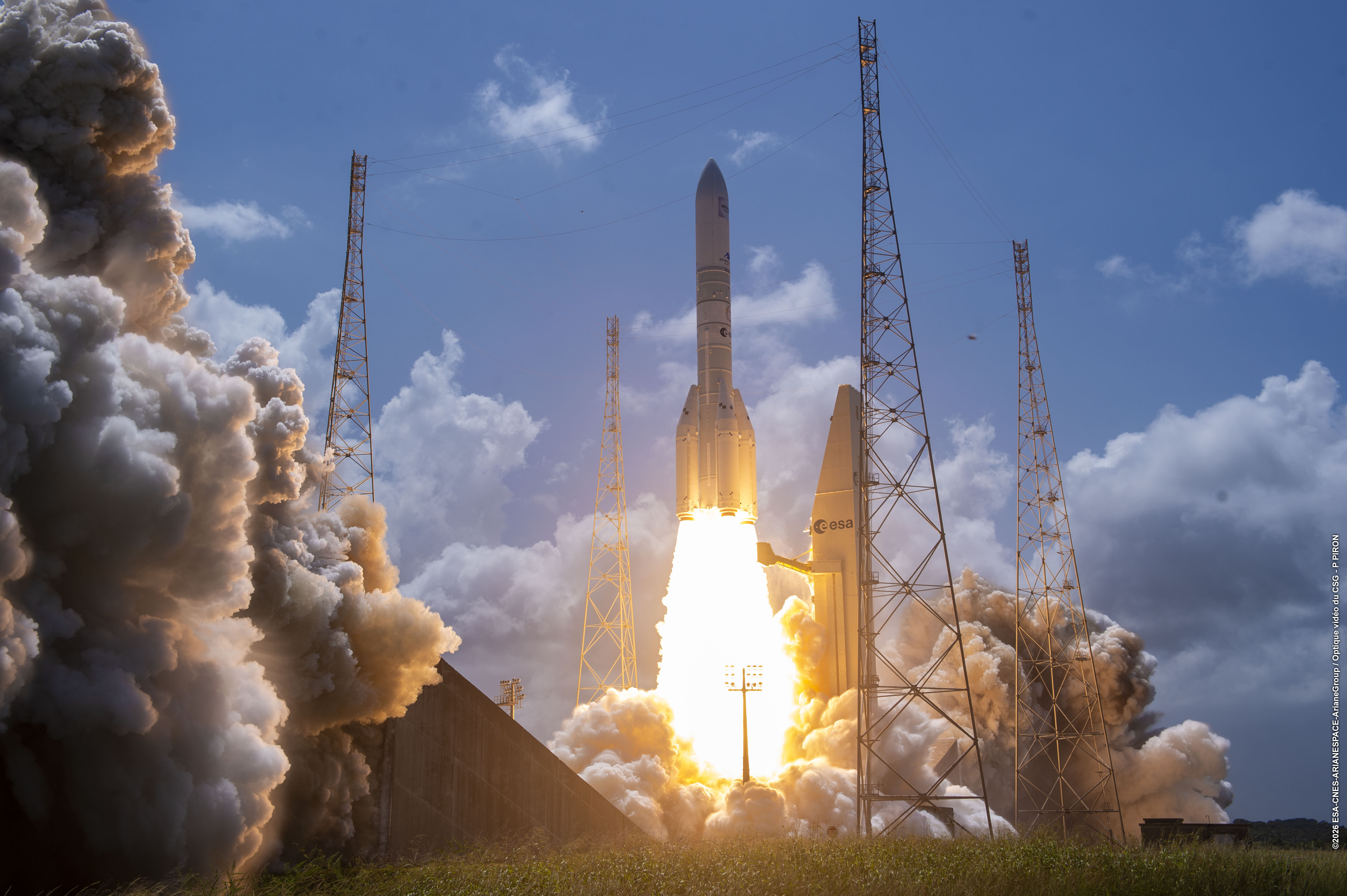
- Amazon Leo (LE-02) from Ariane Launch Area 4, Guiana Space Centre, French Guiana (08:08 UTC) The second Ariane 64 flight, designated VA268, will carry 32 Amazon Leo broadband satellites to low Earth orbit. This is the second of 18 contracted Ariane 64 launches for Amazon’s Leo constellation, which aims to deliver high-speed internet to underserved regions globally. Watch Live Launch Preview
-
RKK Energiya Soyuz-5:
- Demo Flight from 45/1, Baikonur Cosmodrome, Republic of Kazakhstan (11:00 UTC) Demonstration flight of Russia’s new Soyuz-5 (Irtysh) launch vehicle, carrying a mass simulator. The Soyuz-5 is a two-stage rocket powered by an RD-171MV first-stage engine, capable of lifting 17 tonnes to low Earth orbit, and is intended to replace the Zenit-2 and Proton Medium vehicles. Launch Preview
May 1
- SpaceX Falcon 9 Block 5:
- Starlink Group 10-38 from Space Launch Complex 40, Cape Canaveral SFS, FL, USA (17:33 UTC) A batch of 25 Starlink V2 Mini Optimized satellites to low Earth orbit. Booster B1071 will fly for its 33rd time, landing on drone ship Of Course I Still Love You. Watch Live Launch Preview
May 3
- SpaceX Falcon 9 Block 5:
- CAS500-2 & Others from Space Launch Complex 4E, Vandenberg SFB, CA, USA (06:59 UTC) A rideshare mission carrying 46 payloads to sun-synchronous orbit, named for the primary payload manifested by Korea Aerospace Industries. Booster B1071 will fly for its 33rd time, returning to land at Landing Zone 4 at Vandenberg. Payload deployment will continue for approximately 2.5 hours after liftoff. Watch Live Launch Preview
May 6
- SpaceX Falcon 9 Block 5:
- Starlink Group 17-29 from Space Launch Complex 4E, Vandenberg SFB, CA, USA (02:00 UTC) A batch of 25 Starlink V2 Mini Optimized satellites to low Earth orbit. Watch Live
May 9
- SpaceX Falcon 9 Block 5:
- Starlink Group 17-37 from Space Launch Complex 4E, Vandenberg SFB, CA, USA (14:00 UTC) A batch of 24 Starlink satellites for SpaceX’s space-based internet mega-constellation. Watch Live
May 12
- SpaceX Falcon 9 Block 5:
- Dragon CRS-2 SpX-34 from Space Launch Complex 40, Cape Canaveral SFS, FL, USA (23:00 UTC) The 34th Commercial Resupply Services mission to the International Space Station, conducted under NASA’s second CRS contract. A Cargo Dragon 2 capsule will deliver supplies, experiments, and critical materials to support science and research aboard the station.
May 19
- Avio S.p.A Vega-C:
- Solar wind Magnetosphere Ionosphere Link Explorer (SMILE) from Ariane Launch Area 1 (ELV), Guiana Space Centre, French Guiana (03:52 UTC) A joint mission between the European Space Agency and the Chinese Academy of Sciences, SMILE will study how Earth’s magnetosphere and ionosphere respond to the solar wind using four science instruments. The spacecraft will deploy 57 minutes after liftoff into a highly elliptical Earth orbit and has a planned mission life of three years, advancing our understanding of space weather and geomagnetic storms. Watch Live
May 22
- United Launch Alliance Atlas V 551:
- Amazon Leo (LA-07) from Space Launch Complex 41, Cape Canaveral SFS, FL, USA (00:00 UTC) An Atlas V 551 rocket will carry 29 Amazon Leo satellites to low Earth orbit as part of the build-out of Amazon’s planned 3,276-satellite broadband constellation, which will operate across 98 orbital planes at altitudes between 590 and 630 km.
Schedule Changes
- Newly Added: SpaceX Falcon 9 Block 5 | Starlink Group 17-37 has been added to the manifest, scheduled for 2026-05-09 at 14:00 UTC from Vandenberg SFB.
- Arianespace Ariane 64 | Amazon Leo (LE-02) has changed status from Go for Launch to Launch in Flight.
- RKK Energiya Soyuz-5 | Demo Flight has been upgraded from To Be Confirmed to Go for Launch.
- SpaceX Falcon 9 Block 5 | Falcon Heavy | ViaSat-3 F3 (ViaSat-3 Asia-Pacific) has been marked Launch Successful and removed from the upcoming calendar.
- SpaceX Falcon 9 Block 5 | Starlink Group 17-36 has been marked Launch Successful and removed from the upcoming calendar.
Note: Launch dates and times are subject to change due to technical or weather considerations.

Maurice Stellarski