· space brief · 7 min read
Falcon 9 Launches CAS500-2 With 44 Rideshare Payloads | KeepTrack Space Brief
SpaceX Falcon 9 successfully deployed Korea Aerospace Industries' CAS500-2 Earth observation satellite plus 44 rideshare payloads from Vandenberg. 45 new trackable objects entering orbit.
Top Stories
SpaceX Flies South Korea’s CAS500-2 and 44 Rideshare Payloads From Vandenberg
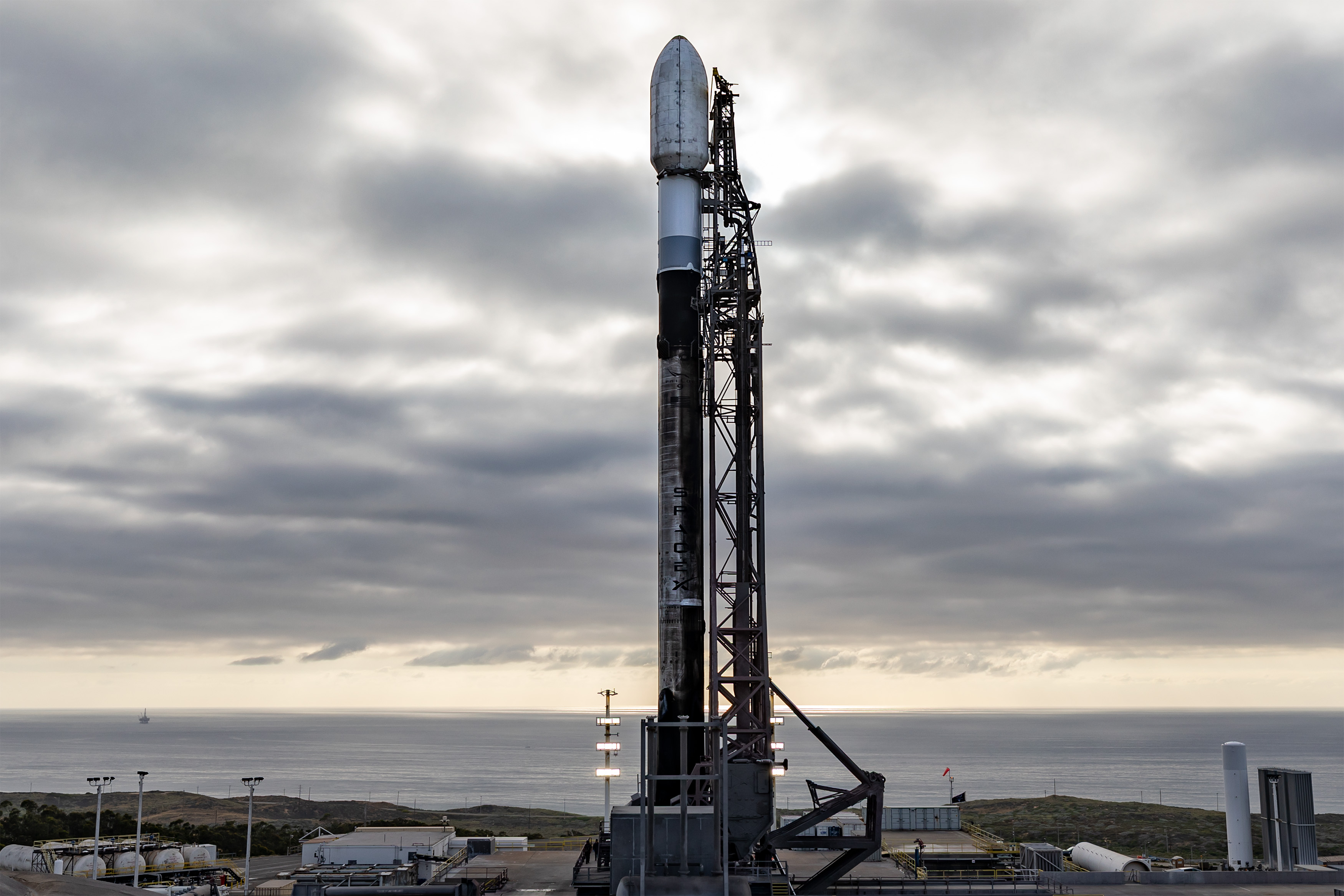
The Falcon 9 lifted off from SLC-4E at Vandenberg Space Force Base at 0700 UTC on May 3. Korea Aerospace Industries’ Compact Advanced Satellite 500-2 was the primary payload, deploying approximately one hour after liftoff. Forty-four additional rideshare payloads rode along.
CAS500-2 is a 500 kg-class Earth observation satellite. With 45 objects entering orbit from a single mission, expect a new cluster of trackable objects in the coming days. You can follow newly cataloged objects as they appear in KeepTrack’s live catalog.
Read the full story: Spaceflight Now
Artemis 3 Schedule Slipping With No Firm Mission Plan
More than two months after NASA announced revised plans for Artemis 3, the agency has not provided details on mission architecture or timeline. The schedule appears to be slipping further with no public date commitment.
Artemis 3 was already restructured once. Without a locked configuration — crew, lander, orbit profile — downstream planning for lunar surface operations stays on hold. NASA has not clarified whether Starship HLS readiness or SLS constraints are the primary driver of the delay.
Read the full story: SpaceNews
NASA Moving to Raise CLPS Contract Ceiling to Fund More Lunar Landers
NASA plans to increase the total contract value for its Commercial Lunar Payload Services program to support a higher flight tempo tied to lunar base development goals. The agency has not yet published revised ceiling figures.
CLPS currently covers robotic lander deliveries from vendors including Intuitive Machines, Astrobotic, and Firefly. A higher ceiling would allow NASA to issue more task orders without a new procurement, accelerating cadence without recompeting the contract.
Read the full story: SpaceNews
Hegseth Orders 5,000 U.S. Troops Out of Germany
Defense Secretary Hegseth has directed the withdrawal of 5,000 U.S. troops from Germany. Pentagon spokesman Sean Parnell cited a review of European force posture and current theater requirements.
No specific units or basing changes have been publicly identified. Repositioning at this scale can affect space and cyber support infrastructure embedded with European commands, though no specific impacts to space operations assets have been announced.
Read the full story: Breaking Defense
Artemis 2 Crew on Media Circuit After Lunar Flyby
The four Artemis 2 astronauts — Reid Wiseman, Victor Glover, Christina Koch, and CSA astronaut Jeremy Hansen — are making network television appearances following their return from the first crewed lunar flyby since Apollo 17 in 1972.
The mission flew a free-return trajectory around the Moon without landing. It validated Orion’s life support systems and deep space communication performance under crew operations. No hardware anomalies requiring Artemis 3 design changes have been publicly reported from the mission data.
Read the full story: Space.com
Satellite of the Day
TIANLIAN 1-03
TIANLIAN 1-03 is a Chinese communication satellite that launched on July 25, 2012, from the Xichang Satellite Launch Center aboard a Chang Zheng 3C rocket. Manufactured by the China Academy of Space Technology (CAST), this spacecraft operates as part of China’s Tianlian (天链, meaning “Sky Link”) relay communication system, a critical infrastructure for supporting crewed spaceflight missions, space station operations, and other orbital activities. The satellite was designed with an 8-year operational lifetime and features the proven DFH-3 bus platform, weighing 2,462 kg at launch with 18.1-meter solar panel spans when fully deployed.
The Tianlian relay constellation serves as an orbiting communications network, similar in concept to NASA’s Tracking and Data Relay Satellite System (TDRSS). TIANLIAN 1-03 maintains a nearly equatorial geostationary-like orbit, allowing it to relay telemetry, tracking, and command signals between ground stations and Chinese spacecraft including crewed missions and the Chinese Space Station. Its box-shaped body with dual solar panels and dish antenna represent a mature design that has proven reliable across multiple launches in the series, making it a cornerstone of China’s space infrastructure.
| Detail | Value |
|---|---|
| NORAD ID | 38730 |
| Operator | CAST (China) |
| Launch Date | July 25, 2012 |
| Orbit | Geostationary, ~5.7° inclination |
| Purpose | Communication |
| Status | Active |
Track this satellite in real-time: Track TIANLIAN 1-03
Upcoming Space Launches
May 3
- SpaceX Falcon 9 Block 5:
- CAS500-2 & Others from Space Launch Complex 4E, Vandenberg Space Force Base, CA, USA (06:59 UTC) A SpaceX Falcon 9 rocket will launch 46 payloads on a rideshare mission named for its primary payload, manifested by Korea Aerospace Industries. Booster B1071, flying for a record 33rd time, will return to land at Landing Zone 4. Payload deployment will continue for approximately 2.5 hours after liftoff. Watch Live Launch Preview
May 6
- SpaceX Falcon 9 Block 5:
- Starlink Group 17-29 from Space Launch Complex 4E, Vandenberg Space Force Base, CA, USA (02:00 UTC) A batch of 25 Starlink V2 Mini Optimized satellites to low Earth orbit. Booster B1081 will land on drone ship Of Course I Still Love You in the Pacific Ocean. Watch Live
May 9
- SpaceX Falcon 9 Block 5:
- Starlink Group 17-37 from Space Launch Complex 4E, Vandenberg Space Force Base, CA, USA (14:00 UTC) A batch of 25 Starlink V2 Mini Optimized satellites to low Earth orbit. Booster B1081 will land on drone ship Of Course I Still Love You in the Pacific Ocean. Watch Live
May 12
-
SpaceX Falcon 9 Block 5:
- NROL-172 from Space Launch Complex 4E, Vandenberg Space Force Base, CA, USA (22:15 UTC) The thirteenth batch of satellites for a classified reconnaissance constellation built by SpaceX and Northrop Grumman for the National Reconnaissance Office, providing imaging and other intelligence capabilities.
-
SpaceX Starship:
- Flight 12 from Orbital Launch Pad 2, SpaceX Starbase, TX, USA (22:30 UTC) The 12th integrated test flight of the two-stage Starship launch vehicle, and the maiden flight of Starship V3 — the third development version of SpaceX’s fully reusable super heavy-lift vehicle. With a lift capacity of up to 100,000 kg to low Earth orbit, Starship is designed for long-duration cargo and crewed missions.
-
SpaceX Falcon 9 Block 5:
- Dragon CRS-2 SpX-34 from Space Launch Complex 40, Cape Canaveral Space Force Station, FL, USA (23:16 UTC) A NASA Commercial Resupply Services mission delivering thousands of pounds of science experiments and supplies to the International Space Station. The Dragon spacecraft will arrive at the station within two days of liftoff. Booster B1 will return to land at Landing Zone 40.
May 19
- Avio S.p.A Vega-C:
- Solar wind Magnetosphere Ionosphere Link Explorer (SMILE) from Ariane Launch Area 1 (ELV), Guiana Space Centre, French Guiana (03:52 UTC) A joint mission between the European Space Agency and the Chinese Academy of Sciences. The SMILE spacecraft will deploy 57 minutes after liftoff into a highly elliptical Earth orbit for a planned three-year mission. Using four science instruments, SMILE will study how Earth’s magnetosphere and ionosphere respond to the solar wind, advancing understanding of geomagnetic storms and space weather. Watch Live
May 22
-
United Launch Alliance Atlas V 551:
- Amazon Leo (LA-07) from Space Launch Complex 41, Cape Canaveral Space Force Station, FL, USA (00:00 UTC) A United Launch Alliance Atlas V 551 rocket will deploy 29 satellites for Amazon’s Project Kuiper broadband internet constellation. This is the penultimate Atlas V mission booked by Amazon, contributing to a low Earth orbit network aimed at delivering high-speed connectivity to underserved regions worldwide.
-
Rocket Lab Electron:
- Viva La StriX (StriX Launch 9) from Rocket Lab Launch Complex 1, Mahia Peninsula, New Zealand (09:30 UTC) The ninth Electron mission for Japanese Earth observation company Synspective, carrying a StriX synthetic aperture radar (SAR) satellite. The spacecraft will deploy into a circular 572 km orbit at 44.8 degrees inclination.
May 31
- Rocket Lab Electron:
- The Grain Goddess Provides (iQPS Launch 7) from Rocket Lab Launch Complex 1, Mahia Peninsula, New Zealand (00:00 UTC) A synthetic aperture radar Earth observation satellite for Japanese Earth imaging company iQPS.
Schedule Changes
- SpaceX Falcon 9 Block 5 | CAS500-2 & Others: Status updated from Go for Launch to Launch in Flight, indicating the vehicle has lifted off as of the time of this report.
Note: Launch dates and times are subject to change due to technical or weather considerations.

Maurice Stellarski