· space brief · 8 min read
SpaceX Launches 13th NRO Proliferated Architecture Mission | KeepTrack Space Brief
Falcon 9 successfully deployed NROL-72 for National Reconnaissance Office's 13th proliferated architecture mission. Low-Earth orbit intelligence constellation expanding since 2021.

Top Stories
SpaceX Flies 13th NRO Proliferated Architecture Mission with NROL-72
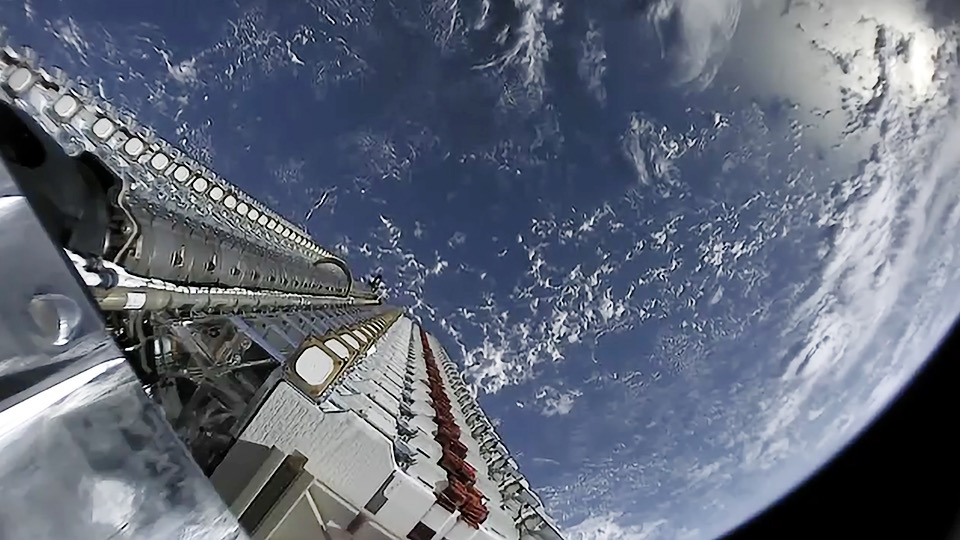
Falcon 9 lifted off from SLC-4E at Vandenberg Space Force Base at 0213:50 UTC on May 12, carrying the NROL-72 payload for the National Reconnaissance Office. This was the 13th consecutive Falcon 9 mission supporting the NRO’s self-described “proliferated architecture” — a growing low-Earth orbit intelligence-gathering constellation built for redundancy and persistence.
Payload details remain classified, but the proliferated architecture program has been expanding rapidly since 2021. Objects from this program typically appear in Space-Track catalogs under classified designations. Use KeepTrack’s Find Satellite tool to monitor newly cataloged objects following this launch.
Read the full story: Spaceflight Now
U.S. Defense Budget Impasse Is Degrading Space Readiness, SpaceNews Op-Ed Argues
A SpaceNews analysis argues that continuing resolutions and delayed defense budgets are directly slowing procurement of space-based military capabilities — ISR, missile warning, and communications systems that combatant commanders rely on daily. The piece draws on operational lessons from Ukraine and Iran to make the case that space is now a first-day-of-conflict domain, not a support function.
The practical consequence is delayed contracts, slower satellite production, and gaps in launch scheduling. For analysts tracking military constellation growth, that slowdown will show up as fewer new objects cataloged per year in key orbital regimes.
Read the full story: SpaceNews
Latvia’s Defense Minister Resigns After Drone Detection System Failure
Latvian Defense Minister Andris Sprūds resigned following a drone incursion where military detection systems failed to identify the incoming aircraft. Mobile alerts were not sent to residents until approximately one hour after the drone had already crashed.
The incident highlights the operational gap between airspace surveillance infrastructure and real-time public warning systems — a problem relevant beyond Latvia. Detection latency of that magnitude in a contested airspace scenario has direct implications for how military planners integrate space-based ISR with ground-based sensor networks.
Read the full story: Breaking Defense
Taiwan Passes Supplementary Defense Budget Below Lai Administration’s NT$1.25 Trillion Request
Taiwan’s parliament approved a supplementary defense budget, but at a lower figure than the NT$1.25 trillion the Lai administration originally requested. Funding will go toward two separate U.S. arms packages already contracted for Taiwan.
The cut reduces near-term procurement capacity at a time when Taiwan is deepening its investment in layered defense systems. Neither package has been publicly broken down by system type.
Read the full story: Breaking Defense
U.S. Navy Stands Up Three New Program Executive Offices for Aviation, Mission Systems, and Munitions
The Navy created three new Portfolio Acquisition Executives covering aviation, mission systems, and munitions. Jason Potter, performing duties of Assistant Secretary of the Navy for Research and Development, said the restructuring is intended to accelerate acquisition across those portfolios.
The mission systems PAE is the one to watch from a space perspective — it covers the sensor and communications architectures that increasingly depend on commercial and military satellite links.
Read the full story: Breaking Defense
Saab Reveals New Carl-Gustaf Warheads, Expands Production in U.S. and India
Saab disclosed new warhead variants for the Carl-Gustaf recoilless rifle system and released delivery timelines from new manufacturing sites in the United States and India. Both facilities are intended to reduce dependence on European production capacity under surge conditions.
No space-specific systems were announced in this release.
Read the full story: Breaking Defense
Turkey’s STM Debuts New Unmanned Systems, Eyes Gulf Defense Partnerships
Turkish defense firm STM unveiled new unmanned systems at a regional show and signaled openness to co-development with Gulf partners. STM’s general manager described expanding use of AI, image processing, and machine learning across their platforms.
STM’s unmanned systems have drawn attention in recent conflicts. Gulf collaboration would extend their operational footprint into a region where several nations are also investing in commercial satellite-based surveillance infrastructure.
Read the full story: Breaking Defense
Satellite of the Day
JILIN-1 GAOFEN 2F
JILIN-1 GAOFEN 2F is a compact Earth observation satellite operated by China Great Wall Industry Corporation (CGSTL) as part of the expanding Jilin-1 constellation. Launched on October 27, 2021, aboard a Kuaizhou-1A rocket from the Jiuquan Satellite Launch Center, this 230-kilogram spacecraft represents China’s growing capabilities in accessible, commercial-grade remote sensing. With a compact box-and-panel design measuring just 1.1 meters in length and a 3-meter solar panel span, the satellite demonstrates how modern Earth observation can be achieved with relatively lightweight, efficient platforms.
The Jilin-1 program is notable for its focus on operational, near-real-time imaging capabilities at an accessible price point, making it a significant player in the global Earth observation market. Operating in a sun-synchronous near-polar orbit, GAOFEN 2F joins a growing fleet of Jilin-1 satellites dedicated to monitoring land use, environmental changes, and disaster response. This satellite exemplifies how commercial space programs are advancing rapid-revisit Earth observation, enabling frequent updates of the same geographic areas—crucial for applications ranging from agriculture to urban planning to emergency management.
| Detail | Value |
|---|---|
| NORAD ID | 49338 |
| Operator | CGSTL (China) |
| Launch Date | October 27, 2021 |
| Orbit | Sun-synchronous, 97.66° inclination |
| Purpose | Earth observation |
| Status | Active |
Track this satellite in real-time: Track JILIN-1 GAOFEN 2F
Upcoming Space Launches
May 12
-
China Aerospace Science and Technology Corporation Long March 6A:
- Unknown Payload from Taiyuan Satellite Launch Center, Launch Complex 9A (11:49 UTC) Details not yet available for this mission.
-
SpaceX Falcon 9 Block 5:
- Dragon CRS-2 SpX-34 from Cape Canaveral Space Force Station, Space Launch Complex 40 (23:16 UTC) A SpaceX Falcon 9 will launch NASA’s Commercial Resupply Services CRS-34 mission. The Dragon spacecraft (tail number C209, flying for a sixth time) will deliver thousands of pounds of science experiments and supplies to the International Space Station, arriving after a roughly 38-hour transit. Watch Live
May 14
- LandSpace Zhuque-2E:
- Unknown Payload from Jiuquan Satellite Launch Center, Launch Area 96A (02:52 UTC) Details not yet available for this mission. The Zhuque-2E is an enhanced methane-fueled medium-lift rocket capable of lifting up to 6,000 kg to low Earth orbit.
May 15
-
CAS Space Kinetica 1:
- Unknown Payload from Jiuquan Satellite Launch Center, Launch Area 130 (04:24 UTC) Details not yet available for this mission.
-
SpaceX Falcon 9 Block 5:
- Starlink Group 17-37 from Vandenberg Space Force Base, Space Launch Complex 4E (14:00 UTC) A batch of 24 Starlink V2 Mini Optimized satellites launching to low Earth orbit. Booster B1097 flying for a ninth time will land on the drone ship Of Course I Still Love You in the Pacific Ocean. Watch Live Launch Preview
-
SpaceX Starship:
- Flight 12 from SpaceX Starbase, Orbital Launch Pad 2 (22:30 UTC) The 12th integrated flight of the Starship-Super Heavy launch system and the first flight of the version 3 rocket configuration. The mission will use Ship 39 and Booster 19 on a suborbital trajectory. Starship is SpaceX’s fully reusable super heavy-lift vehicle with a 100,000 kg payload capacity to low Earth orbit, making it the most powerful rocket ever developed.
May 17
-
SpaceX Falcon 9 Block 5:
- Globalstar 2-R Mission 1 (x 9) from Cape Canaveral Space Force Station, Space Launch Complex 40 (12:50 UTC) A SpaceX Falcon 9 will launch nine Globalstar HIBLEO-4 satellites to low Earth orbit — the first of two launches replenishing Globalstar’s HIBLEO-4 fleet. Booster B1090, flying for a 12th time, will land on the drone ship A Shortfall of Gravitas in the Atlantic Ocean. Watch Live
-
China Aerospace Science and Technology Corporation Long March 8:
- Unknown Payload from Wenchang Space Launch Site, Commercial Launch Complex 1 (14:34 UTC) Details not yet available for this mission.
May 19
-
SpaceX Falcon 9 Block 5:
- Starlink Group 17-42 from Vandenberg Space Force Base, Space Launch Complex 4E (02:11 UTC) A batch of 24 Starlink V2 Mini Optimized satellites launching to low Earth orbit. Booster B1097 flying for a ninth time will land on the drone ship Of Course I Still Love You in the Pacific Ocean. Watch Live
-
Avio S.p.A Vega-C:
- Solar wind Magnetosphere Ionosphere Link Explorer (SMILE) from Guiana Space Centre, Ariane Launch Area 1 (ELV) (03:52 UTC) A Vega-C rocket will launch the SMILE mission, a joint collaboration between the European Space Agency and the Chinese Academy of Sciences. The spacecraft will deploy into a highly elliptical Earth orbit 57 minutes after liftoff, where it will use four science instruments to study how Earth’s magnetosphere and ionosphere respond to solar wind — advancing our understanding of space weather and geomagnetic storms. The mission has a planned operational life of three years. Watch Live
May 21
- Indian Space Research Organization GSLV Mk II:
- GISAT-1A (EOS-05) from Satish Dhawan Space Centre, Second Launch Pad (03:15 UTC) The GEO Imaging Satellite (GISAT-1A) is an Indian Earth observation spacecraft that will operate from geostationary orbit, enabling continuous monitoring of the Indian subcontinent and rapid assessment of natural hazards and disasters.
May 22
-
United Launch Alliance Atlas V 551:
- Amazon Leo (LA-07) from Cape Canaveral Space Force Station, Space Launch Complex 41 (00:00 UTC) A United Launch Alliance Atlas V 551 will launch 29 Amazon Kuiper broadband internet satellites to low Earth orbit. This is the penultimate Kuiper mission booked on an Atlas V rocket as part of Amazon’s effort to build a global low Earth orbit internet constellation.
-
Rocket Lab Electron:
- Viva La StriX (StriX Launch 9) from Rocket Lab Launch Complex 1, Mahia Peninsula, New Zealand (09:30 UTC) A Rocket Lab Electron will deploy a Synspective StriX Synthetic Aperture Radar Earth observation satellite into a 572 km circular orbit at 44.8 degrees inclination. This is the ninth Electron mission flown on behalf of Japan-based imaging company Synspective.
May 31
- Rocket Lab Electron:
- The Grain Goddess Provides (iQPS Launch 7) from Rocket Lab Launch Complex 1, Mahia Peninsula, New Zealand (00:00 UTC) A synthetic aperture radar Earth observation satellite for Japanese Earth imaging company iQPS.
Schedule Changes
- SpaceX Falcon 9 Block 5 | NROL-172: Status changed from Go for Launch to Launch Successful — this mission has been removed from the upcoming launch calendar.
Note: Launch dates and times are subject to change due to technical or weather considerations.

Maurice Stellarski