· space brief · 8 min read
Space Force Plans to Double Active-Duty Force by 2030 | KeepTrack Space Brief
Space Force confirms plan to double active-duty Guardians by 2030, targeting faster response to satellite anomalies and adversary maneuvers in space domain awareness operations.
Top Stories
Space Force Plans to Double Active-Duty Force by 2030
Chief of Space Operations Gen. Chance Saltzman confirmed the service is on track to double its active-duty headcount by 2030. The main bottlenecks are training pipeline capacity and the speed at which new operational units can stand up — not recruiting numbers or funding.
This expansion reflects how heavily the Space Force is investing in dedicated operators for satellite command, space domain awareness, and contested environment response. For KeepTrack users tracking military assets, more trained Guardians means faster response loops on anomalies and potential adversary maneuvers.
Read the full story: SpaceNews
USSF-23 Mission to Demo In-Space Refueling and Satellite Servicing at GEO in 2027
The Space Force is targeting 2027 for the USSF-23 mission, which will place vehicles in geostationary orbit to demonstrate in-space refueling and satellite servicing. No contractor or vehicle details were disclosed, but GEO is the operational tier where this capability matters most — that’s where the high-value comms and missile warning birds live.
If successful, this changes how long GEO satellites can stay operationally viable. It also introduces a new class of maneuvering objects in the geostationary belt that will need close monitoring. Expect new catalog entries when USSF-23 manifests.
Read the full story: SpaceNews
Mitchell Institute: PLA’s Lunar Posture Is a Strategic Threat, U.S. Needs Boots on the Moon
Kyle Puma, senior resident fellow for space studies at the Mitchell Institute, published a report arguing China’s military-led human spaceflight program is positioning the PLA for strategic advantage in lunar access, infrastructure, and resources. The core argument: U.S. physical presence on the Moon is a security requirement, not just an exploration goal.
The report draws a direct line between cislunar maneuvering capability and long-term space domain control. China’s lunar program is defense-led in structure, not civilian-led like NASA’s — that distinction drives the strategic framing.
Read the full story: Breaking Defense
Europe Must Build Physical Space and Defense Infrastructure, Not Just Policy
Elin Hammarberg and Carina Zaring argue in Breaking Defense that European defense resilience cannot be achieved through policy frameworks alone — it requires actual physical infrastructure built and maintained on the continent. The piece pushes back against the tendency to treat sovereignty as a software or governance problem.
The argument has direct implications for space: European launch capability, ground stations, and sovereign satellite constellations are the physical layer that underpins any credible independent defense posture. Without that layer, European operators remain dependent on U.S. or commercial infrastructure they don’t control.
Read the full story: Breaking Defense
Pentagon Nominates Hurst as Full Comptroller After Overseeing $1.5 Trillion FY2027 Budget Request
The White House nominated acting Pentagon comptroller Hurst for the permanent role. He has been performing the duties since August 2025 and led the development of the $1.5 trillion defense budget request for fiscal year 2027.
Confirmation would give the Pentagon a stable financial leadership position ahead of what will be a contentious congressional appropriations process. Defense space programs — including Space Force procurement and satellite communications — are directly exposed to how that budget gets negotiated.
Read the full story: Breaking Defense
Netherlands Pursuing Additional JASSM Missiles for F-35, Discloses Frigate Delay
The Netherlands is opening talks to expand its purchase of JASSM deep-strike missiles for its F-35 fleet, following a 2024 Letter of Offer and Acceptance that covered an initial buy. In the same disclosure, Dutch officials acknowledged a delivery delay on their new anti-submarine warfare frigates.
JASSM targeting at range relies on GPS and space-based ISR. The frigate delay is separately relevant — ASW ships are increasingly integrated with space-based maritime surveillance, and delivery gaps create coverage holes that adversaries can map.
Read the full story: Breaking Defense
CNO: Strait of Hormuz Naval Escort Mission Would Exceed Current Capacity
Adm. Daryl Caudle, Chief of Naval Operations, told reporters that conducting sustained naval escort operations through the Strait of Hormuz would be a “very challenging mission” that exceeds current Navy capacity. The comment came in response to a proposal floated by President Trump earlier this year.
Space-based assets — including commercial SAR satellites and AIS receivers — would carry significant load in any Hormuz escort scenario for real-time maritime tracking. Capacity constraints on the naval side increase the operational pressure on space-based ISR to fill gaps.
Read the full story: Breaking Defense
Satellite of the Day
ASTRON
ASTRON is a Soviet ultraviolet astronomy satellite launched on March 23, 1983, from Baikonur Cosmodrome aboard a Proton-K/D-1 rocket. Built by NPOL for the Institute for Space Research (IKI) and the Bureau for Applied Astrophysics and Theory of Stellar Systems (BABTS), ASTRON was designed to conduct UV observations of celestial objects from its high-inclination orbit. At 3,500 kg and measuring 6 meters in length with a 9-meter solar panel span, the satellite was a substantial platform for its era, though engineers originally expected it to operate for only about a year.
Despite its modest design life, ASTRON proved remarkably durable and continues to be tracked today. The satellite’s high inclination orbit (78.1°) made it particularly valuable for observing polar regions and high-latitude astronomical targets. ASTRON represents an important chapter in Soviet space astronomy during the Cold War, showcasing the USSR’s commitment to UV science when such observations could only be made from space.
| Detail | Value |
|---|---|
| NORAD ID | 13901 |
| Operator | IKI/BABTS (Soviet Union) |
| Launch Date | March 23, 1983 |
| Orbit | High-inclination, 78.09° inclination |
| Purpose | Astronomy, UV observations |
| Status | Active |
Track this satellite in real-time: Track ASTRON
Upcoming Space Launches
May 22
-
Rocket Lab Electron | Viva La StriX (StriX Launch 9):
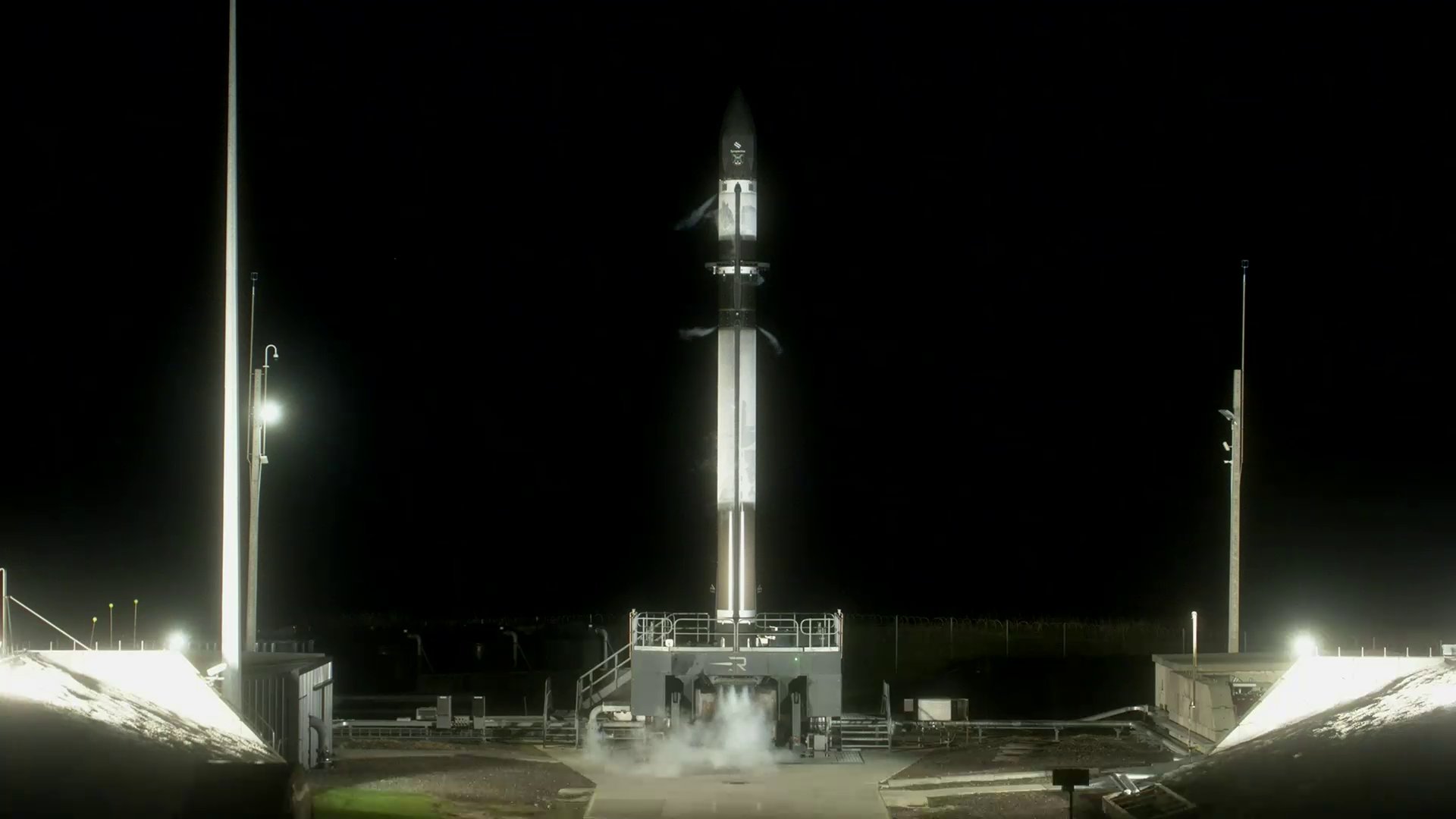
- Viva La StriX from Rocket Lab Launch Complex 1B, Mahia Peninsula, New Zealand (09:30 UTC) A Rocket Lab Electron rocket will launch a StriX SAR Earth observation satellite for Japan-based Synspective — the ninth dedicated Electron mission for the company. The satellite will be deployed into a circular 572 km orbit at 44.8 degrees inclination. Watch Live Launch Preview
-
SpaceX Starship | Flight 12:
- Starship Flight 12 from Orbital Launch Pad 2, SpaceX Starbase, TX, USA (22:30 UTC) The 12th integrated flight of SpaceX’s Starship-Super Heavy launch vehicle and the first flight of the version 3 (Block 3) rocket. Ship 39 will ride atop Booster 19 on a suborbital trajectory, deploying 20 Starlink simulator satellites along the flight path — including two designed to relay imagery of the Starship heat shield during deployment. SpaceX will not attempt to catch the Super Heavy booster at the launch site on this mission. Starship is a fully reusable super heavy-lift vehicle with a liftoff mass of approximately 5,250 tonnes and a stated LEO capacity of 100,000 kg. Watch Live Launch Preview
May 24
-
SpaceX Falcon 9 Block 5 | Starlink Group 17-37:
- Starlink Group 17-37 from Space Launch Complex 4E, Vandenberg SFB, CA, USA (14:00 UTC) A batch of 29 Starlink V2 Mini Optimized satellites to low Earth orbit. Watch Live Launch Preview
-
China Aerospace Science and Technology Corporation Long March 2F/G | Shenzhou 23:
- Shenzhou 23 from Launch Area 91 (SLS-1 / 921), Jiuquan Satellite Launch Center, People’s Republic of China (14:58 UTC) Shenzhou 23 will be the 23rd crewed flight of China’s Shenzhou program, launching atop a Long March 2F/G — the human-rated variant of the Long March 2 family specifically designed to carry the Shenzhou spacecraft. The Long March 2F/G features extended boosters for increased lift capability. The Shenzhou program placed China’s first citizen, Yang Liwei, into orbit in 2003.
May 25
- SpaceX Falcon 9 Block 5 | Starlink Group 10-47:
- Starlink Group 10-47 from Space Launch Complex 40, Cape Canaveral SFS, FL, USA (11:41 UTC) A batch of 29 Starlink V2 Mini Optimized satellites to low Earth orbit. Watch Live Launch Preview
May 26
- China Aerospace Science and Technology Corporation Long March 7A | Unknown Payload:
- Unknown Payload from Launch Pad 201, Wenchang Space Launch Site, People’s Republic of China (16:00 UTC) Payload and mission details are not yet available.
May 28
- SpaceX Falcon 9 Block 5 | Starlink Group 17-41:
- Starlink Group 17-41 from Space Launch Complex 4E, Vandenberg SFB, CA, USA (14:00 UTC) A batch of 29 Starlink V2 Mini Optimized satellites to low Earth orbit. Watch Live
May 29
-
SpaceX Falcon 9 Block 5 | Starlink Group 10-53:
- Starlink Group 10-53 from Space Launch Complex 40, Cape Canaveral SFS, FL, USA (11:52 UTC) A batch of 29 Starlink V2 Mini Optimized satellites to low Earth orbit. Watch Live
-
United Launch Alliance Atlas V 551 | Amazon Leo (LA-07):
- Amazon Leo LA-07 from Space Launch Complex 41, Cape Canaveral SFS, FL, USA (23:33 UTC) A United Launch Alliance Atlas V 551 rocket will deploy 29 Amazon Kuiper LEO broadband satellites — part of Amazon’s constellation aimed at delivering high-speed, low-latency internet access to underserved and remote areas globally. This is the penultimate Atlas V mission booked by Amazon. The Atlas V uses a Russian-built RD-180 engine on its first stage and an RL-10-powered Centaur upper stage, with five solid rocket boosters in the 551 configuration.
May 31
- Rocket Lab Electron | The Grain Goddess Provides (iQPS Launch 7):
- The Grain Goddess Provides from Rocket Lab Launch Complex 1, Mahia Peninsula, New Zealand (TBD) A Rocket Lab Electron rocket will launch a synthetic aperture radar Earth observation satellite for Japanese Earth imaging company iQPS, marking their seventh dedicated launch on Electron.
Schedule Changes
- SpaceX Falcon 9 Block 5 | Starlink Group 10-31 has been removed from the upcoming launch calendar — this mission has completed successfully and its status updated to Launch Successful.
Note: Launch dates and times are subject to change due to technical or weather considerations.

Maurice Stellarski