


· space brief · 8 min read
DAF Space Restructure Announced Within Days, PAE Leaders Named | KeepTrack Space Brief
Department of Air Force announces finalized Program Acquisition Executive structure within days, reshaping oversight of GPS, SBIRS, and Protected Tactical Satcom systems.
Top Stories
DAF Space Acquisition Restructure Coming Within Days, Ainsworth Says
Thomas Ainsworth, acting space acquisition chief for the Department of the Air Force, told reporters the finalized Program Acquisition Executive structure will be announced “in the coming days.” That announcement will include the names of each PAE office leader. The reorganization has been in motion as the DAF works to align its space programs into coherent acquisition portfolios under the new structure.
For those tracking military space assets, this restructure will determine which offices control contracts and oversight for systems like GPS, SBIRS, and Protected Tactical Satcom — with real downstream effects on program timelines.
Read the full story: Breaking Defense
Former Ukraine Official Presses SpaceX to Cut Off Russian Starlink Access
At a defense conference in Amsterdam, former senior Ukrainian defense official Kateryna Chernohorenko called on SpaceX to tighten controls over Starlink terminals reaching Russian forces through third-party countries and intermediaries. Her argument: current enforcement gaps allow adversaries to exploit commercial satellite connectivity that was never intended for them.
This is a recurring pressure point for SpaceX. Russian forces have been documented using Starlink terminals recovered or obtained through grey-market channels. The issue puts SpaceX in the middle of a direct military conflict with real operational consequences on both sides.
Read the full story: SpaceNews
European Nations Mixing Sovereign, Commercial, and Federated Space Capabilities
Speaking in Amsterdam, European defense officials described a deliberate shift away from reliance on any single space architecture. Nations are now blending sovereign systems, bilateral agreements, federated constellations, and dual-use commercial assets to support military readiness. No single model is winning — the mix is the strategy.
For satellite trackers, this means more multi-nation orbital programs with overlapping coverage mandates, and more commercial satellites carrying defense payloads under varying national registrations. That complicates space situational awareness as ownership and mission become harder to attribute from catalog data alone.
Read the full story: SpaceNews
Turkey’s Efes 2026 Drill Integrates Drones, Air Defense, and Naval Forces
Turkey ran its Efes 2026 combined forces exercise, bringing together ships, drones, air defense systems, and helicopters in a large-scale joint drill. Breaking Defense covered it on the ground. The exercise demonstrated Turkey’s growing interest in multi-domain integration at scale — relevant context given Ankara’s parallel push to export defense platforms to Gulf states.
Read the full story: Breaking Defense
Gulf States Increasing Interest in Turkish Air Defense After Iran Strikes
Following Iranian attacks on regional targets, Gulf state defense ministries are showing increased interest in Turkish air defense platforms. Turkish defense firms told Breaking Defense they are prepared to transfer technology in line with Gulf localization mandates. The shift reflects both a supply-side opportunity for Turkey and a Gulf-side urgency to diversify away from Western-dependent systems.
Read the full story: Breaking Defense
Canada Taps EU SAFE Funds to Buy Polish Drones
Canada will purchase Polish drones and deepen defense-industrial ties by drawing on the EU’s €150 billion SAFE defense borrowing and procurement scheme. Canada is the only non-EU country admitted to SAFE, a status it secured in December. The drone purchase is the first concrete procurement to flow from that access.
Read the full story: Breaking Defense
US, Allied, and Adversary Approaches to Drone Wingmen Are Diverging
Breaking Defense’s third installment on manned-unmanned teaming maps how the concept is developing differently across the US, allied militaries, and potential adversaries. The core divergence: the US is building toward tight human-machine integration under doctrinal frameworks, while some adversaries are pursuing more autonomous, lower-cost attritable designs with fewer operator constraints.
Read the full story: Breaking Defense
Satellite of the Day
Eutelsat W2A
Eutelsat W2A is a European telecommunications satellite operated by Eutelsat, a leading global satellite operator based in Paris. Launched aboard an Ariane 5ECA rocket on December 20, 2008, from French Guiana, W2A was designed to provide high-capacity communications services across Europe, the Middle East, and Africa. The satellite carries transponders for television distribution, broadband connectivity, and enterprise communications, serving both broadcast and data transmission markets across its vast coverage footprint.
Operating from a geostationary orbit with an extremely low inclination of just 4.39 degrees, W2A maintains a stable position over the equator—ideal for continuous coverage of its service region. With a launch mass of 5,000 kg, this cylindrical satellite represents the robust engineering that characterizes Eutelsat’s fleet. The W2A mission exemplifies the enduring value of geostationary satellites for wide-area telecommunications, even as the industry evolves with new mega-constellations in low Earth orbit.
| Detail | Value |
|---|---|
| NORAD ID | 33461 |
| Operator | Eutelsat |
| Launch Date | December 20, 2008 |
| Orbit | Geostationary, 4.39° inclination |
| Purpose | Telecommunications |
| Status | Active |
Track this satellite in real-time: Track Eutelsat W2A
Upcoming Space Launches
May 29
- SpaceX Falcon 9 Block 5:
- Starlink Group 10-53 from Space Launch Complex 40, Cape Canaveral Space Force Station, FL, USA (11:52 UTC) A SpaceX Falcon 9 rocket will launch 29 Starlink V2 Mini Optimized satellites into low Earth orbit. Watch Live Launch Preview
May 29–30
- United Launch Alliance Atlas V 551:
- Amazon Leo (LA-07) from Space Launch Complex 41, Cape Canaveral Space Force Station, FL, USA (23:33 UTC) A United Launch Alliance Atlas V rocket will launch a batch of 29 Amazon Leo satellites into low Earth orbit as part of Amazon’s Project Kuiper broadband constellation. The Atlas V 551 — one of the most powerful configurations of the rocket — uses a Russian-built RD-180 main engine and five solid rocket boosters, with a Centaur upper stage powered by an RL10 engine. This is the penultimate Amazon Leo mission booked on an Atlas V. Watch Live Launch Preview
May 30
-
SpaceX Falcon 9 Block 5:
- Starlink Group 17-41 from Space Launch Complex 4E, Vandenberg Space Force Base, CA, USA (14:00 UTC) A SpaceX Falcon 9 rocket will launch 29 Starlink V2 Mini Optimized satellites into low Earth orbit. Watch Live Launch Preview
-
China Aerospace Science and Technology Corporation Long March 2D:
- Unknown Payload from Launch Complex 3 (LC-3/LA-1), Xichang Satellite Launch Center, People’s Republic of China (17:57 UTC) Details to be determined. The Long March 2D is a two-stage carrier rocket primarily used for launching satellites to low Earth orbit and sun-synchronous orbit.
May 31
- Rocket Lab Electron:
- The Grain Goddess Provides (iQPS Launch 7) from Rocket Lab Launch Complex 1, Mahia Peninsula, New Zealand (time TBD) A synthetic aperture radar Earth observation satellite for Japanese Earth imaging company iQPS.
June 1
- Agency for Defense Development South Korean ADD Solid-Fuel SLV:
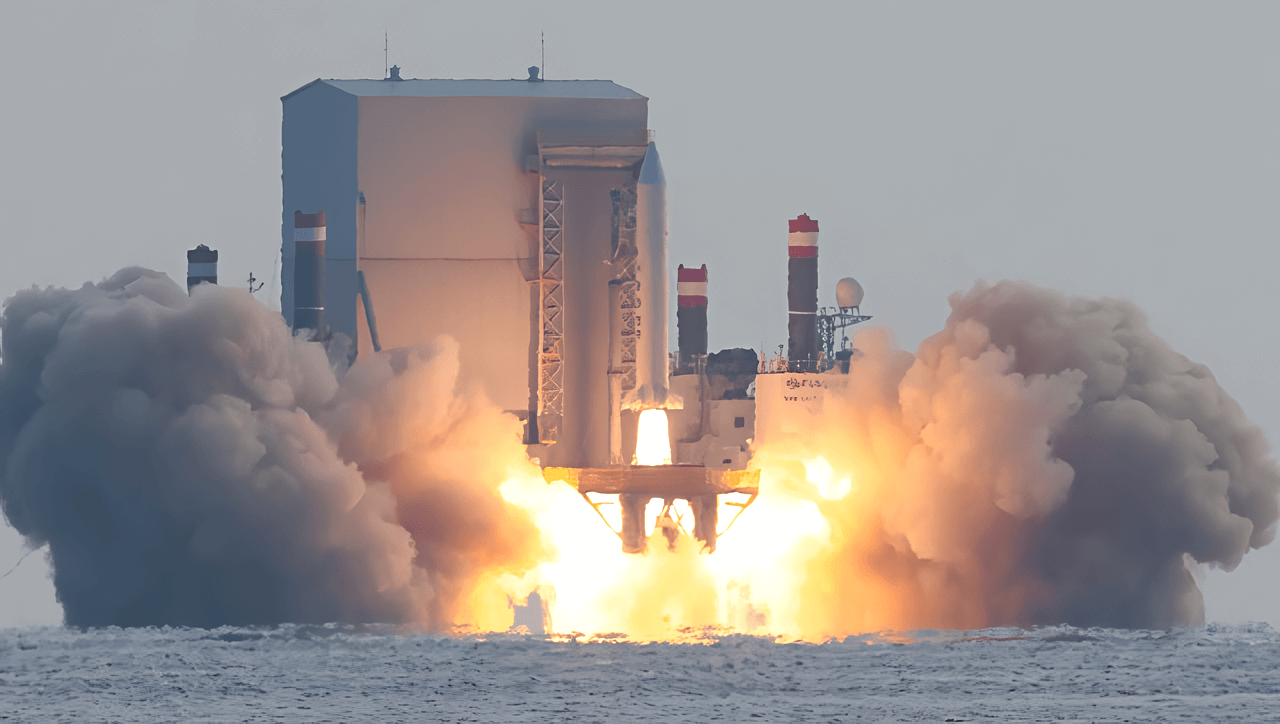
- Demo Flight from ADD Offshore Launch Platform, Sea Launch (05:00 UTC) A demonstration test flight of South Korea’s solid-fuel small launch vehicle, developed by the Agency for Defense Development. Launch Preview
June 3
-
SpaceX Falcon 9 Block 5:
- Starlink Group 10-43 from Space Launch Complex 40, Cape Canaveral Space Force Station, FL, USA (08:02 UTC) A SpaceX Falcon 9 rocket will launch 29 Starlink V2 Mini Optimized satellites into low Earth orbit. Watch Live
-
SpaceX Falcon 9 Block 5:
- Starlink Group 17-47 from Space Launch Complex 4E, Vandenberg Space Force Base, CA, USA (14:00 UTC) A SpaceX Falcon 9 rocket will launch 29 Starlink V2 Mini Optimized satellites into low Earth orbit. Watch Live
June 4
- Blue Origin New Glenn:
- Amazon Leo (LN-01) from Launch Complex 36A, Cape Canaveral Space Force Station, FL, USA (17:21 UTC) Blue Origin’s New Glenn rocket will carry 48 satellites for Amazon’s Leo broadband constellation — formerly known as Project Kuiper — into low Earth orbit. The constellation, managed by Kuiper Systems LLC (a subsidiary of Amazon), is planned to comprise 3,276 satellites across 98 orbital planes at altitudes between 590 km and 630 km, providing global broadband internet access to underserved and remote regions. New Glenn is a large reusable two- or three-stage rocket with a 7-meter-diameter fairing and a low Earth orbit capacity of up to 45,000 kg.
June 5
- China Aerospace Science and Technology Corporation Long March 8:
- Unknown Payload from Commercial LC-1, Wenchang Space Launch Site, People’s Republic of China (05:00 UTC) Details to be determined; the payload is likely SpaceSail Polar Orbit LEO communication satellites. The Long March 8 is capable of delivering up to 8,100 kg to low Earth orbit and is derived from the Long March 7 first stage, paired with a liquid hydrogen-burning upper stage.
June 8
- SpaceX Falcon 9 Block 5:
- Starlink Group 10-35 from Space Launch Complex 40, Cape Canaveral Space Force Station, FL, USA (10:07 UTC) A batch of 29 satellites for the Starlink mega-constellation. Watch Live
June 10
- Indian Space Research Organization GSLV Mk II:
- GISAT-1A (EOS-05) from Satish Dhawan Space Centre Second Launch Pad, Satish Dhawan Space Centre, India (time TBD) GISAT-1A (GEO Imaging Satellite) is an Indian Earth observation satellite that will operate from geostationary orbit to enable continuous monitoring of the Indian subcontinent and rapid assessment of natural hazards and disasters. The GSLV Mk II is India’s largest operational launch vehicle, a three-stage rocket with four liquid strap-on boosters and an indigenously developed cryogenic upper stage.
Schedule Changes
- Long March 8 | Unknown Payload has been newly added to the manifest, scheduled for 05:00 UTC on June 5, 2026, launching from Wenchang Space Launch Site with a status of To Be Confirmed.
- Falcon 9 Block 5 | Starlink Group 10-35 has been newly added to the manifest, scheduled for 10:07 UTC on June 8, 2026, launching from Space Launch Complex 40, Cape Canaveral Space Force Station, with a status of Go for Launch.
Note: Launch dates and times are subject to change due to technical or weather considerations.

Maurice Stellarski

