· space brief · 7 min read
Besxar Semiconductor Pods Launch on Starlink 10-50 | KeepTrack Space Brief
SpaceX Falcon 9 launches Starlink 10-50 with two Besxar semiconductor manufacturing test pods. In-space fabrication experiment explores cost reduction for commercial payloads.
Top Stories
Falcon 9 Flies Besxar Semiconductor Pods Alongside Starlink 10-50
Falcon 9 lifted off from Space Launch Complex 40 on July 4 at 6:50 a.m. EDT (1050 UTC) on the Starlink 10-50 mission. Alongside the standard Starlink batch, the rocket carried two semiconductor manufacturing test pods for Besxar Space Industries — an in-space manufacturing payload riding along with a routine Starlink deployment.
Besxar is testing microgravity semiconductor fabrication at orbital altitude. It’s an early data point for whether commercial in-space manufacturing can piggyback on high-cadence Starlink launches to reduce cost.
Read the full story: Spaceflight Now
ESA Contracts Airbus to Build Aeolus-2 Wind-Monitoring Satellite
ESA has selected Airbus Defence and Space to begin work on Aeolus-2, the follow-on to the original Aeolus wind-profiling satellite. The original Aeolus operated from 2018 to 2023 and was the first satellite to directly measure wind profiles from orbit on a global scale.
Aeolus-2 will continue that atmospheric data mission. Wind profile data feeds directly into numerical weather prediction models used by meteorological agencies worldwide.
Read the full story: SpaceNews
Vast’s Haven-1 Station on Track for Q1 2027 Launch
Vast Space reports Haven-1 is progressing through hardware milestones ahead of a planned Q1 2027 launch. Haven-1 is a commercial space station module designed to host astronaut crews, with SpaceX contracted to provide the Dragon crew transport.
Once in orbit, Haven-1 will be a trackable object of interest for KeepTrack users following commercial station development as NASA transitions low Earth orbit operations away from ISS.
Read the full story: NASASpaceFlight
NASA and SBA Team Up to Channel Private Capital Into Space Component Suppliers
NASA and the U.S. Small Business Administration are jointly working to attract private investment into companies that manufacture critical space hardware components. The partnership targets supply chain gaps — particularly smaller suppliers that produce parts with limited commercial alternatives.
The initiative reflects ongoing concern across government and industry about concentration risk in space component manufacturing, especially for items like radiation-hardened electronics and propulsion subsystems.
Read the full story: SpaceNews
NASA Tests Autonomous Mars Rover Prototype in California Desert
NASA is running field trials on a new rover prototype in the California desert, focused on autonomous navigation and terrain assessment. The goal is a rover capable of making its own routing decisions without waiting for commands from Earth — a necessity given the 3-to-24-minute one-way signal delay to Mars.
Current Mars rovers already have limited autonomous hazard avoidance. This prototype is aimed at more complex decision-making, including selecting science targets independently.
Read the full story: Space.com
Total Solar Eclipse Crosses Spain on August 12, 2026
The August 12, 2026 total solar eclipse will pass directly over Spain, with cities including A Coruña, Bilbao, Madrid, and Zaragoza in or near the path of totality. This is one of the most accessible total eclipses in decades for European observers, with the path covering densely populated regions.
For KeepTrack users, the eclipse geometry is relevant for satellite observers — shadow boundaries and solar illumination angles shift during totality, which can affect visibility windows for low Earth orbit passes.
Read the full story: Space.com
Satellite of the Day
Kosmos 396
Launched in September 1974, Kosmos 396 is a Soviet-era military communications satellite operated by GUKOSR (the Russian Space Forces). Part of the Kosmos program—the Soviet Union’s prolific designation for a wide variety of space missions—this satellite was designed to provide secure military communications relay capabilities. Built by OKB-10 and lofted aboard a Kosmos 11K65M rocket from Plesetsk (PLMSC), Kosmos 396 represents the backbone of Cold War-era Soviet space infrastructure, when the USSR deployed dozens of communications satellites to support global military operations.
At just 60 kg, this compact polyhedron satellite operates in a highly inclined orbit of 74°, making it useful for covering high northern latitudes where Soviet military assets were concentrated. Nearly 50 years after launch, Kosmos 396 remains in orbit and continues to be tracked by space surveillance networks—a testament to the durability of early Soviet satellite design. For satellite trackers, this is a historical gem: witnessing a functioning 1974-vintage military asset crossing the sky offers a tangible connection to space exploration’s earliest decades.
| Detail | Value |
|---|---|
| NORAD ID | 07440 |
| Operator | GUKOSR (Russian Space Forces) |
| Launch Date | September 19, 1974 |
| Orbit | Highly inclined, 74.0° inclination |
| Purpose | Military Communication |
| Status | Active |
Track this satellite in real-time: Track Kosmos 396
Upcoming Space Launches
July 7
- SpaceX Falcon 9 Block 5:
- Transporter 17 (Dedicated SSO Rideshare) from Space Launch Complex 4E, Vandenberg Space Force Base, CA, USA (07:10 UTC) A SpaceX Falcon 9 rocket will launch a collection of 81 payloads on a rideshare mission to a Sun-synchronous Earth orbit. Booster B1097, flying for the 11th time, will land on the drone ship Of Course I Still Love You in the Pacific Ocean. Watch Live
July 9
- SpaceX Falcon 9 Block 5:
- Starlink Group 10-42 from Space Launch Complex 40, Cape Canaveral Space Force Station, FL, USA (09:05 UTC) A SpaceX Falcon 9 rocket will launch 29 Starlink V2 Mini Optimized satellites into low Earth orbit. Booster B1090, flying for the 13th time, will land on the drone ship A Shortfall of Gravitas in the Atlantic Ocean. Watch Live
July 10
- China Aerospace Science and Technology Corporation Long March 10B:
- Demo Flight from Commercial LC-2, Wenchang Space Launch Site, People’s Republic of China (05:12 UTC) Inaugural demonstration flight of the Long March 10B, a reusable launch vehicle capable of delivering up to 16,000 kg to low Earth orbit. The 10B is based on the first stage of the Long March 10A, powered by seven YF-100 series kerosene/liquid oxygen staged-combustion engines, and is designed for downrange recovery via an arrestor net on a recovery barge. The second stage uses a single YF-219 methane/liquid oxygen engine producing 140 tonnes of thrust.
July 11
- SpaceX Falcon 9 Block 5:
- Starlink Group 17-48 from Space Launch Complex 4E, Vandenberg Space Force Base, CA, USA (02:00 UTC) A SpaceX Falcon 9 rocket will launch 29 Starlink V2 Mini Optimized satellites into low Earth orbit. Booster B1090, flying for the 13th time, will land on the drone ship A Shortfall of Gravitas in the Atlantic Ocean. Watch Live
July 12
-
Orienspace Technology Gravity-1:
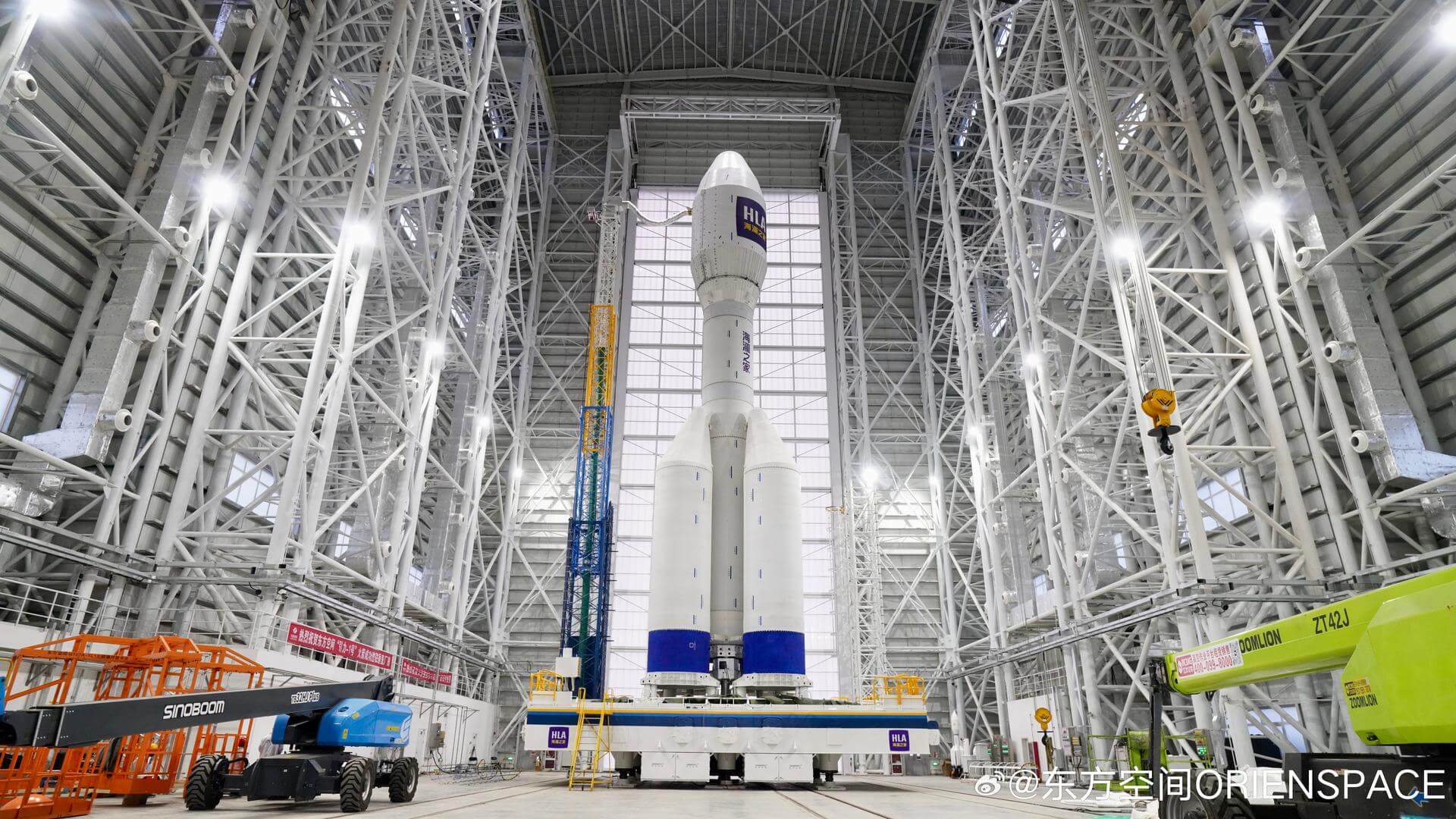
- Unknown Payload from Haiyang Offshore Launch Location, Haiyang Oriental Spaceport (02:00 UTC) Details of the payload are to be determined. Gravity-1 is a four-stage solid-fuel launch vehicle developed by Chinese private company OrienSpace, with a launch mass of 405 tonnes and a low Earth orbit capacity of 6,500 kg. It features five solid rocket motors clustered together, with the center motor igniting just before booster separation.
-
Skyroot Aerospace Vikram-I:
- Demo Flight from Satish Dhawan Space Centre First Launch Pad, Satish Dhawan Space Centre, India (05:00 UTC) First launch of Skyroot Aerospace’s Vikram-I orbital launch vehicle, carrying several cubesats with identities to be determined. Vikram-I is a four-stage vehicle developed by Indian private company Skyroot Aerospace, with the first three stages powered by solid fuel and a hypergolic upper stage, capable of delivering up to 350 kg to low Earth orbit.
July 13–14
- SpaceX Falcon 9 Block 5:
- Starlink Group 15-14 from Space Launch Complex 4E, Vandenberg Space Force Base, CA, USA (22:38 UTC) A SpaceX Falcon 9 rocket will launch 29 Starlink V2 Mini Optimized satellites into low Earth orbit. Booster B1090, flying for the 13th time, will land on the drone ship A Shortfall of Gravitas in the Atlantic Ocean. Watch Live
July 14
- Russian Federal Space Agency (ROSCOSMOS) Soyuz 2.1a:
- Soyuz MS-29 from Launch Pad 31/6, Baikonur Cosmodrome, Republic of Kazakhstan (14:47 UTC) Soyuz MS-29 will carry three crew members to the International Space Station: Roscosmos cosmonauts Pyotr Dubrov and Anna Kikina, and NASA astronaut Anil Menon. The Soyuz 2.1a features a fully digital flight control system and serves as the primary vehicle for crewed Soyuz and Progress missions to the station. This mission is part of the International Space Station programme, a multinational partnership involving sixteen nations.
Schedule Changes
- SpaceX Falcon 9 Block 5 | Starlink Group 10-50: Status changed from Go for Launch to Launch Successful — this launch has been removed from the upcoming calendar.
- Long March 8A | SpaceSail Polar Group #14: Status changed from Go for Launch to Launch Successful — this launch has been removed from the upcoming calendar.
Note: Launch dates and times are subject to change due to technical or weather considerations.

Maurice Stellarski