· space terms · 5 min read
Hohmann Transfer Orbit
The cheapest way to get from one orbit to another, invented on paper in 1925 by a man who never built a rocket.
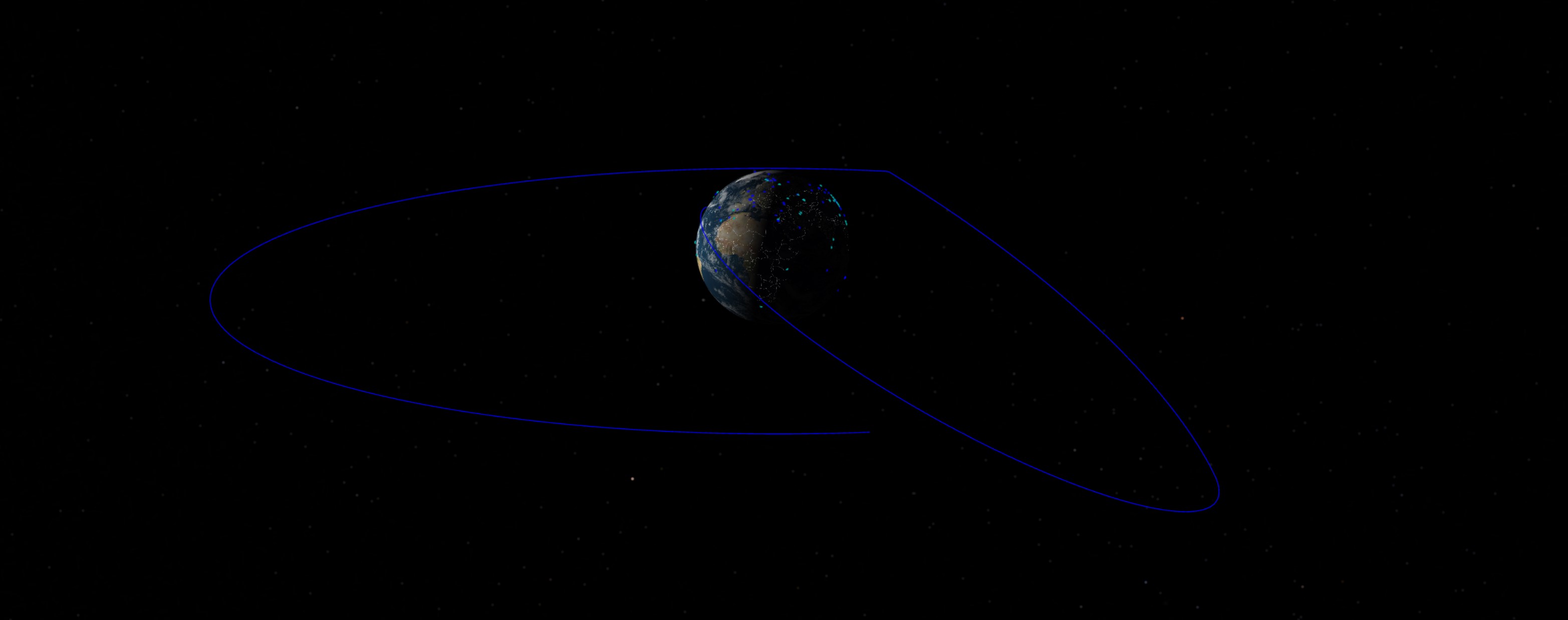
Imagine you’re driving on a circular highway and you need to switch to a larger circular highway farther out. You can’t just jump across. You have to take an exit ramp that curves outward, merge onto the bigger highway, and then match its speed. In orbital mechanics, that exit ramp is a Hohmann transfer orbit, and it is the most fuel-efficient way to move a spacecraft between two circular orbits.
The concept is simple enough to draw on a napkin. You start in a low orbit. You fire your engine once to stretch your orbit into an ellipse that just barely touches the higher orbit at its far point. You coast along that ellipse for half a lap, slowing down as you climb. When you reach the top of the ellipse, where it grazes the target orbit, you fire your engine a second time to circularize. Two burns. One orbit change. Minimum fuel.
The Technical Bits
A Hohmann transfer uses two impulsive burns, meaning the engine fires are short enough to be treated as instantaneous changes in velocity (called delta-v). The first burn happens at the periapsis of the transfer ellipse, which is tangent to the lower orbit. The second burn happens at the apoapsis, which is tangent to the higher orbit.
The math comes from conservation of energy and Kepler’s laws. The transfer ellipse has a semi-major axis equal to the average of the two orbit radii. The speed at each end of the ellipse is determined by the vis-viva equation, and the delta-v for each burn is the difference between the required elliptical speed and the circular speed at that altitude.
For a concrete example: moving from the International Space Station’s orbit (about 420 km altitude) to geostationary orbit (35,786 km altitude) requires a first burn of roughly 2.4 km/s and a second burn of about 1.5 km/s. Total delta-v: approximately 3.9 km/s. The transfer takes about 5 hours and 15 minutes, which is half the period of the transfer ellipse.
Why It Matters
Almost every satellite launched to geostationary orbit gets there via a Hohmann transfer (or a close variant of one). The rocket places the satellite into a low parking orbit, then a second burn raises the apogee to geostationary altitude. The satellite coasts up to that altitude and performs a circularization burn. Geostationary Transfer Orbit, or GTO, is literally a Hohmann transfer orbit.
Interplanetary missions use the same principle. A Mars transfer orbit is a Hohmann ellipse between Earth’s orbit and Mars’s orbit around the Sun. The spacecraft leaves Earth’s vicinity when the planets are in the right alignment (roughly every 26 months), coasts along the transfer ellipse for about 9 months, and arrives at Mars on the opposite side of the ellipse. The launch window exists because the transfer only works when Earth and Mars are in the right relative positions.
Apollo missions to the Moon used a translunar injection burn that was essentially the first half of a Hohmann transfer from Earth orbit to lunar distance, though the Moon’s gravity complicated the second half.
What Most People Get Wrong
The Hohmann transfer is the most fuel-efficient two-burn transfer between coplanar circular orbits. But it is not always the best option.
If you need to change orbital planes (inclination), a Hohmann transfer doesn’t help. Plane changes require a separate burn perpendicular to the orbit, and those burns are expensive in delta-v. This is why launch sites near the equator are preferred for geostationary satellites: launching from near the equator means the satellite is already close to the right inclination, so less fuel is wasted on plane changes.
If you’re in a hurry, a Hohmann transfer is slow. The transfer to geostationary orbit takes over 5 hours. For human spaceflight to the ISS, faster rendezvous profiles using more burns (and more fuel) get crews there in as little as 3 hours. The tradeoff between fuel and time is a constant tension in mission design.
For very large orbit changes, a bi-elliptic transfer can actually be more fuel-efficient than a Hohmann. This counterintuitive result was proved in 1959 by Ary Sternfeld and involves three burns instead of two, with an intermediate orbit that swings far beyond the target before coming back. It only saves fuel when the ratio between the initial and final orbit radii is larger than about 11.9 to 1.
Fun Fact Space Nerds Might Not Know
Walter Hohmann was not a rocket scientist. He was a civil engineer from Essen, Germany, who worked for the city planning department. His 1925 book “Die Erreichbarkeit der Himmelskörper” (The Attainability of Celestial Bodies) was a hobby project. He worked out the math for interplanetary transfers using nothing but pencil, paper, and the orbital mechanics that had been understood since Kepler and Newton. He never built or launched a rocket. He died in 1945, twelve years before Sputnik proved that his theoretical transfer orbits had practical applications.
His book was largely ignored when it was published. It gained attention decades later when rocket engineers realized that the most fuel-efficient transfer orbit between two circular paths was exactly the ellipse Hohmann had described. NASA named the concept after him, and the Hohmann transfer has been used on virtually every orbital transfer mission since the dawn of the space age.

Theodore Kruczek