· space terms · 5 min read
Space Object Catalog
The master ledger of everything orbiting Earth — how tens of thousands of satellites, rocket bodies, and debris fragments are tracked and numbered
Somewhere in a secure facility in Colorado, there’s a list. It contains every known human-made object orbiting Earth — from billion-dollar spy satellites to flecks of paint traveling at 17,000 mph. That list is the space object catalog, and it’s essentially the census of everything we’ve ever put into orbit that’s still up there.
The Technical Bits
The space object catalog (also called the satellite catalog or simply the “cat”) is a continuously updated database maintained primarily by the U.S. Space Force’s 18th Space Defense Squadron (formerly the 18th Space Control Squadron). Each tracked object receives a unique identifier called a NORAD Catalog Number (also known as a Satellite Catalog Number or SATCAT number) — a sequential integer assigned in roughly the order objects are first detected.
As of early 2026, the catalog tracks over 50,000 objects, including:
- Active satellites: Operational spacecraft performing their missions
- Defunct satellites: Dead spacecraft still in orbit but no longer functioning
- Rocket bodies: Upper stages and boosters that remain in orbit after delivering their payloads
- Debris: Fragments from collisions, explosions, or deterioration of larger objects
Each cataloged object has an associated orbital element set — a mathematical description of its orbit — that gets updated regularly as tracking sensors collect new observations. These element sets are published as Two-Line Element sets (TLEs), which are freely available to the public through Space-Track.org and other distribution channels.
Why It Matters
Without the catalog, satellite operations would be like flying blind in the world’s most dangerous airspace. The catalog serves several critical functions:
- Collision avoidance: Operators use catalog data to predict close approaches between their satellites and other objects. When a conjunction looks dangerous, they can maneuver to avoid it — but only if they know the threat is there.
- Launch screening: Before every rocket launch, trajectory analysts screen the planned flight path against the catalog to ensure the rocket won’t pass dangerously close to an existing object.
- Reentry prediction: When objects are losing altitude and approaching reentry, catalog data helps predict when and where they’ll come down.
- Space traffic management: As orbits become more congested, the catalog is the foundation for any future space traffic management system, much like how aircraft registries underpin air traffic control.
- Attribution: When something unexpected happens in orbit — a satellite breaks up, an object maneuvers unexpectedly — the catalog provides the baseline for investigating what happened and who was involved.
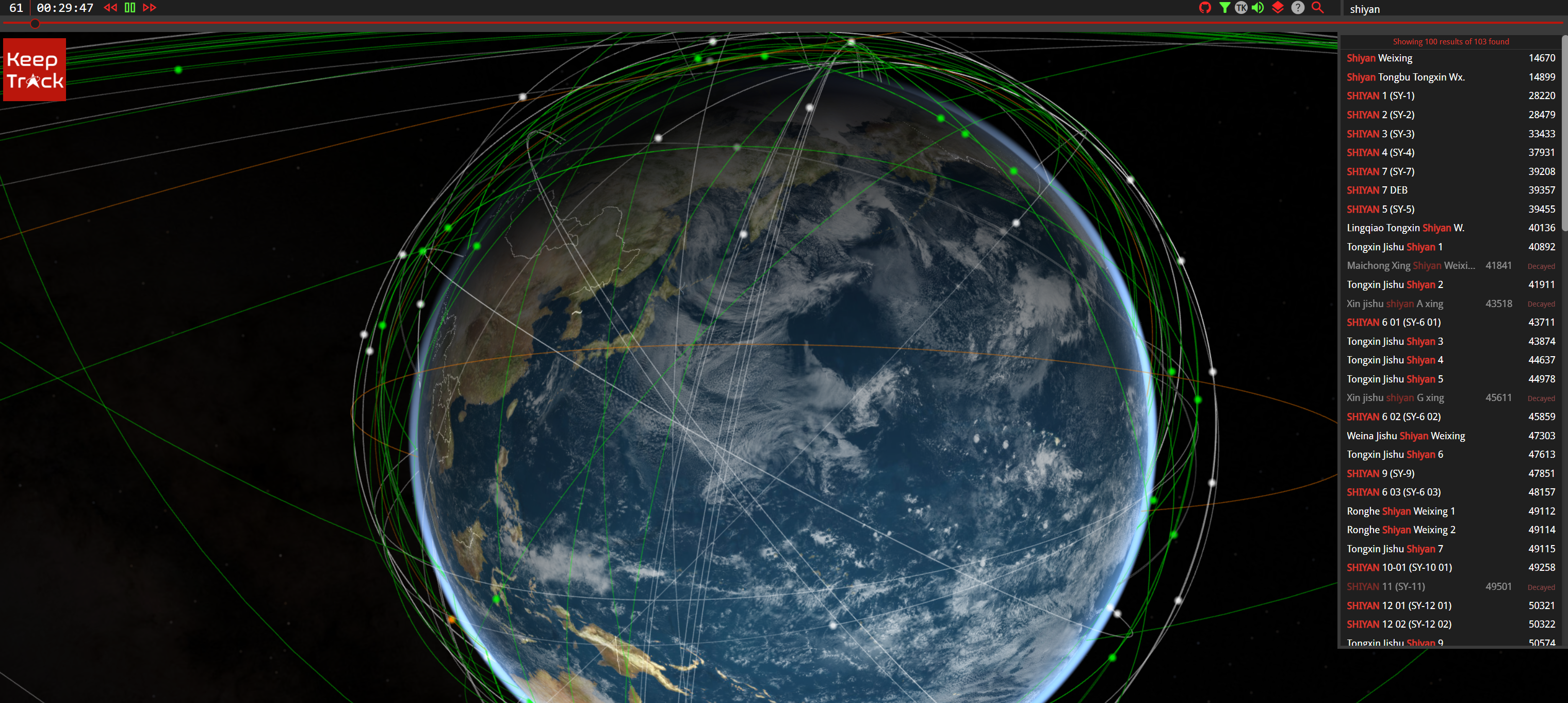
You can explore the catalog visually using KeepTrack, which plots every cataloged object in a 3D view and lets you search by NORAD ID.
What Most People Mix Up
The biggest misconception is that the catalog contains everything in orbit. It doesn’t — not even close. The catalog only includes objects large enough to be reliably tracked by the Space Surveillance Network’s sensors. In low Earth orbit, the detection threshold is roughly 10 centimeters (about the size of a softball). In geosynchronous orbit, where objects are much farther away, only objects about 1 meter or larger are routinely tracked.
NASA estimates there are over 100 million pieces of debris larger than 1 millimeter in orbit, but only about 50,000 are in the catalog. That means the vast majority of potentially damaging orbital debris is untracked — a sobering reality for satellite operators and astronauts.
Another common confusion: the public catalog and the military catalog are not the same. The U.S. military maintains classified elements for certain sensitive objects that never appear in the publicly available data. Commercial Space Domain Awareness providers sometimes track objects that aren’t in the public catalog at all.
Fun Fact Space Nerds Might Not Know
NORAD Catalog Number 1 belongs to Sputnik 1’s rocket body — not Sputnik 1 itself. When the Soviets launched the world’s first artificial satellite on October 4, 1957, the U.S. tracking network initially detected and cataloged the much larger and brighter R-7 rocket upper stage before identifying the smaller satellite. Sputnik 1 itself received catalog number 2. Both objects reentered the atmosphere within months, but their catalog numbers are retired forever — they’ll never be reassigned. Every number in the catalog is unique and permanent, creating a sequential historical record of the Space Age itself.
Inside the Catalog
A typical catalog entry contains far more than just an ID number. For each object, the catalog records:
- NORAD Catalog Number: The unique identifier (e.g., 25544 for the ISS, 15873 for INTELSAT 511)
- International Designator: A launch-based identifier (e.g., “1998-067A” means the first object from the 67th launch of 1998)
- Object name: The common name of the satellite or a generic description for debris
- Object type: Payload, rocket body, debris, or unknown
- Country of origin: The launching state responsible for the object
- Launch date and site: When and where it was launched
- Orbital parameters: Periodically updated element sets describing the current orbit
- Radar cross section: An estimate of the object’s apparent size to radar, categorized as small, medium, or large
Think of the space object catalog as the space equivalent of a vehicle registration database — except the vehicles never stop, they travel at 17,000 mph, and a fender bender can create thousands of new entries.

Theodore Kruczek