· space terms · 5 min read
Space Domain Awareness (SDA)
The evolution from simply tracking objects in orbit to understanding the full strategic picture of who is doing what in space — and why
Knowing where a satellite is and knowing what it’s doing are two very different things. Space Domain Awareness is the difference between seeing a car on a highway and understanding that it’s an unmarked police vehicle running surveillance on the vehicle ahead of it. It’s not just tracking — it’s comprehension.
The Technical Bits
Space Domain Awareness (SDA) is the comprehensive understanding of the space environment — including the location, status, capability, and intent of all objects and actors operating in Earth’s orbital regions and beyond. It builds on the foundation of Space Situational Awareness (SSA) but extends far beyond simple tracking.
Where SSA asks “what is up there and where is it going?”, SDA asks much harder questions:
- Attribution: Who owns or controls this object?
- Characterization: What can this object do? What sensors, propulsion, or payloads does it carry?
- Intent: Is this object’s behavior normal, or is it maneuvering in a way that suggests hostile or intelligence-gathering activity?
- Context: How does this object’s behavior fit into broader geopolitical or military patterns?
The U.S. Department of Defense formally adopted the term “Space Domain Awareness” around 2019, replacing the older “Space Situational Awareness” in official doctrine to reflect this broader, more strategic scope.
Why It Matters
Space is no longer just a place where countries park weather satellites and broadcast television. It has become a contested domain — a place where nations test anti-satellite weapons, conduct rendezvous and proximity operations near adversary satellites, and deploy systems that blur the line between peaceful and military use.
SDA matters because:
- Threat detection: Identifying when a foreign satellite maneuvers close to a sensitive national security asset. A satellite that suddenly changes orbit to approach another could be conducting an inspection, jamming signals, or positioning for a future attack.
- Norms enforcement: Without the ability to observe and attribute behavior in space, there’s no way to enforce norms of responsible conduct or hold bad actors accountable.
- Conflict deterrence: When adversaries know their space activities are being watched and attributed, it creates a deterrent effect similar to how surveillance cameras discourage crime.
- Decision support: Military and intelligence leaders need SDA to make informed decisions during crises that involve space assets — including understanding whether a satellite failure was caused by a technical malfunction or a deliberate attack.
What Most People Mix Up
The most common confusion is treating SDA as just a rebranding of SSA. While SSA is a component of SDA, the two are meaningfully different in scope. SSA is primarily a technical discipline focused on tracking orbits and predicting conjunctions. SDA wraps around that with intelligence analysis, threat assessment, and strategic context.
Another common misconception is that SDA is exclusively a military concept. While the U.S. military drove the terminology shift, commercial satellite operators, allied nations, and international organizations have increasingly adopted SDA framing as they recognize that understanding the space environment requires more than just orbit data. Companies need to know if their satellites are being interfered with. Insurers need to assess whether a satellite loss was accidental. Regulators need to verify compliance with spectrum and orbital slot agreements.
Fun Fact Space Nerds Might Not Know
One of the most fascinating SDA challenges involves so-called “resident space objects” that aren’t in any public catalog. Multiple commercial SDA providers have reported tracking objects in geosynchronous orbit that don’t match any known satellite in the public space object catalog. These could be classified military satellites, small debris fragments that were never cataloged, or objects that maneuvered away from their original orbital slots. The existence of these “unknown unknowns” illustrates exactly why SDA goes beyond basic tracking — you need intelligence analysis to figure out not just that something is there, but what it is, who put it there, and what it’s doing.
The SDA Ecosystem
Modern SDA relies on a layered system of capabilities:
- Ground-based sensors: Radar systems like the U.S. Space Fence on Kwajalein Atoll can detect objects as small as 10 centimeters in low Earth orbit, while optical telescopes track objects in higher orbits by their reflected sunlight.
- Space-based sensors: Dedicated surveillance satellites observe the GEO belt and other orbital regions from vantage points that ground sensors can’t easily reach.
- Signals intelligence: Monitoring radio emissions from satellites reveals information about their capabilities, operational status, and sometimes their mission.
- Open-source intelligence: Commercial satellite imagery, amateur astronomer observations, radio frequency monitoring by hobbyists, and public TLE data all contribute to the overall SDA picture.
- Data fusion and AI: Combining inputs from dozens of sensor types into a coherent operational picture requires increasingly sophisticated algorithms and machine learning.
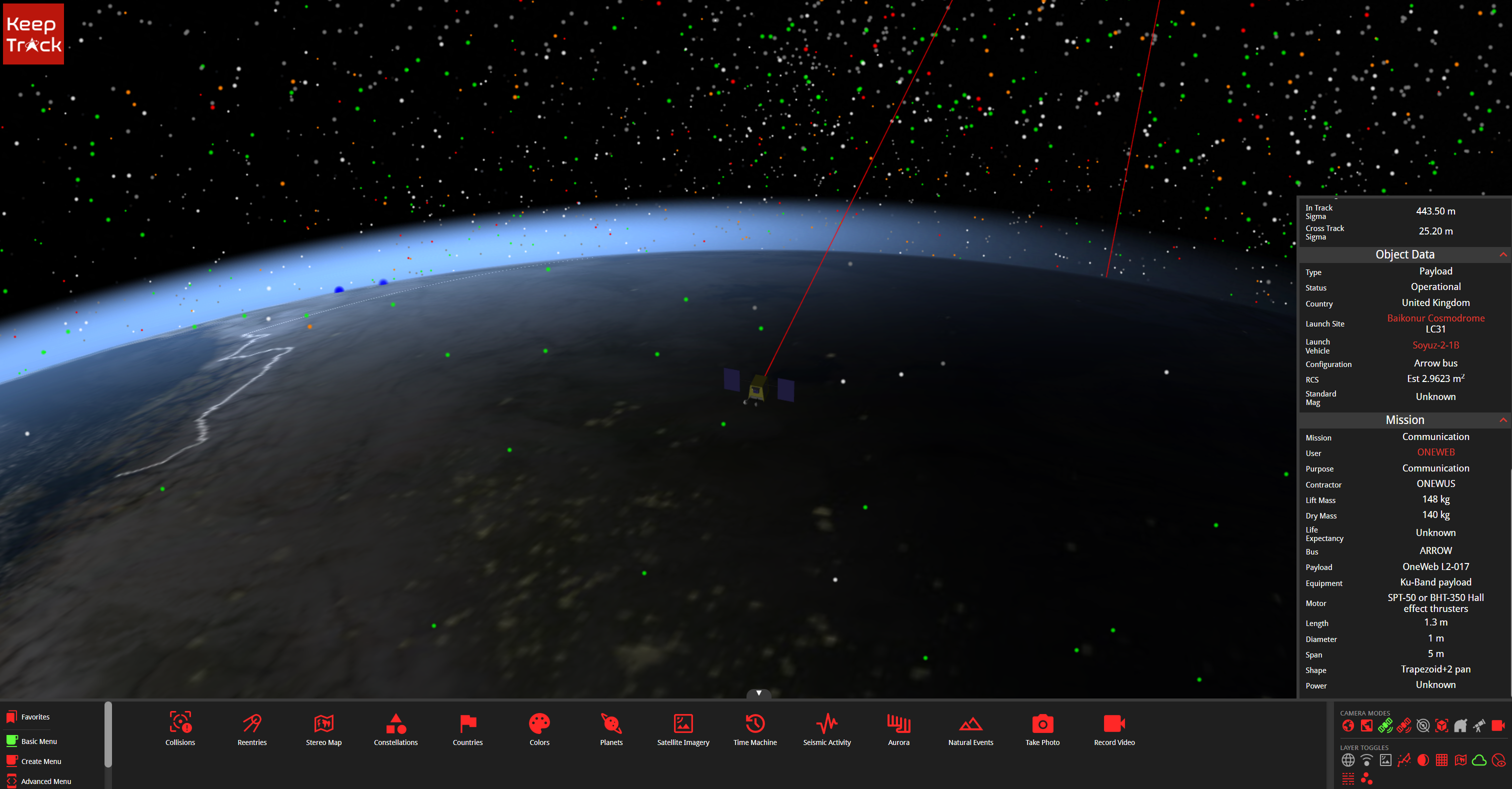
Tools like KeepTrack contribute to the broader SDA ecosystem by making publicly available tracking data accessible and visual, helping researchers, educators, and space enthusiasts understand orbital activity.
Think of Space Domain Awareness as the difference between a security camera that records footage and a security team that watches the feeds, recognizes faces, understands behavioral patterns, and can tell you not just that someone entered the building, but who they are, what they’re likely after, and whether you should be worried.

Theodore Kruczek