· today in space history · 6 min read
The Day Fiery Failure Launched NASA
Sixty-eight years ago, America's first satellite exploded on the launchpad in front of the entire world. But from the ashes of Vanguard TV-3 came the determination that would eventually win the Space Race.
The world watched in shock as a fireball engulfed America’s first satellite on the launchpad. Sixty-eight years ago today, the United States was humbled under the backdrop of Soviet space triumphs. Yet from this baptism by fire came a determination that would fuel America’s technological efforts throughout the Cold War. This is the story of Vanguard TV-3—better known as “Flopnik.”
A Project Born Before the Race
Project Vanguard didn’t start because of the Space Race; rather, it was accelerated by it. The project first came together in 1955, following the announcement of the International Geophysical Year (1957-1958)—a global effort dedicated to extensive research in geophysics. Both America and the USSR set goals of sending satellites to space, with tensions heating as two nations’ worth of brilliant scientists competed for Earth’s orbit.
Three proposals from the Air Force, Army, and Navy were drafted for the honor of designing America’s satellite, each taking a different approach to the task. The Navy proposed Project Vanguard, which would use a rocket system based on the existing Viking framework—America’s liquid propellant sounding rockets developed as successors to captured Nazi V-2 rockets from World War II. This plan seemed the most feasible and most pacifist, and it was set into motion on September 9, 1955.
The objectives were ambitious: America had three years to launch a satellite into orbit, track it, and perform scientific experiments with it. Rockets, ground-based tracking networks, and computing infrastructure all had to be perfect.
Beyond the scientific goals, the satellites’ revolutions around Earth would serve as a diplomatic tool. Despite being developed by the Naval Research Laboratory, it was technically a civilian project staffed with non-military scientists and funded by the National Science Foundation. By focusing on science rather than missile warfare, America hoped to send a message that space was international territory—and that borders shouldn’t limit discovery.
But it wasn’t all idealism. The United States also wanted to establish space superiority and lay the groundwork for future surveillance and reconnaissance vehicles. Framing the project as scientific exploration provided a convenient cover to avoid escalating tensions into open conflict.
Racing Against Sputnik
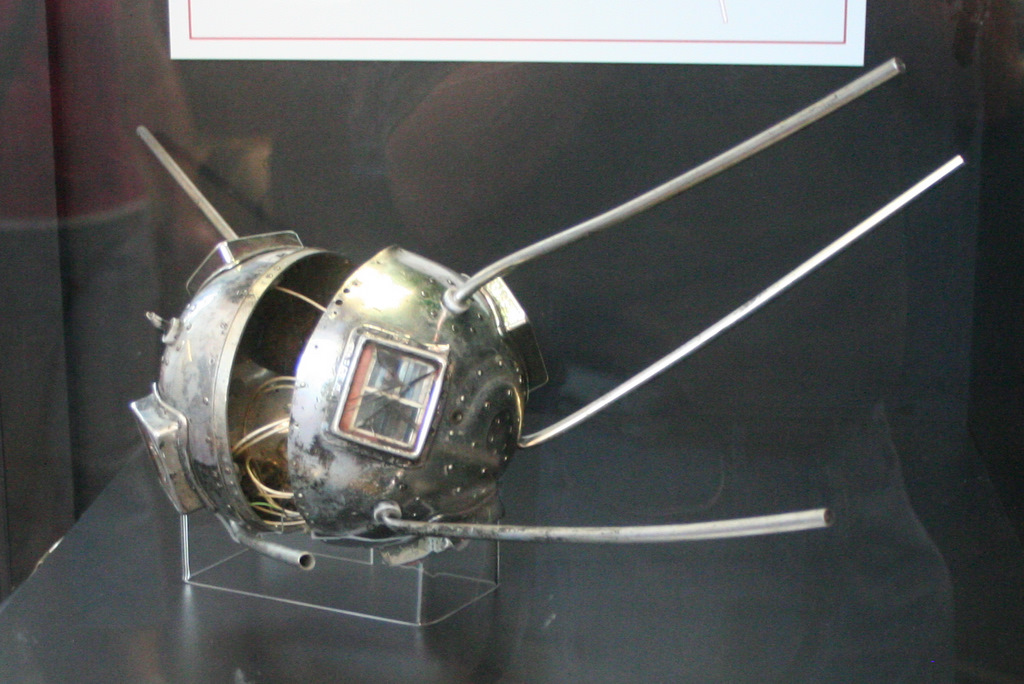
The engineers who breathed life into this machine did so with shaking hands and crushing pressure on their shoulders—because they were already behind. On October 4, 1957, while Vanguard TV-3 was still being meticulously designed and tested, the Soviets shocked the world. Sputnik I rocketed into low elliptical orbit, and suddenly that 183-pound metal ball with antennas dealt a brutal blow to American morale.
In the months before Sputnik’s launch, Americans had been witnessing suborbital test flights, lulled into a false sense that they were ahead of their rivals. Project Vanguard went into hyperdrive, completing the satellite and its test vehicle just two months later on December 6th.
The payload was a 3.3-pound aluminum sphere with two miniature radio transmitters that ground stations would use to track its orbit. When strapped to the three-stage launch vehicle, it formed Vanguard TV-3. The media craved a hopeful story of success, eagerly expecting “revenge” on the Soviets. Despite the launch being officially billed as a test, journalists sat patiently by their typewriters expecting this to be America’s first official satellite launch.
Four Feet of Failure
The launch would take place at Cape Canaveral, Florida—home of America’s missile test programs. At 16:44, the first-stage engine ignited. The rocket lifted itself into the air with purpose… reaching a maximum elevation of four feet.
What happened next was rapid and startling. Thrust was lost, and the rocket settled back onto the pad as its propellant tanks ruptured. The instant it hit the ground, a fiery storm erupted from the base, engulfing the metal in orange flames and damaging the payload beyond repair.
“There is a very large black smoke cloud—a very large black area around the location that the explosion occurred,” described an observation pilot. Civilians throughout a three-mile radius of the launch crowded into the streets, watching as observation B-17s circled above the blooming fireball.
The spectacular failure drew brutal mockery from the media. Vanguard was labeled “Flopnik” and “Kaputnik” by exasperated Americans. International press piled on, and a phrase uttered by Soviet Premier Nikita Khrushchev to Western diplomats echoed in the minds of the nation: “We will bury you.”
Rising from the Ashes
The failure of Vanguard became the motivating factor for American success. Work started immediately, with focus shifting to a previous proposal from the Army. Wernher von Braun—a German rocket scientist working for the Army Ballistic Missile Agency after the controversial Operation Paperclip—pitched the technology behind Explorer 1.
This new satellite was an elongated tube hosting a cosmic ray detector to measure radiation in orbit, and it became the Army Ballistic Missile Agency’s crowning achievement. On January 31, 1958, Explorer 1 underwent a successful launch. Hoisted by the Juno-1 launch vehicle in a four-stage configuration, it did everything TV-3 couldn’t. Using a liquid-fueled rocket and Baby-Sergeant solid motors, it reached an altitude of 1,594 miles. The data it gathered proved crucial for discovering Earth’s inner radiation belt—now known as the Van Allen Belt.
And Project Vanguard itself didn’t die with TV-3. On March 17, 1958, Vanguard 1 became the world’s first solar-powered satellite and the second American satellite in orbit. Remarkably, it’s still orbiting Earth today, making it the oldest artificial object in space.
A Failure That Built NASA
America regained its dignity and set itself on the trajectory to win the Space Race. While Vanguard TV-3’s explosion was humiliating, it proved to be only a temporary setback. When the rocket couldn’t launch itself, it effectively rocket-launched something else entirely: institutional reform and the unification of American space efforts.
The failure highlighted the problems of having military branches compete for space supremacy. Within months, President Eisenhower signed the National Aeronautics and Space Act, creating NASA in July 1958. The new agency consolidated America’s disparate space programs under civilian leadership—a direct response to the chaos that had contributed to Flopnik’s failure.
In the end, Vanguard TV-3 remains just a blip in the successful history of American spaceflight. But it was an important blip—the moment America learned that reaching space would require not just brilliant engineering, but the right organizational structure to support it.

Mariana Mokhova