· today in space history · 8 min read
The Day We Banned the Word "Film"
On January 20, 1972, the second KH-9 HEXAGON lifted off from Vandenberg - carrying the most sophisticated reconnaissance system ever built by engineers who weren't allowed to say 'film,' 'camera,' or even talk to each other about what they were doing.
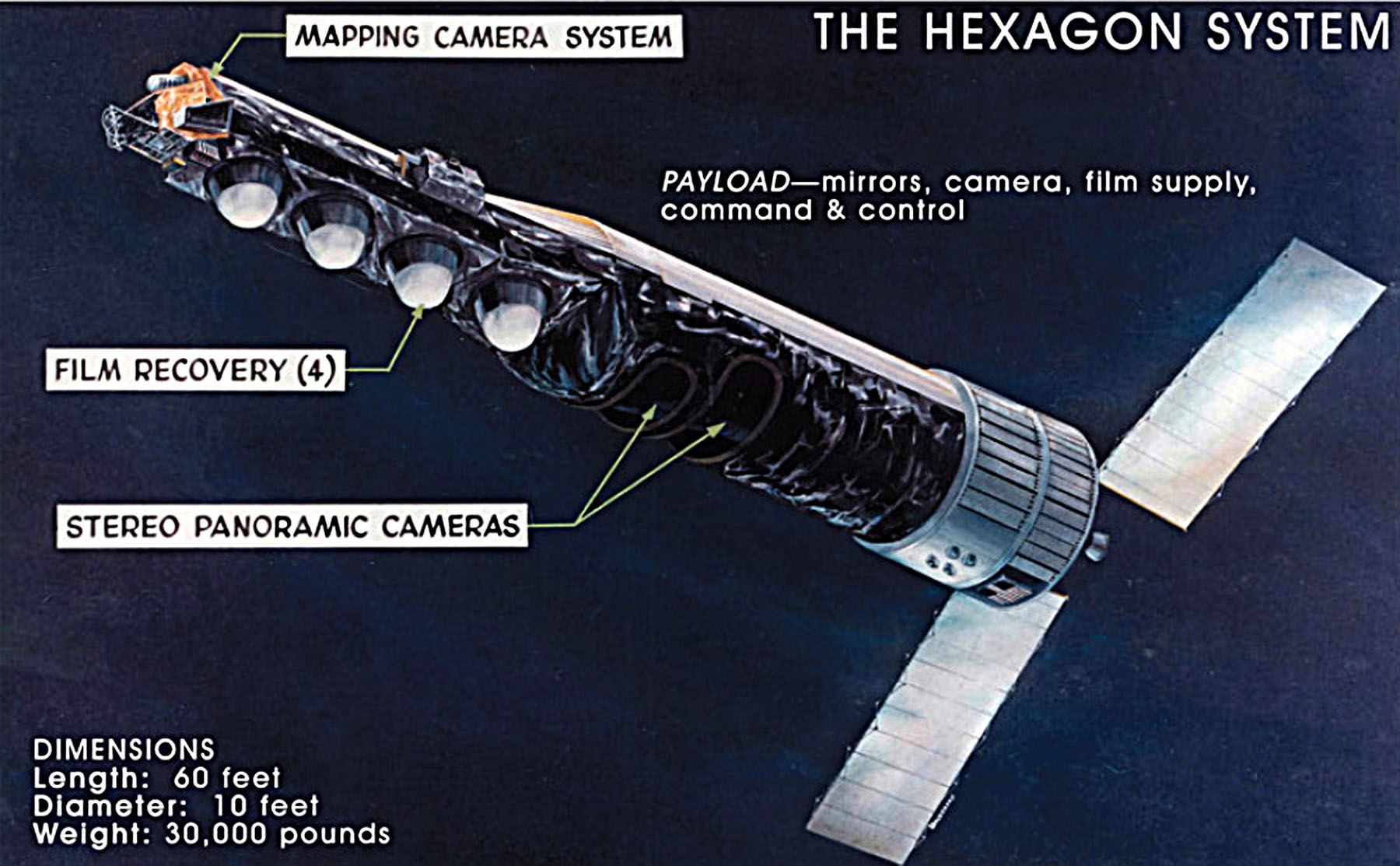
On January 20, 1972, at 18:36 GMT, a Titan IIID rocket thundered off the pad at Vandenberg Air Force Base’s Space Launch Complex 4E. The payload was officially described as a spacecraft “engaged in investigation of spaceflight techniques and technology” - bureaucratic poetry that translated to absolutely nothing useful. What actually rode atop that rocket was the second KH-9 HEXAGON reconnaissance satellite, a 60-foot, 30,000-pound behemoth that would spend the next 40 days photographing Soviet missile sites, submarine pens, and bomber airfields from 153 to 330 kilometers above the Earth.
The engineers who built it called it “Big Bird.” The CIA called it “the most complicated thing we’ve ever put into orbit.” And the more than 1,000 workers at Perkin-Elmer’s windowless facility in Danbury, Connecticut - the ones who designed and manufactured its revolutionary camera system - couldn’t call it anything at all. Not to their wives. Not to their children. Not even to each other, unless they were inside the classified facility and had explicit need to know.
This was Cold War reconnaissance at its most paranoid and most brilliant - a machine so secret that the word “film” was forbidden in phone conversations, so sophisticated that Soviet engineers never built anything comparable, and so successful that it helped prevent World War III by letting American decision-makers know exactly what the other side was doing.
The Problem With Saying “Film”
The culture of secrecy surrounding HEXAGON bordered on the absurd, but it wasn’t arbitrary. Phil Pressel, the mechanical engineer who led the design of the satellite’s optical bar camera system, spent 30 years at Perkin-Elmer living under rules that would make a spy novelist wince.
“We couldn’t use the word ‘film,’” Pressel later explained. “We could never use ‘HEXAGON,’ we couldn’t say ‘optical bar’ and other words. We used abbreviations and we had to talk in code.” The logic was straightforward: if you said “film,” that implied “camera,” and if you were building cameras, you were probably building something that took pictures. And if the Soviets figured out what kind of pictures, and from where, they could start hiding things.
The code words were enforced ruthlessly. If someone slipped up during a phone call with Lockheed or another contractor, the person on the other end would immediately hang up. When engineers traveled, they left behind anything that could connect them to Perkin-Elmer - no badges, no pencils with the company name, nothing. At their destination, they signed visitor logs simply as “self.”
Oscar Berendsohn, a metallurgical engineer on the project, traveled under the name “Oscar Brown.” His wife Christine knew not to call his hotel; she’d call the office, and he’d check in and call her back. She died without ever knowing what he actually did for a living. When the project was declassified in 2011, Berendsohn was 87 years old. He walked into his local tavern and announced: “My name is Oscar Berendsohn and I built spy satellites for a living.” It was the first time he’d said those words out loud.
What Made Big Bird Fly
The January 20, 1972 launch was only the second HEXAGON mission, but the program had already proven its worth - and its fragility. The first satellite, launched in June 1971, had performed beautifully until one of its film return capsules suffered a parachute failure. The capsule slammed into the Pacific Ocean with 2,600 Gs of force and sank to 16,400 feet near Hawaii.
What followed was one of the most audacious recovery operations in American history. The USS Trieste II, a deep-sea submersible that had never gone below 10,000 feet, was sent to retrieve the capsule before the Soviets could find it. After months of delays, mechanical failures, and foul weather - with Soviet trawlers potentially lurking nearby - the Trieste II finally grabbed the wreckage on April 25, 1972. The film had disintegrated after nine months underwater, but the mission proved the Navy could recover assets from depths previously thought impossible.
The second mission, launching on this day in 1972, carried lessons learned from that first flight. The satellite would operate for about 40 days before re-entering on February 29, 1972. It also carried a secondary payload - a small SIGINT satellite designated OPS 7719 that would remain in orbit for years, quietly monitoring Soviet radar emissions.
The Connecticut Connection
In Danbury, Connecticut, a windowless building on Wooster Heights overlooking the municipal airport held one of the Cold War’s strangest workplaces. Engineers walked through air showers to enter cleanrooms. They used slide rules instead of computers (which barely existed in the forms we’d recognize). They accomplished digital-age precision with analog-age tools.
The complexity was staggering. Joseph Prusak, an engineer who joined the project in 1967, remembered his first briefing: “I thought they were crazy. They envisaged a satellite that was 60-foot long and 30,000 pounds and supplying film at speeds of 200 inches per second. The precision and complexity blew my mind.”
Years later, after multiple successful launches, Prusak was shown what HEXAGON could actually do - an image of his own house in suburban Fairfield, Connecticut, clearly showing the pool in his backyard. “This was light years before Google Earth,” he said. The official resolution was two to three feet; the actual resolution remains classified, though Phil Pressel has hinted it was “much better under the right conditions.”
CIA Director's Challenge
John McCone challenges American companies to create a satellite combining CORONA's wide coverage with GAMBIT's high resolution. Perkin-Elmer wins the camera contract in October 1966.
First HEXAGON Launch
KH-9 Mission 1 lifts off from Vandenberg. The satellite works perfectly, but one film capsule's parachute fails - triggering a dramatic deep-sea recovery operation.
Mission 2 Launch
The second HEXAGON reaches orbit. The program is now operational, beginning 14 years of continuous reconnaissance coverage.
Final Launch - Failure
The 20th and last HEXAGON is destroyed when its Titan 34D rocket explodes seconds after liftoff. Of 20 launches, 19 were successful - a remarkable record for such a complex system.
Declassification
After 40 years of secrecy, the NRO publicly displays a HEXAGON satellite for one day at the Udvar-Hazy Center. Engineers who worked on the project can finally tell their families what they did.
Why It Mattered
The intelligence gathered by HEXAGON fundamentally shaped American Cold War strategy. The satellite’s wide-area coverage let analysts systematically map Soviet military infrastructure - every ICBM silo, every bomber base, every submarine pen. This wasn’t just about knowing where Soviet weapons were; it was about knowing where they weren’t.
“At the height of the Cold War, our ability to receive this kind of technical intelligence was incredible,” says space historian Dwayne Day. “We needed to know what they were doing and where they were doing it, and in particular if they were preparing to invade Western Europe. Hexagon created a tremendous amount of stability because it meant American decision makers were not operating in the dark.”
The satellite’s mapping camera - carried on 12 of the 20 missions - provided additional strategic value. Between 1973 and 1980, it photographed virtually the entire Earth’s landmass at 20-foot resolution, creating the foundation for accurate targeting and, ironically, the GPS navigation systems we use today. Nearly 29,000 of these images were declassified in 2002 and transferred to the U.S. Geological Survey, where scientists continue to use them for climate and geological research.
The Brotherhood of Big Bird
For decades after the project ended, the engineers who built HEXAGON met weekly at the food court of the Danbury Fair mall - the same mall that now overlooks what used to be their secret workplace. They’d gather near the McDonald’s, gray-haired men talking about golf and grandchildren, forbidden until 2011 from discussing the greatest achievement of their professional lives.
When declassification finally came, the revelations rippled through families. Mark Boughton, Danbury’s mayor, discovered his father had worked on HEXAGON only when he was invited to speak at a reunion of former workers. “Learning about Hexagon makes me view him completely differently,” Boughton said. “He was more than just my Dad with the hair-trigger temper and passionate opinions about everything. He was a Cold War warrior doing something incredibly important for our nation.”
Phil Pressel, the Belgian-born Holocaust survivor who designed the satellite’s camera system, teared up when he first saw the declassified HEXAGON on display. “I lived with secrecy at Perkin-Elmer for 30 years,” he said. “We were never allowed to talk about anything.” He later wrote the definitive book on the program: Meeting the Challenge: The Hexagon KH-9 Reconnaissance Satellite.
The book’s title captured something essential about HEXAGON. When the CIA first presented its requirements - a 60-foot satellite, 30,000 pounds, film moving at 200 inches per second, resolution of two to three feet from orbital altitude - the engineers thought they were being asked to do the impossible. “We almost to a person said, ‘We can never do this. It’ll never happen. It’s almost impossible,’” Pressel recalled.
They met the challenge anyway. Nineteen times out of twenty, Big Bird flew perfectly. And on January 20, 1972, as the second HEXAGON reached orbit above a world that had no idea it existed, America’s eyes in the sky opened a little wider.
References(7)
- KH-9 Hexagon - Wikipedia
- Secret No More: Spy Satellite Designer Reveals Life's Work - Space.com
- The Story of the Hexagon, a Danbury-Built Spy Satellite - Connecticut Magazine
- Hexagon KH-9: Meeting the Challenge - SPIE
- CIA Declassifies Amazing 1972 Spy Satellite Capsule Deep-Sea Rescue - Space.com
- HEXAGON KH-9 Reconnaissance Satellite - National Museum of the USAF
- Declassified US Spy Satellites Reveal Rare Look at Secret Cold War Space Program - Space.com

Theodore Kruczek