· today in space history · 5 min read
The Day the Dyna-Soar Dream Died
Exactly 62 years ago, Defense Secretary Robert McNamara ended the X-20 Dyna-Soar program, canceling one of the most ambitious spaceplane projects of the early Space Race - a vehicle that could have put aircraft in orbit decades before the Space Shuttle.

The Cold War was, at its core, a conflict of opposing ideologies. The Space Race, a crucial appendage of that battle, was no exception - different visions for the future of space clashed for domination of the cosmos. Most designs for early spacecraft were remarkably similar: create a vehicle to enter orbit, then descend using a parachute. But just because those models are the ones that succeeded doesn’t mean other designs didn’t almost reach Earth’s orbit. Enter the X-20 Dyna-Soar, a brainchild of the US Air Force that nearly introduced an unheard-of concept to the skies: spaceflight aboard an aircraft.
Exactly 62 years ago today, Defense Secretary Robert McNamara announced the cancellation of the X-20 Dyna-Soar program, ending a potential timeline where aircraft meandered through space.
Dark Origins
Like many ideas of the Space Race, the concept behind Dyna-Soar has dark, twisted roots in Nazi Germany’s numerous proposed war technologies. On April 27, 1942, a plan known as Amerikabomber was finalized, encompassing three concepts for an aircraft that could reach America and drop a payload of up to 6.5 tons.
One such concept was the Silbervogel (German for “Silver Bird”). It was an innovative idea for spaceflight performed by an aircraft in a series of bounces. This skip-and-glide technique, developed by German engineers Eugen Sänger and Irene Bredt, almost resembled a skipping stone. The aircraft would accelerate, then use lift from its wings to redirect its glide angle upward several times. This allowed it to cool off from the friction generated while traveling through dense air. Nazi scientists believed an aircraft dipping in and out of suborbit could hit distant targets, from New York to Los Angeles, while reducing thermal stress.
Luckily, the Silbervogel’s strategic uselessness outweighed its technological wonder, and the silver bird never spread its wings.
This didn’t mean the idea was lost, however. Operation Paperclip ensured the transfer of these horrific yet brilliant minds to the United States, where the idea of an aircraft that could fly in space resurfaced, and the rough vision for X-20 Dyna-Soar was born.
Why Ascend to Orbit?
The Dyna-Soar program was initiated on October 10, 1957, by the US Air Force - just six days after Sputnik rocketed through Earth’s orbit. As space began to take on greater military significance, efforts to surpass the Soviets in space technology intensified. Features such as high-quality reconnaissance and being undetectable in space made Dyna-Soar attractive to military planners. The aircraft could also be recalled or retargeted at any point - flexibility that was impossible with missiles at the time.
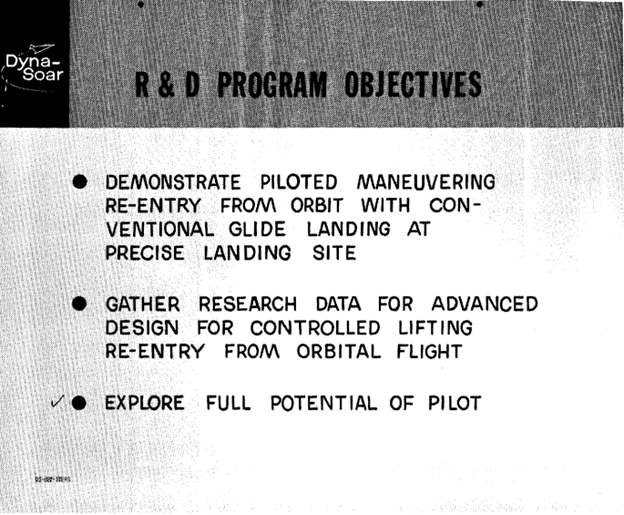
Another aspect that excited engineers was the presence of a pilot on the aircraft. Studies were conducted to analyze the success rates of piloted versus non-piloted flights, which indicated strong confidence in human operators. The presence of an operative on the spaceplane was used as further reasoning behind the innovative nature of the machine.
As confidence in piloted spaceplanes was reinforced, Dyna-Soar steadily progressed through the development pipeline, arriving at the preliminary construction stage.
Building the Impossible
Construction of Dyna-Soar was handled by Boeing, who was contracted for the project on November 9, 1959. The decision was controversial, as the original designer of the project, Walter Robert Dornberger, was no longer in control of it. Dornberger’s grand vision was for a spacecraft that could carry a payload of nuclear weaponry - a stark contrast to the proposals of other project leaders, which included the rendezvous and destruction of enemy satellites.
The final development plan, signed off by General Thomas D. White (US Air Force Chief of Staff) and Hugh Dryden (NACA Director), designated the primary goal of Dyna-Soar to be a reconnaissance weapons system. The project eventually garnered a budget of approximately $660 million.
The primary goal was to ensure that the aircraft could re-enter the atmosphere and land successfully on an airfield. The final design would include a rounded shape made of René 41 nickel superalloy with ski-like landing skids - rubber tires would have caught fire during reentry.
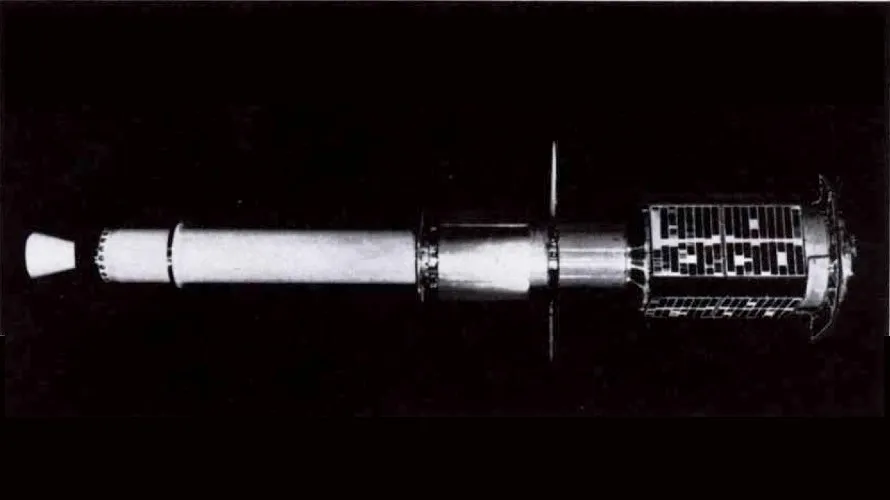
Dyna-Soar would be lifted to suborbital velocities using a Titan IIIC booster, but the main challenge was the glider itself. It went through what was described as “the most exhaustive wind tunnel program in the history of flight.” ASSET (Aerothermodynamic Elastic Structural Systems Environmental Tests) vehicles were launched on September 18, 1963, to test the heat shield the spaceplane would use. The development of a new spacesuit was also announced that month, and seven astronauts - including Neil Armstrong - were chosen as pilots for the new spaceplane.
A Dream Too Broad
Ultimately, the project was cancelled on December 10, 1963. This was done for a variety of reasons, the most pressing being a lack of agreement on what the actual end goal for the spaceplane was. Was it a research system for NASA or a weapon carrier? The focus on the logistics of skip-and-glide overshadowed the program’s real orbital goals.
The project was headed by the Air Force, yet when it was determined that piloted spacecraft were NASA’s responsibility, the reasoning behind the Air Force having a space program was questioned. Furthermore, when studied, officials found that the Gemini program was a far more cost-effective alternative for studying re-entry systems.
Despite its cancellation, Dyna-Soar still allowed for multiple breakthroughs, such as our understanding of boost trajectories and re-entry technologies. Controlled re-entry was achieved two years later by Gemini 3. Later spaceplanes, such as Martin’s X-23 PRIME, the Space Shuttle, and the European Hermes proposal, all benefited from this research.
Equipment such as ultra-high temperature-resistant ceramic nose caps and sensor transducer equipment on the vehicle allowed the US to progress in its understanding of hypersonic flight. The project still lives on as a testament to the recycling and betterment of innovative ideas - proof that even cancelled dreams can pave the way for future triumphs.
Additional Resources

Mariana Mokhova