· today in space history · 10 min read
The Satellite That Found 22 Photons and Changed Astronomy
On April 27, 1961, a Scout rocket lifted a 37-kilogram NASA satellite into orbit from Wallops Island carrying the first serious instrument for detecting cosmic gamma rays. Explorer 11 operated for seven months before its tape recorder failed. In that time it registered 22 gamma-ray photons - a pitiful number by modern standards, but enough to launch an entire branch of astronomy.
Explorer 11 launch
Scout X-1 launches from Wallops Island, Virginia at 2:17 p.m. Eastern. Enters 486 by 1,786 km orbit at 28.9-degree inclination.
Tape recorder fails
Onboard magnetic tape recorder stops working after 78 days of operation, but real-time data continues to be collected during passes over ground stations.
Science mission ends
Final scientific telemetry received. Total of 22 high-confidence gamma-ray events detected across 141 hours of observing time.
Results paper submitted
Kraushaar and Clark submit 'Search for Primary Cosmic Gamma Rays with the Satellite Explorer XI' to the Physical Review, announcing the first upper limits on cosmic gamma-ray flux.
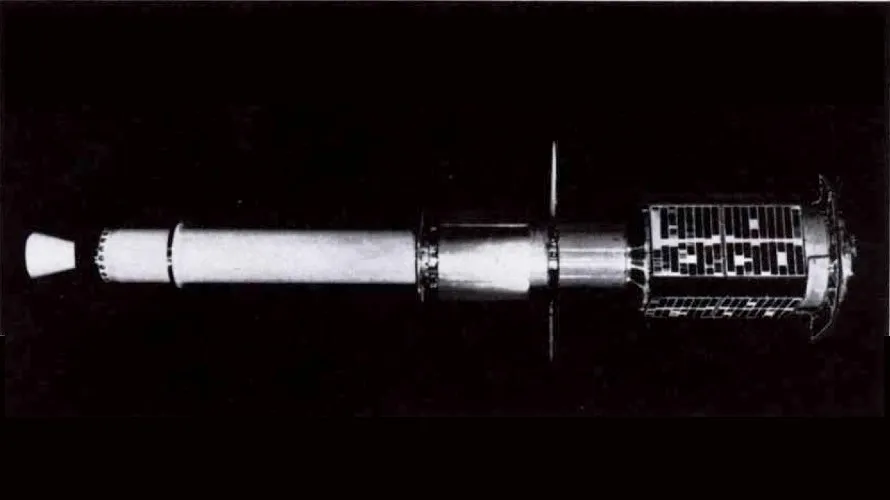
On the morning of April 27, 1961, two weeks after Yuri Gagarin’s historic flight and in the middle of a frantic American scramble to respond, a small rocket lifted off from NASA’s Wallops Flight Facility on the eastern shore of Virginia. The rocket was the Scout X-1, a modest four-stage solid-propellant vehicle built by Vought Aeronautics. Its payload was a 37-kilogram satellite shaped like a tall cylinder about the size of a household trash can. The satellite had a name that suggested it was one of many: Explorer 11, the eleventh entry in NASA’s serial numbered series of scientific Earth-orbiting satellites.
Most of the world was not paying attention. The previous ten Explorers had included discoveries like the Van Allen radiation belts (Explorer 1 in 1958) and the first geodetic satellite measurements, but space news in the spring of 1961 was dominated by human spaceflight. The Mercury program was still ramping up. The Freedom 7 Mercury-Redstone flight was ten days away. A small scientific satellite barely registered in the public coverage.
Explorer 11 was not designed to register in public coverage. It was designed to do something nobody had ever done before: look at the universe in a part of the electromagnetic spectrum that cannot be observed from the ground.
A Wavelength Nobody Could Reach
Gamma rays are the highest-energy, shortest-wavelength photons in the electromagnetic spectrum. They have energies above roughly 100,000 electron volts (100 keV), and they are produced by the most extreme astrophysical processes in the universe: nuclear fusion in stars, particle acceleration around black holes, radioactive decay in supernova remnants, annihilation of matter and antimatter. Detecting them from orbit was the only way to map the high-energy universe.
The problem was that in 1961 nobody had ever tried. Earth’s atmosphere is opaque to gamma rays - they interact with atomic nuclei in the air well before reaching the ground, producing cascades of secondary particles that spread their energy over tens of meters. Ground-based telescopes could not see gamma rays at all. Balloon-borne detectors had been tried at high altitudes, but their effective exposure was limited by weather, wind, and the thin residual atmosphere at 30-40 km.
A satellite, above all the atmosphere, could in principle observe gamma rays directly. The engineering question was how to detect them. Gamma rays do not focus through lenses or mirrors the way visible light does. They have to be registered by their interactions with dense matter - the sort of nuclear physics measurements that required bulky scintillators, photomultiplier tubes, and heavily instrumented anti-coincidence systems to distinguish genuine gamma rays from the much more numerous charged-particle background in space.
The MIT Instrument
The scientific instrument on Explorer 11 was designed by William Kraushaar and George Clark at MIT, with support from the NASA Goddard Space Flight Center. It was the culmination of several years of theoretical work in the late 1950s on how to build a satellite-borne gamma-ray telescope.
The instrument centered on a small cesium iodide scintillator crystal, about 3 cm thick, surrounded by a plastic anti-coincidence shield. A gamma ray passing through the plastic shield without triggering it, and then depositing energy in the crystal, would register as a candidate gamma-ray event. The pulse size from the crystal indicated the gamma ray’s energy. A Cherenkov radiator below the crystal ruled out charged-particle events that could mimic gamma rays.
The instrument was sensitive to gamma rays above 50 MeV - high enough energy that terrestrial radioactive decay was not a confusing background, and low enough that cosmic-ray secondary gamma rays (which dominate below about 10 MeV) were partially suppressed.
The satellite itself was built by the Goddard team around a simple spinning bus. Explorer 11 had no active attitude control - it spun at about 15 rpm to stabilize itself, and the scintillator pointed outward perpendicular to the spin axis. As the spacecraft orbited Earth every 108 minutes, its detector swept across different directions in the sky. Over the course of days and weeks, the instrument accumulated observations of the entire celestial sphere.
Power came from a ring of solar cells around the body. Communications were a simple 108 MHz telemetry beacon. Data storage was a small magnetic tape recorder that could hold up to 16 hours of data for dump over ground stations.
141 Hours of Science
Explorer 11 operated for almost exactly seven months. Its tape recorder failed on July 14, 1961, which significantly reduced its observing efficiency. But even with only real-time telemetry, the instrument continued to observe the sky during passes over ground stations at Goldstone (California), Woomera (Australia), and Grand Forks (North Dakota).
By November 17, 1961, when final scientific data was received, Explorer 11 had accumulated approximately 141 hours of observing time on the sky. In that time, the instrument registered 22 events that met the criteria for high-confidence cosmic gamma-ray detections - events that were not suppressed by the anti-coincidence shield, that deposited energy in the expected range, and that could be distinguished statistically from the background of instrumental noise.
We had planned for perhaps a hundred events over the mission lifetime. We got 22. But 22 was enough. Twenty-two photons, distributed approximately uniformly on the sky, meant that the cosmic gamma-ray background was no stronger than we could measure.
The paper Kraushaar and Clark submitted to the Physical Review in 1962 reported an upper limit: the cosmic gamma-ray flux above 50 MeV was not greater than about 10^-3 photons per square centimeter per second per steradian. That may not sound impressive, but it was the first numerical measurement of the gamma-ray sky ever obtained from orbit, and it ruled out several theoretical models of the gamma-ray background that had predicted much higher fluxes.
What 22 Photons Meant
The 22-photon detection established three things that shaped gamma-ray astronomy for decades.
It established that the sky had a weak but measurable gamma-ray background. The upper limit Kraushaar and Clark set was in the same order of magnitude as the actual background that more sensitive missions would eventually measure - which meant that the field was neither an empty null result nor a rich beacon-filled sky. Gamma-ray astronomy would require patient integration with progressively more sensitive instruments.
It established that a satellite-borne scintillator, built with the engineering techniques of 1960, could actually count gamma rays against a cosmic-ray background that dominated terrestrial detectors. This was not obvious. Several competing theoretical models in the 1950s had suggested that charged-particle backgrounds would always overwhelm any gamma-ray signal from space. Explorer 11’s anti-coincidence design settled the argument: the detection was feasible.
And it established a template for NASA’s subsequent gamma-ray astronomy missions. The OSO-3 satellite in 1967 used a refined version of Kraushaar’s instrument concept to make the first statistically significant detection of gamma-ray emission from the galactic plane. The SAS-2 satellite in 1972 mapped the galactic gamma-ray sky with much higher sensitivity. COS-B flew in 1975, and the Compton Gamma-Ray Observatory in 1991. Each mission carried instruments that traced their heritage directly back to Kraushaar and Clark’s 1961 scintillator.
Why Wallops, Why Scout
The launch details are worth knowing. Explorer 11 flew on a Scout X-1, NASA’s smallest launch vehicle - a four-stage solid-propellant rocket with a payload capacity of about 50 kg to low Earth orbit. The Scout was designed specifically for small scientific payloads where the larger, more expensive Atlas and Thor-Delta rockets would have been overkill. NASA launched 117 Scouts between 1960 and 1994, and the vehicle quietly carried dozens of important scientific satellites that would otherwise have been too small to fund as dedicated missions.
The launch site was Wallops Island, Virginia, not the more famous Cape Canaveral. Wallops was and remains NASA’s dedicated small-launch facility, and for the Scout-class payloads of the 1960s it was the standard departure point. Explorer 11’s launch azimuth was east-northeast, producing a 28.9-degree inclination orbit that carried the spacecraft primarily over the populated portions of the Northern Hemisphere - convenient for ground station coverage.
The total cost of the Explorer 11 mission was approximately $3.5 million in 1961 dollars, including the launch vehicle and tracking support. Adjusted for inflation, this is about $37 million in 2026 dollars - a fraction of what any modern astrophysics satellite costs. The Kraushaar-Clark instrument itself cost roughly $1 million. Both numbers reflect a time when small, focused scientific missions could be built and flown with graduate-student teams rather than the hundred-person project offices that major NASA missions now require.
What It Started
The legacy of Explorer 11 is the field of high-energy astrophysics. Every major gamma-ray satellite since 1961 has built on the detection techniques, the background analysis, and the observational strategies pioneered by the 22-photon result.
The Fermi Gamma-ray Space Telescope, launched in 2008 and still operating in 2026, has detected over 7 billion gamma-ray events since its launch - almost exactly 10^8 times more than Explorer 11. Fermi has cataloged roughly 7,000 gamma-ray sources across the sky: pulsars, supernova remnants, active galactic nuclei, blazars, gamma-ray bursts, and unresolved sources that still resist identification. The high-energy sky is now one of the best-mapped domains in astronomy.
More subtly, Explorer 11 established the pattern that would characterize decades of NASA small-satellite science: use focused, low-cost instruments flown on modest launch vehicles to answer specific questions that could not be addressed from the ground. The Explorer program continues today, and contemporary Explorer missions (IRIS, NICER, TESS) operate in the same tradition - small satellites doing specific science at costs that fund-allocating committees can tolerate.
Why the Date Still Matters
April 27 has been a footnote in space history for sixty-five years. There was no televised launch, no press conference afterward, no astronaut to celebrate. A tape recorder failed three months into the mission. The final results arrived as a short paper in the Physical Review a year later, cited mostly by other gamma-ray astronomers.
But the 22 photons that satellite detected over seven months in 1961 were the first gamma rays ever registered from cosmic origins by an instrument in space. They confirmed that gamma-ray astronomy was possible. They established the technical approach that would guide the field for the next half-century. And they demonstrated that a 37-kilogram satellite launched from a small Virginia island on a modest rocket could quietly, patiently, open an entire window onto the universe.
The Fermi telescope that today maps the gamma-ray sky in unprecedented detail is Explorer 11’s direct descendant. So is every other high-energy observatory in orbit or in planning. The telescopes are bigger. The satellites are heavier. The data rates are billions of times higher. The concept - a scintillator in space, looking patiently at photons the atmosphere cannot admit - has not changed.
References(8)
- Kraushaar and Clark - Search for Primary Cosmic Gamma Rays with the Satellite Explorer XI, Physical Review Letters, 1962
- Explorer 11 Mission Summary - NASA Space Science Data Coordinated Archive
- History of High-Energy Astrophysics - Chicago Astronomical Society Conference Proceedings, 1993
- The Explorer Program: A Half-Century of Discovery - NASA Goddard, 2008
- Scout Launch Vehicle Family Historical Summary - NASA Langley, 1994
- Fermi Gamma-ray Space Telescope - NASA Mission Overview
- Astrophysics with Gamma-Ray Telescopes - Fichtel and Trombka, NASA SP-453, 1981
- Discovery of Gamma-Ray Bursts from the Vela Satellites - Klebesadel, Strong, and Olson, Astrophysical Journal, 1973

Theodore Kruczek