· deep dive · 12 min read
The NASA Budget Proposal That Nobody Asked For (Again)
The White House wants to cut NASA's science budget nearly in half for the second year running. Administrator Jared Isaacman says it's enough. Congress already rejected this exact idea once.
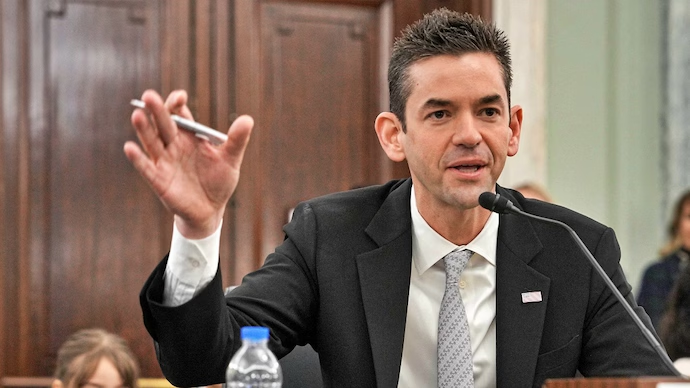
On Friday, April 3, the White House Office of Management and Budget released its fiscal year 2027 budget request for NASA. The ask: $18.8 billion - a 23% cut from the agency’s current funding, including a 47% reduction to NASA’s science portfolio. More than 40 missions would be terminated. The proposed topline is identical to last year’s request, which Congress rejected in January and replaced with $24.4 billion in actual appropriations. So the Trump administration, apparently undeterred by the word “no,” is running the same play again.
The timing borders on performance art. Four astronauts aboard Orion are currently en route to the Moon on the Artemis II mission - the first crewed voyage beyond low Earth orbit since 1972 - and today they’ll fly closer to the lunar surface than any humans have in over fifty years. The budget that would fund (and defund) the agency responsible for getting them there landed while they were still in transit.
NASA Administrator Jared Isaacman, appearing on CNN’s State of the Union on Sunday, offered an unequivocal defense. Asked whether he supported the proposed cuts, he replied: “Yes, of course I do.” His argument: NASA’s budget still exceeds that of every other space agency in the world, and its science budget alone outstrips every other space agency combined. Factor in the roughly $10 billion in supplemental funding from last year’s reconciliation bill - the “One Big Beautiful Bill Act” - and Isaacman says the agency can pursue a lunar settlement, a nuclear-propelled Mars spacecraft, and flagship science missions like the Nancy Grace Roman Space Telescope, all within the proposed envelope.
It’s a bold claim. Whether it survives contact with arithmetic is another question entirely.
What’s Actually in the Budget
The proposal is a near-carbon copy of the FY2026 request, which OMB released about a year ago. The parallels are hard to miss: same topline, same category of cuts, same rhetorical framing about eliminating “low-priority” and “unnecessary” activities.
The science directorate would lose $3.4 billion, with OMB describing the terminated missions as “low-priority.” The two examples it chose to highlight - Mars Sample Return (up to $11 billion in estimated total cost) and SERVIR (a $10-million-per-year climate data partnership with USAID) - sit at opposite ends of the spending spectrum. Lumping them together under the same label tells you more about messaging strategy than about programmatic logic.
NASA’s own 384-page budget document, released later the same day, is notably thinner than previous editions. Programs slated for cancellation aren’t listed as canceled. They’re just absent. The Chandra X-Ray Observatory, the Astrophysics Probe mission, and OSIRIS-APEX - all proposed for termination in the FY2026 request, all revived by Congress - vanish from the pages entirely. Whether this constitutes administrative efficiency or bureaucratic passive-aggression is a matter of interpretation.
The International Space Station would take an $1.1 billion hit, bringing NASA’s annual ISS spending down from roughly $3 billion. The space technology directorate faces a $297 million reduction - nearly a third of its current funding - with the White House targeting what it calls “frivolous technology projects with no applications.” STEM education programs would be zeroed out completely, a repeat of last year’s proposal.
On the other side of the ledger, exploration programs - meaning Artemis - would see a nearly 10% boost to $8.5 billion. The budget includes $175 million for new robotic missions to support the lunar base that Isaacman unveiled at NASA’s “Ignition” event on March 24. This is the first time the White House has formally backed the lunar base concept in a budget document.
The Isaacman Paradox
Here’s where the story gets interesting. Isaacman isn’t a typical political appointee nodding along to whatever the White House sends over. He’s a billionaire who personally funded and commanded two orbital spaceflights, dropped out of high school at 16 to start a payments company that now processes hundreds of billions of dollars annually, and once set a world record for circumnavigating the globe in a light jet. Before taking the job, he wrote a 62-page document called “Project Athena” that laid out a vision for NASA’s future. He was confirmed by a 67-30 Senate vote in December 2025 after a nomination saga that saw his name withdrawn, resubmitted, and dragged through two confirmation hearings over the course of a year.
Since taking office, Isaacman has moved fast. He visited every NASA center in his first 50 days. He issued a workforce directive to bring core engineering competencies back in-house after about 4,000 civil servants - roughly 20% of the workforce - left the agency through deferred resignation programs in 2025. He announced a three-phase plan to build a permanent lunar base for approximately $20 billion over seven years. He paused the Lunar Gateway space station to redirect those resources toward surface infrastructure. He restructured the Artemis manifest so that the first crewed landing now targets Artemis IV in 2028 rather than the repeatedly delayed Artemis III, which has been repurposed as an Earth-orbit rendezvous test.
In isolation, many of these moves have drawn genuine enthusiasm from the space industry and even some cautious praise from the advocacy community. The workforce directive was a surprise coming from an administration that’s been systematically reducing federal headcounts everywhere else. The Ignition roadmap, whatever you think of its timeline, at least gave NASA a coherent story to tell about where it’s headed.
But the budget proposal undercuts the narrative. Isaacman is telling NASA’s scientists and engineers that they’re the agency’s “jewel” and that he wants to rebuild institutional expertise. He’s telling Congress that his $20 billion lunar base needs extensive scientific research for safe implementation. And then the budget arrives proposing to gut the science portfolio that would supply that research by nearly half.
There are cuts to outer solar system programs, astrophysics, heliophysics - all things that feed into the human program and enable the human program.
The Planetary Society’s Jack Kiraly put it plainly: the science being cut is the same science that makes the human program possible. You can’t build a lunar base without understanding the radiation environment, the regolith mechanics, and the thermal extremes that science missions characterize. Heliophysics doesn’t sound glamorous until you realize it’s the discipline that tells you whether your astronauts are about to get hit by a solar particle event.
History Repeating, With Variations
Last year’s version of this budget fight followed a predictable script. OMB proposed massive cuts. Space advocacy organizations mobilized. Over 100 members of Congress signed letters opposing the reductions. Congress eventually rejected nearly all of them. The resulting FY2026 appropriations bill included statutory language explicitly protecting missions that the White House had proposed canceling.
The 2027 version looks likely to follow the same trajectory. Democratic representatives have already declared it “dead on arrival.” Republican Senators Susan Collins and Patty Murray - the chair and vice chair of the Appropriations Committee - have both criticized the overall request. A quarter of the House of Representatives signed onto a Planetary Science Caucus letter urging appropriators to prioritize NASA science.
FY2026 Budget Proposed
White House proposes $18.8B for NASA - a 24% cut from enacted levels, including 47% cut to science
Isaacman Confirmed
Senate confirms Jared Isaacman as NASA Administrator by a 67-30 vote after yearlong nomination saga
FY2026 Budget Enacted
Congress passes $24.4B NASA budget, rejecting most proposed cuts. Science funded at $7.25B with statutory protections
Workforce Directive
Isaacman announces plan to rebuild civil servant workforce and reduce contractor dependency
Ignition Event
NASA unveils $20B lunar base plan, pauses Gateway, restructures Artemis manifest
Artemis II Launch
First crewed mission beyond LEO since 1972 lifts off from Kennedy Space Center
FY2027 Budget Proposed
White House again proposes $18.8B for NASA with nearly identical cuts. Isaacman voices support
But treating the annual cycle of proposed cuts and congressional rescues as a system that works misses the real damage being done. Each year this pattern repeats, the uncertainty compounds in ways that don’t show up on an appropriations spreadsheet.
Consider what it means to manage a ten-year flagship science mission when your own executive branch proposes to terminate it every twelve months. Contracts can’t be signed with confidence. Hiring freezes become the default posture. Graduate students doing research at NASA-funded labs see the writing on the wall and leave the field. International partners, watching this annual spectacle, build contingency plans that don’t include the United States.
As one analysis from SpaceDaily put it, the proposed cuts don’t have to pass to do their work. The corrosion is institutional, and it accumulates quietly.
The ISS Question
Buried in the budget is a $1.1 billion reduction to International Space Station operations - a cut that looks straightforward on paper but gets complicated fast when you consider what Isaacman announced at Ignition.
The original plan for ISS transition involved retiring the station by 2030 and handing low-Earth orbit operations to commercial successors. Multiple companies - Axiom Space, Vast, and others - have been developing private stations. But at the Ignition event, NASA acknowledged something the industry had been whispering for years: the commercial market for space stations hasn’t materialized the way anyone hoped. Space tourism, in particular, hasn’t generated the recurring demand that business plans assumed.
“Tourism hasn’t really materialized as a market,” said Dana Weigel, NASA’s ISS program manager, at the Ignition event on March 24. “We certainly have had a number of tourist-sponsored missions, but those have been limited and we haven’t seen recurring demand for them.”
NASA’s new approach involves attaching a commercial module to the existing station, then eventually separating it into free flight - a more incremental transition than the clean break previously envisioned. But building that future costs money, and cutting ISS funding by a third makes the math harder regardless of the architectural approach.
The National Space Society, which was broadly supportive of Isaacman’s cost-saving initiatives, called the ISS funding reduction “unwise and counterproductive.” Their statement cut to the core tension: “A strong NASA requires both a robust exploration program and a fully funded science portfolio. These are not competing priorities - they are mutually reinforcing pillars of U.S. space leadership.”
The Conflict Nobody Can Quite Define
Isaacman’s confirmation hearings surfaced a question that hasn’t gone away: how do you evaluate NASA’s relationship with SpaceX when the agency’s administrator spent years as SpaceX’s highest-profile private customer?
Before becoming administrator, Isaacman funded and commanded the Inspiration4 mission in 2021 (the first all-civilian orbital spaceflight) and the Polaris Dawn mission in 2024 (which included the first commercial spacewalk and reached farther from Earth than anyone since Apollo). Both missions flew on SpaceX hardware. During confirmation, he pledged to resign from Shift4 Payments and cancel remaining Polaris Program missions. He addressed the SpaceX relationship directly, noting that he used the company because it was “the only organization that can deliver astronauts to space and back since the retirement of the shuttle.”
Under Isaacman’s direction, NASA’s budget proposal would transition away from the Space Launch System - a program with deep congressional support and contractor relationships - in favor of commercial alternatives “like SpaceX’s Starship or Blue Origin’s New Glenn” once those systems are available. The budget states that beyond Artemis V, NASA will “initiate a new procurement to obtain commercial transportation services to launch astronauts.” SpaceX is also one of two companies developing Human Landing Systems for the lunar surface, alongside Blue Origin.
Nobody has alleged actual impropriety. But the structural position is unusual. The administrator who personally spent tens of millions of dollars on SpaceX missions is now overseeing an agency whose largest commercial partnerships increasingly involve that same company. Isaacman maintains that the relationship is purely professional. “There are no pictures of us at dinner, at a bar, on an airplane or on a yacht because they don’t exist,” he told senators about his relationship with Musk during his confirmation hearing.
The budget doesn’t change this dynamic, but it does sharpen it. Programs with established government contractor workforces face cuts or uncertainty. Programs tied to commercial providers face, in relative terms, stability or growth.
What Happens Next
The honest answer is: probably exactly what happened last time.
Jamie Wise, a staffer on the House Appropriations Committee’s Commerce, Justice and Science subcommittee, predicted at the Goddard Space Science Symposium in March that the FY2027 request would look like FY2026. He was right. The fact that a House appropriations staffer could call the White House’s budget proposal weeks in advance tells you how formulaic this has become.
Congress will hold hearings. Isaacman will testify. Advocacy organizations - the Planetary Society has its Day of Action scheduled for April 19-20 - will mobilize their members. Appropriators will write their own version of the bill. The final number will land somewhere much closer to current funding levels than to what OMB proposed.
But “Congress will probably fix this” isn’t a strategy. It’s an admission that the executive branch’s budget proposal for the nation’s space agency is, at best, a negotiating position and, at worst, an annual exercise in institutional destabilization.
Isaacman has the resume, the ambition, and apparently the political capital to shape NASA’s future. His Ignition roadmap is the most coherent vision the agency has had in years. The question is whether that vision is sustainable within a budget framework that asks scientists and engineers to spend every year wondering whether their programs will exist in twelve months.
Four astronauts are about to see the far side of the Moon for the first time since Apollo. The budget that will determine whether anyone follows them to the surface is still very much TBD.
References(11)
- White House FY2027 Budget Proposal - OMB
- Isaacman Defends NASA Budget Proposal Despite Steep Cuts - SpaceNews
- White House Again Proposes Steep NASA Budget Cuts - SpaceNews
- As Astronauts Aim for Moon, Trump Recommends Slashing NASA Budget - CNN
- What Is the Skinny Budget and What Does It Mean for NASA - The Planetary Society
- NASA Unveils Initiatives to Achieve National Space Policy - NASA
- NASA Seeks to Bolster Workforce, Reduce Reliance on Contractors - SpaceNews
- Trump FY2027 NASA Budget Supports Moon Missions, Cuts Everything Else - SpacePolicyOnline
- NASA Chief Jared Isaacman Backs Trump's Proposed Budget Cuts - The Hill
- You Just Saved NASA's Budget (FY2026 Outcome) - The Planetary Society
- Isaacman Wants to Restore NASA's Core Competencies - SpacePolicyOnline

Theodore Kruczek