· today in space history · 12 min read
STS-30 | When Atlantis Sent a Radar to Venus
On May 4, 1989, Space Shuttle Atlantis lifted off from LC-39B carrying Magellan, NASA's first interplanetary mission since 1978. The eleven-year drought ended in a payload bay, and the radar that emerged would map ninety-eight percent of Venus through clouds that no camera could ever see through.
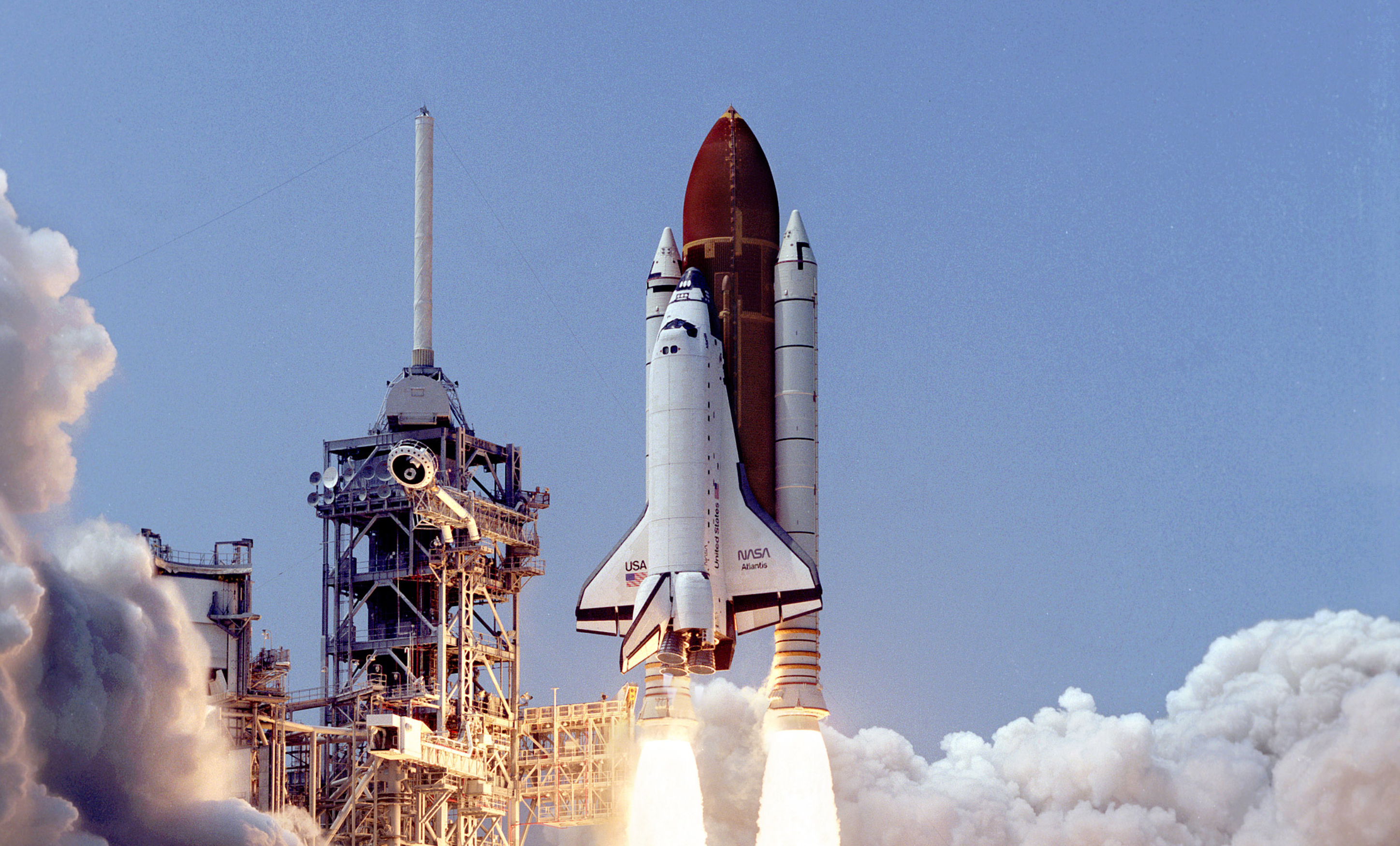
Thirty-seven years ago today, on the afternoon of May 4, 1989, Space Shuttle Atlantis lit its main engines and rolled off Launch Complex 39B at the Kennedy Space Center. The flight was designated STS-30. It was the fourth flight of Atlantis and the twenty-ninth shuttle mission overall. By the standards of the program, it was an unremarkable launch. The crew was five strong, the duration would be just over four days, and the orbit would never climb above low altitude. By the standards of American planetary exploration, it was the most consequential launch in more than a decade.
In the cargo bay of Atlantis sat a spacecraft called Magellan, mated to a two-stage Inertial Upper Stage. Together they weighed about thirty-three thousand pounds. Together they represented the first interplanetary probe the United States had launched since 1978. For eleven years, the country that had landed on the Moon, sent two Vikings to Mars, and dispatched two Voyagers toward the outer solar system had not sent a single new spacecraft to another world. STS-30 ended that. It also did so in a way that no Apollo mission ever had: not from a Saturn V, not from a Titan or an Atlas, but from a crewed vehicle, with five people in the cabin and a planetary probe behind them.
The point of the mission was Venus. The point of Venus was that nobody had ever really seen it.
The Drought
The American planetary program in the 1980s was not so much paused as suffocated. The decade had begun with the Voyager 2 encounter at Saturn and the promise of a Galileo mission to Jupiter and a Venus Orbiting Imaging Radar. By mid-decade, those promises were unraveling under three pressures at once: shrinking NASA budgets, the political insistence that the Space Shuttle would launch every American payload, and the loss of Challenger in January 1986. After Challenger, the entire shuttle fleet was grounded for two and a half years. Every planetary mission that had been queued up to launch from a shuttle’s payload bay went into deep storage.
Magellan, which had begun life under the name VOIR (Venus Orbiting Imaging Radar) and been radically descoped to fit the post-Challenger budget reality, was originally scheduled to launch in 1988. It slipped. Galileo slipped further. Ulysses, the joint NASA/ESA mission to study the Sun’s poles, slipped further still. By the time Atlantis was cleared to fly STS-30 in early 1989, eleven calendar years had passed since the launch of Pioneer Venus 2 in August 1978, and that gap was the longest hiatus in U.S. interplanetary launches since the program had begun.
Pioneer 11 to Jupiter and Saturn
Last of the Pioneer outer-planet probes. Reached Saturn in 1979.
Viking 1 and Viking 2 to Mars
Two orbiters and two landers. Surface operations into 1982.
Voyager 2
Outer-planet grand tour. Still operating in 1989; would reach Neptune three months after Magellan launched.
Voyager 1
Faster trajectory to Jupiter and Saturn. Launched two weeks after Voyager 2.
Pioneer Venus 1 (Orbiter)
Radar altimetry of Venus. Operated until 1992.
Pioneer Venus 2 (Multiprobe)
Final U.S. interplanetary launch before the drought.
Challenger lost
STS-51L breakup grounds the shuttle fleet for 32 months. Centaur-G upper stage cancelled.
Magellan / STS-30
Drought ends. First U.S. interplanetary mission in 11 years.
Galileo / STS-34
Atlantis launches Galileo to Jupiter five months later.
Ulysses / STS-41
Discovery launches the joint NASA/ESA solar polar mission.
Mars Observer
First U.S. mission to Mars since Viking. Lost just before orbit insertion in 1993.
Magellan ends
Deliberate atmospheric entry into Venus after four years of mapping.
The drought matters because it reframes the launch. STS-30 was not just an interesting payload deployment. It was the first proof, after Challenger, that the shuttle could still serve as a planetary launch platform at all. Five months later Atlantis would do the same thing for Galileo. A year after that, Discovery would do it for Ulysses. The shape of the planetary renaissance of the early 1990s was set on May 4, 1989, by the simple fact that the IUS in the back of Atlantis fired correctly.
Six Hours, Fourteen Minutes
The crew was unusually senior for a deployment mission. David M. Walker commanded, with Ronald J. Grabe in the right seat as pilot. The mission specialists were Norman E. Thagard, Mary L. Cleave, and Mark C. Lee. Thagard would later become, in 1995, the first American to launch on a Russian Soyuz and live aboard the Mir space station. Cleave, on this flight, became the first woman to fly on a planetary mission of any kind. None of that was in the press kits at the time. In May 1989 they were a deployment crew, and the deployment was the entire point of the mission.
Atlantis lifted off at 14:46:59 EDT, an afternoon launch that put the orbiter into a roughly 184-mile circular orbit. The first six hours of the flight were spent quietly: orbit checkout, payload bay door opening, payload checkout, attitude alignment for the deployment burn. Then, six hours and fourteen minutes after liftoff, the crew released Magellan and its IUS from the payload bay on a set of cradle-mounted spring assemblies. Atlantis backed away under reaction control thruster firings, putting safe distance between the orbiter and the upper stage before ignition.
The IUS was a two-stage solid-fueled vehicle built by Boeing, originally designed to replace the cancelled shuttle-based Centaur-G after Challenger. It was a workhorse. It was also limited; its specific impulse and total Δv budget were why Magellan had to take a long, looping cruise to Venus rather than a direct transfer. About an hour after deployment, the IUS first stage ignited and burned for two and a half minutes. The second stage followed shortly after. Together the two burns put Magellan onto a Type IV trans-Venus trajectory: one and a half loops around the Sun, fifteen months in cruise, arrival at Venus on August 10, 1990.
Atlantis landed at Edwards Air Force Base, Runway 22, on May 8, 1989. Mission duration: 4 days, 0 hours, 56 minutes, 28 seconds. The orbiter was back in California before Magellan had finished its first loop around the Sun.
The crew’s remaining three and a half days were a mix of secondary experiments, Earth observation, and the kind of extended station-keeping that comes with a mission whose primary purpose has happened in the first afternoon. The deployment had worked. The IUS had worked. Magellan was on its way. Atlantis came home.
A Radar That Could See Through Clouds
Venus is the closest planet to Earth and one of the hardest to look at. Its atmosphere is a global cloud deck, sulfuric acid hanging at altitudes between roughly forty-five and seventy kilometers, opaque at every visible and near-infrared wavelength. Photographs of Venus in visible light show a featureless yellow-white ball. The Soviet Venera landers in the 1970s and 1980s did manage to photograph the surface from beneath the clouds, but only from a single point each, and only for the few minutes before the heat and pressure destroyed the spacecraft. Mapping Venus from orbit with a camera was not an option. It would never be an option.
The way around the problem was to stop using light. Magellan’s instrument was a synthetic aperture radar, an antenna firing pulses of microwave energy at the surface and listening for the reflections, with the spacecraft’s own motion along its orbit used to synthesize an effective antenna far larger than the physical dish. Microwaves at the chosen wavelength of 12.6 centimeters, the S-band, pass through Venus’s clouds essentially unattenuated. To the radar, the atmosphere was not there.
The architecture imposed unusual constraints on the spacecraft. Magellan’s high-gain antenna had to do triple duty: fire the radar, listen for the echoes, and also serve as the communications dish for transmitting the data back to Earth. The orbiter could not do all three at once. Each Venus orbit was therefore divided into two phases. For the part of the orbit closest to the planet, the antenna pointed downward and ran the radar. For the part of the orbit furthest from the planet, the antenna swung around to point at Earth and dump the data. Mapping and downlinking traded off, orbit after orbit, for four years.
What Magellan Found
Magellan reached Venus on August 10, 1990. After a fifteen-month cruise it executed an orbit insertion burn to settle into a near-polar elliptical orbit around the planet. Mapping began in September. The first cycle, eight months long, covered eighty-four percent of the surface. The second and third cycles filled in coverage gaps and added stereo data for topography. By the end of the primary mission Magellan had mapped ninety-eight percent of Venus to a resolution of roughly 100 to 250 meters per pixel, depending on geometry.
The Venus that emerged from the data was nothing like Earth and nothing like Mars. It was a planet of volcanoes. Project scientists eventually catalogued more than 1,600 major volcanic features. There were familiar shield volcanoes, but there were also forms with no Earth analog: pancake domes, perfectly circular flat-topped flows tens of kilometers across, deposited by lavas of unusual viscosity. There were coronae, vast oval depressions ringed by concentric fractures, apparently created by rising plumes of mantle material that lifted the crust and then collapsed it. Coronae appear nowhere else in the known solar system. They were a Venusian invention.
What Magellan did not find was equally important. There were no plate tectonics. Earth’s surface is broken into a dozen or so rigid plates that grind against one another, generating earthquakes, mountains, and volcanoes along their edges. Venus had no such plates. Its crust appeared to be a single shell, deformed in places, fractured in others, but not segmented. The implications were profound. Without plate tectonics, Venus had no efficient mechanism for releasing internal heat through ridge spreading and subduction the way Earth does. The leading hypothesis, still actively debated, is that Venus releases its heat in catastrophic global resurfacing events every few hundred million years, with the planet sitting in relative quiet between them. Magellan’s surface was estimated to be roughly 500 to 800 million years old on average, geologically young by planetary standards but ancient by Earth’s.
The Magellan mission to Venus was the first deep space mission to be launched in over eleven years, the first deep space mission ever launched by the Space Shuttle, and the first spacecraft to image the entire surface of Venus.
The instrument that produced these results was, by the standards of the spacecraft built around it, almost laughably austere. Magellan was assembled from parts left over from other programs. Its main bus was a spare from the Voyager program. Its propulsion module was inherited from a Defense Department satellite line. Its high-gain antenna was a flight spare from Voyager. The frugality of the spacecraft was a direct consequence of the descoping that had killed the original VOIR concept; what survived was leaner, simpler, and built around a single overriding instrument. It worked.
After the Cruise
Five months after STS-30, on October 18, 1989, Atlantis lifted off again from the same launch complex with the same kind of payload arrangement: an interplanetary probe stacked on an IUS, sitting in the cargo bay. This was STS-34. The probe was Galileo, headed for Jupiter via a baroque six-year trajectory that would slingshot it past Venus once and Earth twice. The crew deployed Galileo on the first day of the flight, the IUS fired correctly, and Atlantis came home.
The pattern set by Magellan held. Less than a year later, in October 1990, Discovery launched Ulysses on STS-41, with another IUS-and-PAM combination sending the spacecraft on a Jupiter gravity assist toward a polar orbit around the Sun. For a brief window in 1989 and 1990, the shuttle was the United States’ planetary launch vehicle, and the eleven-year drought turned into a flood. Three interplanetary missions in seventeen months, all from the same fleet of orbiters that two years earlier had been grounded.
It would not last. After Ulysses, no further planetary missions flew from a shuttle. The IUS upper stage was expensive. The orbiter’s crew time was expensive. Expendable launchers like the Titan IV and the Atlas could do the same job at lower cost and without putting astronauts in proximity to live upper stages. By the mid-1990s the planetary program had moved entirely back to expendable rockets, where it has remained ever since. STS-30, STS-34, and STS-41 are the only three crewed launches in human history that sent spacecraft to other worlds.
The Last Planetary Shuttle Launch
Magellan operated until October 1994. After mapping was complete, the spacecraft conducted a series of aerobraking experiments, dipping the low point of its orbit into Venus’s upper atmosphere to circularize the orbit using atmospheric drag. The technique was new. It worked. Aerobraking later became a standard tool for Mars Reconnaissance Orbiter and other missions, and Magellan was the place it was first proven at another planet. When the spacecraft’s fuel finally ran out, controllers commanded a deliberate plunge into the Venusian atmosphere, transmitting telemetry until the signal cut off. The orbiter that had spent four years mapping Venus through the clouds ended its mission inside them.
Looking back from 2026, the May 4, 1989 launch reads differently than it did at the time. Contemporary press coverage treated STS-30 as a routine deployment mission with an interesting payload. The crew was experienced, the orbiter was reliable, and the IUS had been used before. Nobody at the time was writing about the end of an eleven-year drought, because the drought was just the present, and the planetary program’s resurgence had not yet happened. The significance of STS-30 was something that became visible only in hindsight, after Galileo reached Jupiter, after Magellan finished mapping Venus, after the planetary program quietly moved off the shuttle and onto expendable launchers, after the shuttle program itself ended in 2011, and after Venus exploration entered its own long quiet that has not yet ended either.
The next U.S. orbiter at Venus is scheduled to be VERITAS, NASA’s planned synthetic aperture radar mission, no earlier than the early 2030s. When it arrives, it will be flying over a planet whose first detailed map was made by a spacecraft launched from the back of a shuttle thirty-seven years ago today, by five astronauts who never went to Venus themselves but spent six hours and fourteen minutes making sure the radar that did got pointed in the right direction.

Theodore Kruczek