· today in space history · 14 min read
Aurora 7 and the Day NASA Almost Lost Scott Carpenter
Exactly 64 years ago today, Scott Carpenter became the fourth American to orbit the Earth aboard Aurora 7. His five-hour flight produced new science, a tense reentry, and 39 minutes of silence in which the country wondered if it had just lost its astronaut.
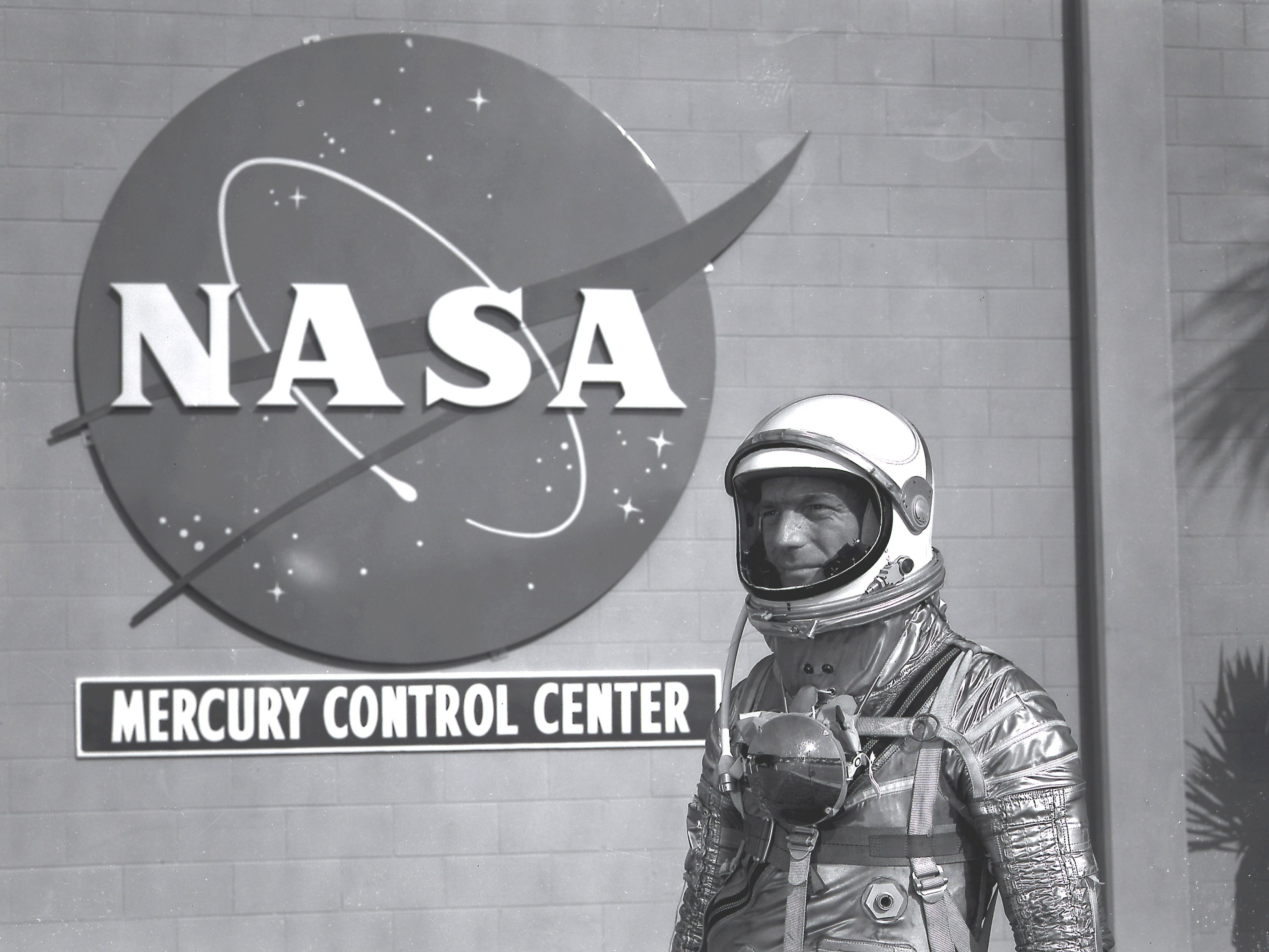
Sitting alone in silence, Scott Carpenter was enclosed in a cramped vessel, tumbling through space. His capsule, Aurora 7, was astonishingly hot. He did his due diligence in not letting this distract him as he released a tethered balloon from the spacecraft. Radio clatter and machinery surrounded him, as the earth spun beneath him at its steady 17,500 mph. It was then that he looked out the window and saw something that made him double take. A flurry of fireflies, luminous and bolder than the moon itself, drifting through the air outside his capsule.
Exactly 64 years ago today, Scott Carpenter became the fourth American to go to space, orbiting the earth thrice and performing several experiments. His journey came close to ending in tragedy in an unexpected landing, yet the flight still proved a historic success.
A Change of Plans
By March of 1962, America’s spirits were soaring as momentum picked up in their space programs. The USSR was no longer the only nation achieving ‘firsts’ in space exploration. NASA had several resounding victories in sending Alan Shepard and Gus Grissom to space. These flights were impressive, but were locked in suborbit. The next big sensation was the flight of John Glenn, who orbited the earth thrice aboard Friendship 7. It was here that Cold War patriotism concentrated within the Space Race particularly. American masses adored their space program, newspapers lauded astronauts as heroes, and schools stopped classes to watch coverage.
Riding on the ecstasy of consistent success, a new mission was planned: Mercury-Atlas 7. This mission would essentially be a repeat of the Friendship 7 flight: 3 orbits around Earth with the addition of new experiments to perform in the vessel.
The astronaut set to undergo the mission was Donald ‘Deke’ Slayton, a WW2 veteran selected for astronaut training. After being erratically spun in his centrifuge course, an electrocardiogram discovered an irregularity in his pulse. Upon further testing, doctors determined that Slayton had an issue with his heart called atrial fibrillation. This medically disqualified him from participating. NASA now had to choose someone to take Slayton’s place: his backup, Walter M. Schirra, or someone else.
Backup pilots for astronauts don’t go to space for their mission, but they train identically to the real pilot for seamless substitution if called upon. Oddly enough, the backup pilot for Slayton wasn’t the person to replace him. Instead, NASA picked the backup for John Glenn, a man who trained to excel in operating the systems that Mercury-Atlas 7 was modeled after: Scott Carpenter. He already possessed thorough knowledge of the MA-6 flight systems, trained directly for orbital procedures, and had spent more time at NASA altogether. Thus, Carpenter was chosen for the flight.
The capsule he would use bore the name Delta 7, awarded to it by Slayton. Once Carpenter replaced him, he took the liberty of changing the name to Aurora 7. The word ‘aurora’ had a special meaning for Carpenter. Aurora is a word for dawn, and that’s exactly how Carpenter saw his mission: as a light in the sky that represented the dawn of a new space age. The 7 was kept to honor the original Mercury Seven Astronauts. Interestingly enough, Carpenter grew up on Aurora Ave. and Seventh St. in Boulder, Colorado, however he admitted that this wasn’t a connection he made when naming the spacecraft.
A Small Delay
On May 24, 1962, Carpenter was ready to make his journey to the stars: he would become the sixth person in space, and the fourth American. It was a dark, sleepy morning in Florida when Carpenter entered the Mercury capsule at Cape Canaveral. The side of Carpenter’s temporary metallic home boasted an artistic portrayal of its name, a product of an artist named Cece Bibby. Bibby was already a veteran in the ordeal of capsule decoration, having previously designed the insignia for John Glenn’s spacecraft. This totem of beauty did not soothe every worry of NASA directors nor Carpenter. Despite being ready for takeoff, the flight was delayed by 45 minutes due to issues with the fog.
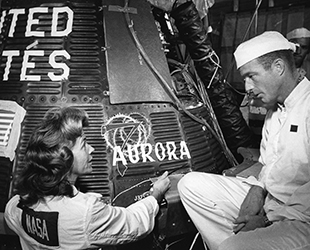
For those 45 minutes, Carpenter lay in the cramped capsule, the quiet of his thoughts interrupted briefly by the crackle of communications. The launch crews resolved the delay, which was not the sole factor worrying Carpenter. Atlas rockets had the grim reputation of failing, particularly in spectacular, curling explosions reaching far into the sky. Some astronauts joked that it was like riding a bomb.
Despite these gnawing doubts, the launch was excellent, sans one abnormality of a hydraulic switch for the sustainer engine, which did not interfere with proper functioning. At 7:45 a.m. EST, the rocket lifted into the air, pummeling towards orbit.
Scientific Directives Aboard Mercury-Atlas 7
Mercury-Atlas 7 wasn’t a carbon copy of John Glenn’s mission, varying in the experiments it performed on board. The spacecraft became a flying lab of scientific artifacts pertaining to many fields of science. Observation of liquid in space, determining visibility of ground flares, making meteorological photographs and releasing a multi-colored balloon tethered to the spacecraft were the experimental duties put upon Carpenter.
The liquid experiment was particularly significant to NASA’s long term goals. The agency was in the middle of developing a moon rocket, at the bowels of which a fuel tank used liquid oxygen and hydrogen to propel it upwards. This field was largely unstudied under the weightlessness of space. Thus, one check box on Carpenter’s list of experiments was observing how liquid behaved in microgravity. The experiment confirmed that the capsule encasing the liquid on board provided enough surface tension to stabilize it. This was a pleasant reassurance that spacecraft movement and acceleration don’t cause dangerous sloshing or unpredictable redistribution inside the tanks.
Another experiment Carpenter performed was with a balloon. Despite being quite a whimsical sight from the outside, it boasted a scientific purpose. The multi colored balloon was to be unleashed into space for the purpose of seeing which colors were most vivid to the naked eye. Such study of color is far from trivial. Docking and rendezvous operations depend on astronauts interpreting visual information from outside their vessels.
Though the balloon was overengineered to survive space, the experiment ended up failing. As the balloon swelled, it ripped and thrashed around the capsule erratically, tangling around itself in the process. Luckily, this failure wasn’t grave enough to render the experiment fruitless: scientists discovered that bright orange is extremely visible in orbit.
Aboard Mercury-Atlas 7
Carpenter remained in the capsule for 4 hours, 39 minutes, and 32 seconds. In this time, he achieved all of his experimental objectives. After finishing his experiments with liquids and balloons, Carpenter moved on to snapping pictures of earth. His lens captured the meteorological phenomena of our planet, as well as its terrestrial features. Neither did it miss the faint swell of light spanning Earth’s horizon. On moonless nights, observers on Earth can also catch a glimpse of our Earth’s slight luminescence, which is called the airglow. Carpenter’s observations and photographs of the layer led to the study of its physical characteristics, such as the length of the light and its brightness. We now know that the airglow layer is simply the natural light emitted by our atmosphere.
As the hours dragged on, Carpenter felt the heat of the capsule wear on him. The temperatures extended past 100 degrees Fahrenheit, with his candy bars melting in his hands. He did comment, however, that he was never extremely uncomfortable. The environmental control systems in the Mercury capsules were primitive at best, with no advanced climate regulation. This was coupled with the intermittent malfunction of the cooling system built into Carpenter’s suit. Instead of circulating air to remove heat, the system did nothing to prevent the thick layer of Carpenter’s equipment (gloves, pressure suit, helmet, communication gear, restraints, survival equipment, etc) from raising his temperature.
Moisture built up in Carpenter’s visor and fogged it, leaving him swiping at the droplets within the cramped capsule. Dehydrated and fatigued, Carpenter couldn’t even rely on the food brought along for the mission. His nutrition primarily consisted of ¾ inch solid nutrition cubes that had a special coating on them. The food was inadvertently crushed during spacecraft preparations on the launch pad, leaving Carpenter to struggle with getting the crumbs in his mouth. He reported that chewing and swallowing, however, was normal.
Despite the careful conduction of his experiments, Carpenter was rather loose with fuel usage. Once a spacecraft is in orbit, it’s coasting. There’s no need for fuel to propel it. When the yaw, pitch, and roll are irregular, the astronaut can manually use thrusters to expel bursts of hydrogen peroxide, which modify aim. Carpenter had to use such manual controls several times to correct orientation malfunctions. The most pressing issue at hand, however, was that the automatic system that determined whether or not the spacecraft was oriented properly was malfunctioning too.
Chris Kraft, the flight Director, was more and more alarmed at the quickly draining fuel. Carpenter, on the other hand, ripped off a bit of tape to cover the low fuel warning, ridding himself of distractions as he continued his experiments. His focus wasn’t directed at those for long either, as he was quickly drawn to an odd sight outside of his window.
Interstellar Fireflies
Peering into the abyss of space at sunrise, Carpenter saw something most peculiar. Tiny particles were wafting about the space outside the capsule, not quite stars but elegant crystals ensnaring his attention. He snapped photographs of the particles, finding that the little snowflakes were brighter than the moon they glittered next to. He devised his own experiment of rapping his hand against the screen to see how it affects their movement. The action disturbed the particles, which drifted away from the spacecraft.
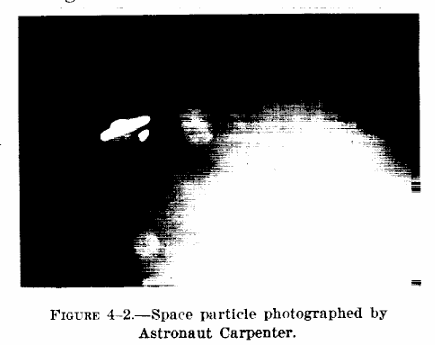
The odd phenomenon puzzled scientists. It wasn’t the first time the particles were spotted in space. They were first reported by John Glenn during his orbital mission, where he described bright luminous specks drifting around the spacecraft.
NASA scientists passed around several potential explanations. They considered the origin of the particles to stem from a dye or a fragment of fiberglass. After consulting Carpenter’s observations, they figured that the particles were born from the condensation that accumulated on exterior surfaces of the capsule. As the spacecraft was plunged into the icebath temperatures of space, the moisture was frozen. The luminous effect was caused due to the sun illuminating the particles after they cracked off the capsule.
A Brush With Death
After almost 5 hours in space, it was time to re-enter Earth’s atmosphere and head home. Carpenter began firing retrorockets to slow the spacecraft for re-entry, the thrum of the spacecraft mounting. But something was wrong. A resistance arose, and was interfering with a smooth journey back. This resistance came in the form of the automatic stabilization systems. Their job is to tilt and spin and adjust the spacecraft’s orientation to match the horizon. A malfunction within it led to a failed scan of the horizon, making the spacecraft behave erratically, moving around with no sense of up and down. As Carpenter hurriedly tried to fix alignment, he made an almost fatal blunder.
Pioneering in space was something I would willingly give my life for.
As Carpenter rushed to fix the orientation of the space ship, he left the automatic stabilization systems on. As they worked to fix the alignment, Carpenter was using even more fuel on a manual correction by firing thrusters himself. These simultaneous corrective actions (also called dual authority control) drained both fuel tanks at once. The fuel billowed out uselessly for 10 minutes, draining crucial reserves needed for re-entry. The hurried re-aiming ended up being 25 degrees off from the ideal orientation. Three seconds too late, Carpenter initiated retrofire, and began re-entry.
Aurora slammed into the upper atmosphere. The air in front of the capsule compressed so rapidly it drove temperatures outside the heatshield to thousands of degrees. The breath was stuck in Carpenter’s throat as 7-8 g’s of force made him lurch in his seat and feel about 8 times heavier than normal.
The capsule ripped through the sky towards the Atlantic Ocean, shaking and rattling as a parachute deployed to cushion the drop. At 12:41 pm, the spacecraft plopped into the ocean near Anegada Island in the Caribbean, 250 miles off course.
Carpenter was dazed. He just survived what would have been a death drop had he had even a little less fuel in his automatic systems. Collecting himself, he realized he only had seconds to adjust to stillness upon hearing the gentle trickle of water into the capsule. The harsh landing led to the spacecraft tilting about 45 degrees, leading to its slow flooding. As the capsule bobbed unevenly in the ocean, America scrambled to locate where it landed, unsure of his status.
While thousands watch and pray, certainly here at Cape Canaveral, the silence is almost intolerable. We may have lost our astronaut.
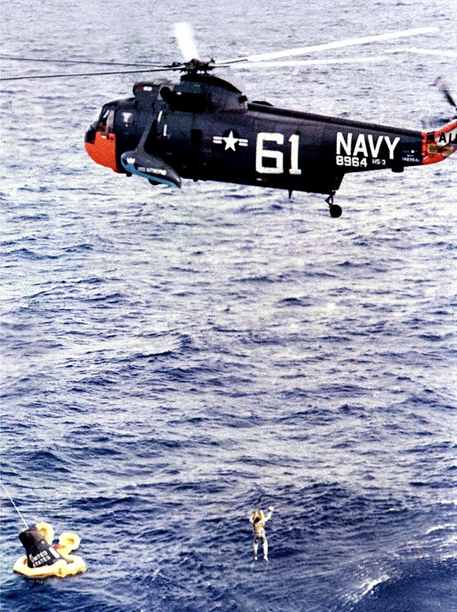
The recovery teams were actively updated on Carpenter’s position and stages of the flight as he landed. They had to completely recalculate his position based on the new route taken. A group of Air Rescue Service Aircraft with a pararescue team were dispatched from Puerto Rico as a precautionary measure. Despite having his general location, combing through the waters for a tiny spacecraft took time, and it would be another 39 minutes before Carpenter’s capsule was spotted.
Maintaining a calm demeanor throughout the ordeal, Carpenter took this time to climb out of the hatch and onto the top of the capsule. He proceeded to abandon the capsule in favor of a life raft. The raft floated in the Atlantic ocean for an hour before Carpenter was picked up. He was lifted on a helicopter and flown back to a carrier. The capsule was abandoned in the ocean as it slowly filled with seawater, being retrieved much later on.
Success and Reprimand
The Mercury-Atlas 7 mission is often overlooked for not having grandiose discoveries; yet there’s something undeniably breathtaking about all the little breakthroughs made on board (as well as the dramatic finish). The discovery of the ‘fireflies’ or ice crystals led to later programs investing in better venting and insulation systems. The experiments performed on board shaped future technologies that revolved around liquid fuel. Even menial things, like what color is brightest in space, are monumental discoveries when you consider their impact in future rendezvous maneuvers.
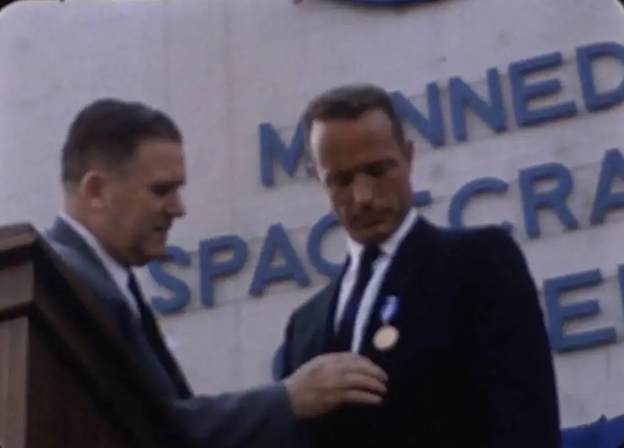
And of course, the most historically flashy part of the ordeal: the landing. The end of Carpenter’s spaceflight harbored significantly different reactions from the public and NASA. Carpenter was praised as a hero as he stepped back on solid ground, being another symbol of Cold War prestige and American victory. He made appearances on broadcasts and magazine covers. However, in NASA, the flight triggered a shift in astronaut culture entirely.
How much of the fuel waste historians pin on Carpenter versus the malfunctioning alignment mechanism is a contested topic. In the immediate aftermath of the flight, however, the blunder was blamed on the astronaut directly. The unserious treatment of fuel throughout the journey told higher ups that the program needed more discipline, not just for managing fuel, but for exploration in general.
Improvising observations and interacting with space lightheartedly was quickly replaced with strict timelines, procedural precision, and fuel conservation. This shift in attitude was reflected in the very next spaceflight by Walter Schirra aboard Sigma 7. The mission was extremely conservative, its primary focus being engineering efficiency. Landing with large reserves of fuel remaining led to a positive reaction from NASA, and an emphasis of replicating such practices on future flights.
More than anything, this flight is a testament that astronauts are not calculating mechs conducting experiments. They, too, eat candy bars. They, too, tap at the window upon seeing something odd. They, too, make mistakes. The pioneers of the cosmic frontier are just as human as the rest of us as they teeter the edge of human knowledge.
References(6)
- Mercury-Atlas 7 (Aurora 7) - NASA
- Pretty Good Oscillations: Remembering Aurora 7, 60 Years On (Part 2) - AmericaSpace, May 2022
- Tired of Apologising: The Flight of Aurora 7 - AmericaSpace, May 2012
- Mercury-Atlas 7 - Science Dog, March 2019
- Mercury Astronaut Scott Carpenter and the Controversy Surrounding Aurora 7 - Popular Science, Vintage Space
- Why Do Aircraft Have an Unusable Amount of Fuel? - Airplane Academy

Mariana Mokhova