· x report · 3 min read
SpaceX Targets 600th Falcon Booster Landing on Starlink 17-22 | KeepTrack X Report
SpaceX attempts its 600th Falcon 9 booster landing during the Starlink 17-22 mission, adding 25 satellites from Vandenberg SFB.

Latest Developments
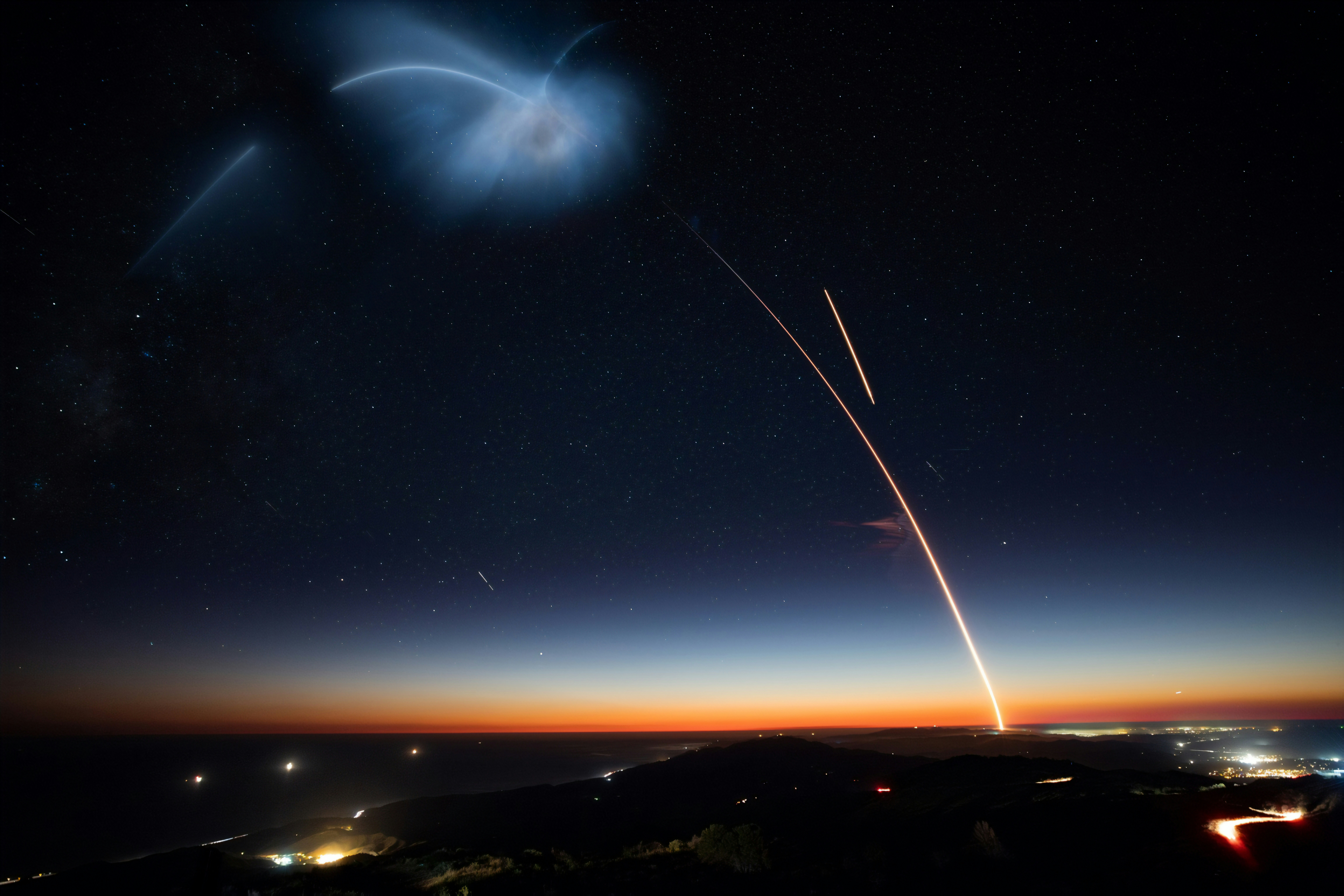
SpaceX is targeting a landmark 600th Falcon booster landing attempt today during the Starlink 17-22 mission, lifting off from Pad 4E at Vandenberg Space Force Base at 7:33:40 a.m. PDT. The flight will deliver 25 new Starlink broadband satellites to low Earth orbit, continuing the steady drumbeat of constellation expansion that has pushed the network to 11,828 satellites launched, 10,258 currently in orbit, and 10,242 actively operational. The 600-landing milestone underscores the degree to which rapid booster reusability has become the backbone of Starlink’s deployment cadence, enabling SpaceX to sustain a launch rate that no other operator can match. Tracking data from the newly inserted batch will be closely watched as the 25 satellites complete orbit-raising maneuvers and slot into the broader Shell 17 plane structure.
Space Safety
The current Starlink conjunction environment presents a moderate overall risk profile with four MODERATE-risk events identified in the April 2026 timeframe, though none have reached HIGH-risk classification. The highest-concern conjunction involves STARLINK-33563 with COSMOS 2251 DEB on Apr 13, 2026 at a maximum collision probability of 0.3973 and minimum range of 12 meters, followed by STARLINK-5601 approaching DELTA 1 DEB with a 0.3479 probability. In parallel, four Starlink satellites are predicted to reenter Earth’s atmosphere between Apr 18-21, 2026, with decay windows ranging from 1,440 to 2,880 minutes, representing routine end-of-life disposal operations with no high-interest flagging.
| Risk | Starlink Sat | Other Object | Status | Min Range (km) | Rel Speed (km/s) | Max Prob | Time of Closest Approach |
|---|---|---|---|---|---|---|---|
| MODERATE | STARLINK-33563 | COSMOS 2251 DEB | Non-operational | 0.012 | 11.318 | 0.3973 | Apr 13, 21:44 UTC |
| MODERATE | STARLINK-5601 | DELTA 1 DEB | Non-operational | 0.014 | 8.499 | 0.3479 | Apr 11, 06:26 UTC |
| MODERATE | STARLINK-33680 | FLOCK 4G-17 | Operational | 0.024 | 12.627 | 0.1287 | Apr 9, 13:55 UTC |
| MODERATE | STARLINK-35339 | THEA | Operational | 0.022 | 14.11 | 0.1272 | Apr 11, 01:33 UTC |
| LOW | STARLINK-32841 | YAOGAN-43 01D | Operational | 0.038 | 9.497 | 0.0672 | Apr 11, 14:30 UTC |
| LOW | STARLINK-36431 | WT 1B | Unknown | 0.052 | 1.153 | 0.04499 | Apr 14, 13:45 UTC |
| LOW | STARLINK-32376 | OBJECT AD | Operational | 0.046 | 11.243 | 0.04409 | Apr 12, 08:38 UTC |
| LOW | STARLINK-30245 | SL-19 R/B | Non-operational | 0.037 | 14.371 | 0.04406 | Apr 7, 16:55 UTC |
| LOW | STARLINK-35657 | ION SCV-008 | Operational | 0.041 | 13.969 | 0.03903 | Apr 12, 19:09 UTC |
| LOW | STARLINK-31383 | TEVEL2-7 | Operational | 0.038 | 14.746 | 0.03837 | Apr 8, 19:55 UTC |
| Satellite | NORAD ID | Predicted Decay | Window (min) | Inclination | Lat | Lon |
|---|---|---|---|---|---|---|
| STARLINK-4465 | 53496 | Apr 18, 23:39 UTC | 1440 | 97.6° | -41.3° | 67.3° |
| STARLINK-1894 | 46744 | Apr 19, 21:45 UTC | 1440 | 53.0° | 43.3° | 297.8° |
| STARLINK-1965 | 47566 | Apr 20, 16:05 UTC | 1440 | 53.0° | -53.1° | 244.0° |
| STARLINK-1612 | 46164 | Apr 21, 09:38 UTC | 2880 | 53.0° | -50.7° | 292.9° |
Detailed Coverage
SpaceX Chases 600th Falcon Booster Landing on West Coast Starlink Run
SpaceX’s Starlink 17-22 mission represents more than a routine constellation replenishment flight — it marks the attempt at the 600th successful recovery of a Falcon 9 or Falcon Heavy first stage, a figure that would have seemed extraordinary when the company first landed a booster back in December 2015. Liftoff from Vandenberg’s Pad 4E is scheduled for 10:33:40 UTC, with the booster targeting a drone ship landing in the Pacific Ocean downrange of the launch site.
The 25 Starlink satellites aboard are destined for Shell 17, SpaceX’s higher-inclination orbital shell that prioritizes coverage across mid-to-high latitude regions including much of North America, Europe, and the northern Pacific. Once the batch completes autonomous orbit-raising over the coming days, ground-based trackers and platforms like KeepTrack will be able to resolve the individual objects as they spread across their designated plane. Successful recovery of the booster would mean SpaceX has now reflown a first stage more than 600 times cumulatively — a reusability record unmatched in spaceflight history.
Read the full story: Spaceflight Now
Constellation Status
The Starlink constellation remained stable since the last check, with no new launches or orbital changes recorded. As of April 16, 2026, SpaceX maintains 11,828 total satellites launched, of which 10,258 remain in orbit and 10,242 are operational, while 1,570 have decayed from their orbits.
- Total Launched: 11828
- Total On Orbit: 10258
- Total Working: 10242
Track Starlink satellites in real-time: Track Starlink

B1049