· x report · 8 min read
SpaceX Wins $4.16B Space Force Missile-Tracking Deal | KeepTrack X Report
SpaceX secures a $4.16B Space Force contract for airborne-threat tracking satellites while targeting its 200th OCISLY drone ship landing.

Latest Developments
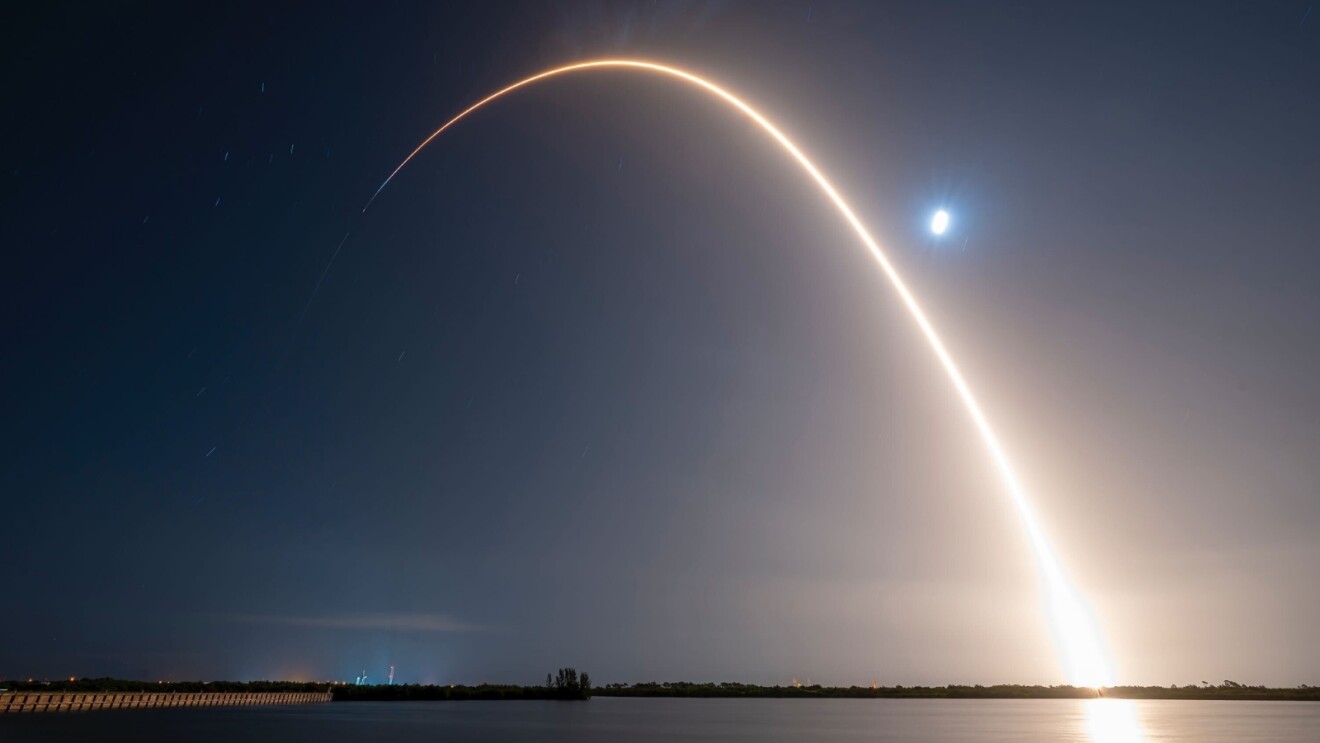
SpaceX is dominating both the military and commercial space landscape this week, having secured a $4.16 billion Space Force contract to deploy satellites capable of tracking airborne threats anywhere on Earth — the largest single defense award in the company’s recent history. On the launch front, SpaceX is executing a dual-pad operation today, with 24 Starlink satellites lifting off from Vandenberg and 29 more from Cape Canaveral, the latter mission targeting a milestone 200th landing aboard drone ship Of Course I Still Love You. With 10,505 Starlink satellites currently in orbit and 10,489 confirmed operational out of 12,138 launched to date, the constellation continues its relentless expansion. Meanwhile, SpaceX’s amended S-1 IPO filing is generating significant financial market turbulence, briefly pulling Tesla shares down 5% amid fresh speculation about a possible merger.
Space Safety
The current Starlink conjunction threat picture shows seven moderate-risk events concentrated over a 72-hour window from June 2-6, 2026, with no HIGH risk conjunctions currently assessed. The most critical event involves STARLINK-6258 and STARLINK-30487 on Jun 6 at 06:40 UTC with a maximum collision probability of 0.42 and minimum range of 22 meters, though both are Starlink assets with known orbital characteristics. Concurrently, four Starlink satellites are predicted for reentry within the same six-day period, with STARLINK-3729 presenting the widest decay window of 48 hours and STARLINK-1993 exhibiting a full 24-hour uncertainty band centered on Jun 5.
| Risk | Starlink Sat | Other Object | Status | Min Range (km) | Rel Speed (km/s) | Max Prob | Time of Closest Approach |
|---|---|---|---|---|---|---|---|
| MODERATE | STARLINK-6258 | STARLINK-30487 | Partially Operational | 0.022 | 9.82 | 0.4184 | Jun 6, 06:40 UTC |
| MODERATE | STARLINK-33999 | LEMUR-2-FURIAUS | Operational | 0.013 | 8.137 | 0.3838 | Jun 6, 09:26 UTC |
| MODERATE | STARLINK-1168 | STARLINK-35164 | Operational | 0.026 | 1.383 | 0.3482 | Jun 6, 04:56 UTC |
| MODERATE | STARLINK-3352 | STARLINK-32700 | Operational | 0.033 | 10.43 | 0.2275 | Jun 3, 02:07 UTC |
| MODERATE | STARLINK-3124 | CZ-4B DEB | Non-operational | 0.028 | 6.004 | 0.127 | Jun 3, 17:10 UTC |
| MODERATE | STARLINK-31972 | IRIS-F3 | Operational | 0.029 | 7.854 | 0.1181 | Jun 4, 09:53 UTC |
| MODERATE | STARLINK-35328 | CZ-6A R/B | Non-operational | 0.021 | 14.86 | 0.1181 | Jun 4, 19:04 UTC |
| LOW | STARLINK-34172 | OBJECT C | Operational | 0.024 | 14.721 | 0.09041 | Jun 5, 05:35 UTC |
| LOW | STARLINK-31808 | SL-4 DEB | Non-operational | 0.030 | 12.955 | 0.08134 | Jun 2, 12:01 UTC |
| LOW | STARLINK-37441 | HAWK-13C | Operational | 0.040 | 2.006 | 0.07178 | Jun 3, 15:23 UTC |
| Satellite | NORAD ID | Predicted Decay | Window (min) | Inclination | Lat | Lon |
|---|---|---|---|---|---|---|
| STARLINK-3255 | 50201 | Jun 3, 07:54 UTC | 60 | 53.2° | -38.9° | 17.8° |
| STARLINK-5384 | 54836 | Jun 3, 21:51 UTC | 240 | 43° | 42.6° | 213.3° |
| STARLINK-1993 | 47588 | Jun 5, 08:53 UTC | 1440 | 53° | 52.4° | 333° |
| STARLINK-3729 | 52135 | Jun 5, 15:02 UTC | 2880 | 53.2° | 28° | 53.1° |
Detailed Coverage
SpaceX Bags $4.16 Billion Space Force Deal to Track Airborne Threats From Orbit
The U.S. Space Force has awarded SpaceX a landmark $4.16 billion contract to develop and operate a constellation of satellites designed to detect and track airborne threats — including hypersonic missiles and advanced aircraft — anywhere on the globe. The contract underscores the Pentagon’s accelerating push to move fire-control and surveillance functions into low Earth orbit, where SpaceX’s manufacturing scale and rapid deployment cadence give it a structural advantage over traditional defense primes.
The award cements SpaceX’s transformation from a launch services provider into a full-spectrum defense space company. Satellite trackers and analysts will be watching closely to see how these new national security payloads are registered and maneuvered, given the operational sensitivity likely to surround their orbital parameters and ground contacts.
Read the full story: Space.com
Falcon 9 Eyes Historic 200th OCISLY Landing in Back-to-Back Starlink Missions Today
SpaceX is running parallel countdowns this morning, with the Starlink 10-43 mission targeting a 6:11 a.m. EDT liftoff from Cape Canaveral’s SLC-40, followed by the Starlink 17-47 mission departing Vandenberg’s SLC-4E at 7:36 a.m. PDT. The Vandenberg booster’s recovery attempt would mark the 200th successful landing aboard drone ship Of Course I Still Love You — a milestone that would have seemed implausible a decade ago. Together the two missions would loft 53 additional Starlink satellites, continuing the cadence needed to sustain constellation density and on-orbit sparing margins.
The back-to-back nature of today’s launches exemplifies the operational tempo SpaceX has reached with Falcon 9, and the simultaneous use of both coasts highlights how the company has diversified launch infrastructure to avoid single-point bottlenecks. Tracking services will be busy cataloguing the new objects as they raise their orbits and slot into assigned planes over the coming days.
Read the full story: Spaceflight Now – Vandenberg | Spaceflight Now – Cape Canaveral
SpaceX S-1 Amendment Triggers Tesla Sell-Off and Merger Speculation
A single clause buried in SpaceX’s amended S-1 IPO filing sent Tesla shares tumbling roughly 5% in a single trading session, igniting widespread debate about whether Elon Musk might engineer some form of combination between the two companies post-IPO. Analysts are divided: some read the language as standard disclosure boilerplate, while others argue it signals a deliberate effort to give SpaceX shareholders a pathway to Tesla equity — or vice versa. The episode has amplified scrutiny over Musk’s cross-company financial entanglements at precisely the moment SpaceX is seeking public market validation.
The IPO itself, if completed at expected valuations, would rank among the largest U.S. public offerings in years and would formally separate Starlink’s commercial balance sheet from SpaceX’s launch business — a distinction investors and regulators have long sought clarity on. How the company ultimately structures its post-IPO capital allocation between Starlink infrastructure, Falcon 9 production, and Starship development will define its growth story for the next decade.
Read the full story: Teslarati
After the IPO: Will SpaceX Remain a Launch Company?
SpaceX’s approaching public offering is prompting a fundamental question the industry hasn’t had to ask before: once Starlink revenue dwarfs launch revenue, does the Falcon 9 business become a strategic liability or a crown jewel? Analysts note that Starlink already generates the majority of SpaceX’s cash flow, suggesting that launch — despite its prestige — may increasingly serve as a cost center enabling constellation replenishment rather than a standalone profit engine. The IPO prospectus will force SpaceX to publish segment-level financials for the first time, giving rivals and customers an unprecedented window into the economics of reusable rocketry.
The piece also raises the longer-term question of what role Starship plays in the company’s identity post-IPO. If Starship becomes the primary heavy-lift vehicle for both government and commercial customers, Falcon 9 and Falcon Heavy face an eventual sunset — and SpaceX would need to manage that transition without disrupting the manifest commitments that currently underpin its revenue.
Read the full story: Space.com
China’s Long March 12B Debuts With No Airspace Warning — A Transparency Red Flag
China launched the first-ever flight of its Long March 12B rocket on June 1 without issuing the standard airspace closure notices that spacefaring nations typically file in advance. The rocket, which bears a strong external resemblance to SpaceX’s Falcon 9 and features partial reusability, successfully completed its debut mission — but the absence of pre-launch notifications alarmed aviation safety officials and space situational awareness analysts who rely on those notices to deconflict airspace and prepare tracking assets.
The Long March 12B is designed to compete directly with Falcon 9 in the medium-lift market, and its unannounced launch hints at a posture in which China prioritizes operational surprise over international transparency norms. For the global SSA community, the episode underscores the growing challenge of tracking a launch cadence that may deliberately obscure its own timeline.
Read the full story: Space.com
Impulse Space Raises $500 Million to Build Fleet of Ultra-Mobile Orbital Tugs
Impulse Space — founded by Tom Mueller, the engineer who designed SpaceX’s Merlin engine and was the company’s first-ever employee — has closed a $500 million funding round to accelerate development of its Mach spacecraft, a highly maneuverable orbital transfer vehicle capable of delivering payloads across a wide range of orbital regimes on short notice. The investment reflects surging demand for last-mile delivery in space, particularly from defense customers who need to reposition assets rapidly without waiting for a dedicated launch. Impulse’s vehicles could also play a meaningful role in debris remediation and on-orbit servicing as LEO congestion intensifies.
Mueller’s pedigree gives Impulse credibility with both institutional investors and technical talent, and the $500 million raise positions the company to scale production well beyond its initial prototype fleet. With Starlink’s 10,505-satellite constellation already redefining what LEO population density looks like, services that help payloads navigate a more complex orbital environment are becoming structurally valuable.
Read the full story: Space.com
Weekly Launch Preview: SpaceX and Chinese Megaconstellations Vie for LEO Bandwidth
This week’s launch manifest is headlined by SpaceX’s dual Starlink missions — detailed above — alongside Chinese commercial operators pressing their own broadband ambitions into low Earth orbit. NASASpaceFlight’s preview counts six missions across five vehicles, a tempo that reflects how thoroughly megaconstellation replenishment has come to dominate the global manifest. The density of overlapping launches from multiple nations is itself becoming a space situational awareness challenge, as tracking networks must simultaneously catalogue new objects from providers with varying levels of orbital data transparency.
For SpaceX specifically, the week’s missions keep the Falcon 9 fleet operating at a pace designed to sustain Starlink’s service quality while also fulfilling commercial and government rideshare commitments. With Starship still maturing, Falcon 9 remains the indispensable workhorse — and each additional launch adds to a reliability record that now underpins a global communications network serving millions of users.
Read the full story: NASASpaceFlight
Constellation Status
No changes have occurred in the Starlink constellation since the last check. The constellation maintains its current totals of 12,138 satellites launched, with 10,505 currently in orbit, 10,489 operational, and 1,633 that have decayed from orbit.
- Total Launched: 12138
- Total On Orbit: 10505
- Total Working: 10489
Track Starlink satellites in real-time: Track Starlink

B1049