· deep dive · 11 min read
The Satellites the Size of a Studio Apartment
AST SpaceMobile's BlueBird constellation is a bet that raw aperture size wins. Each satellite unfolds a 64-square-meter phased-array antenna in orbit, the largest commercial antenna ever deployed. The company claims a stock smartphone on the ground can connect directly to it. The competition says the physics doesn't support that. Seventeen satellites in and a contract with AT&T, Verizon, and Vodafone, somebody's math is wrong.
The engineering challenge can be stated in one sentence: a smartphone has a thumb-sized antenna and transmits around 200 milliwatts. A cell tower typically sits two to five kilometers away. AST SpaceMobile wants the satellite in geostationary-equivalent reception geometry - more than 500 kilometers away, which is two to three orders of magnitude further than any phone was ever designed to talk to. That puts a noise-floor link budget problem into the realm where theoretical physicists start disagreeing about whether it is solvable at all.
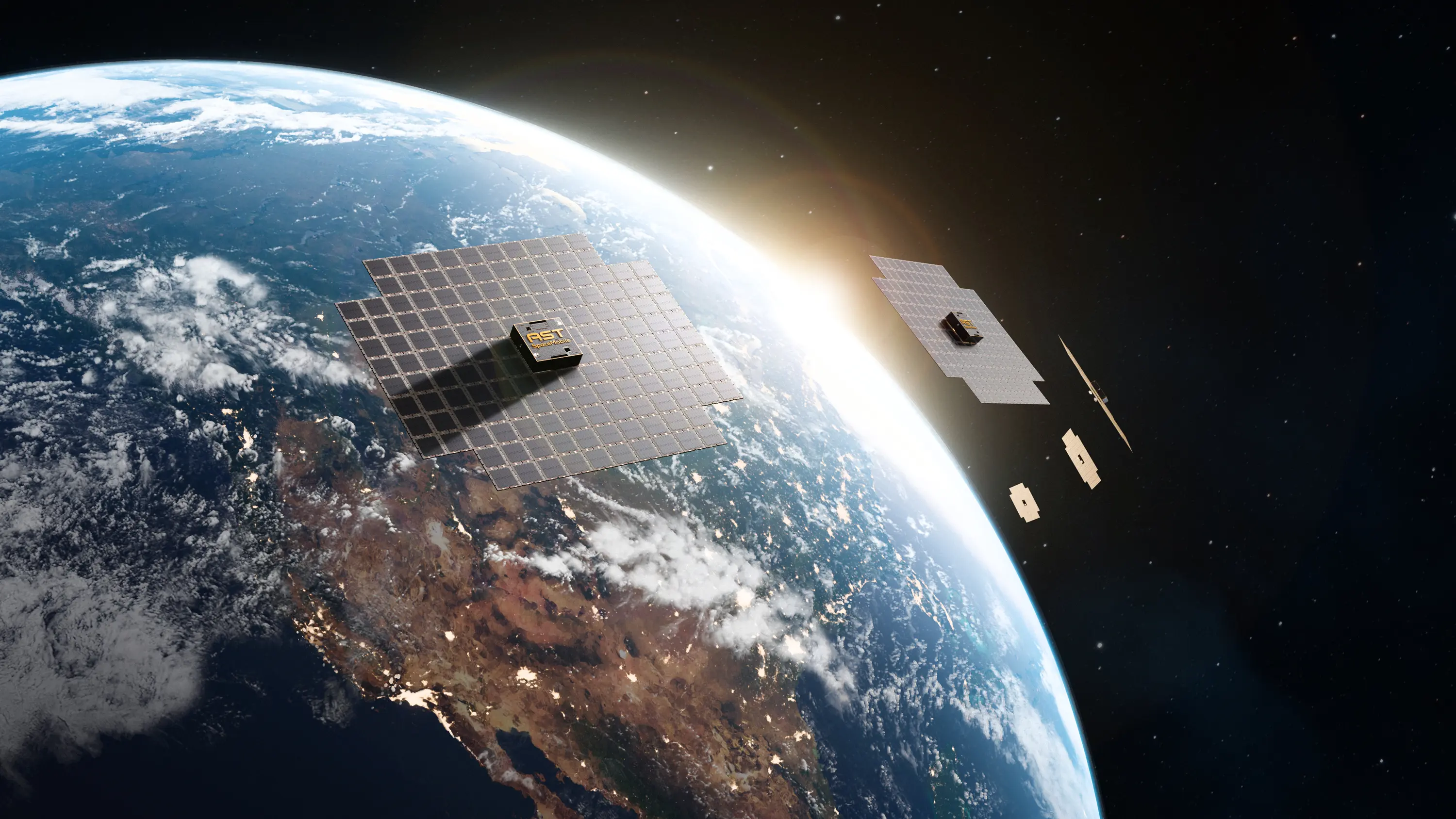
AST SpaceMobile’s answer is not to make the phone stronger. It is to make the satellite absurdly good at listening. BlueBird satellites are the largest commercial communications arrays ever flown in space, each carrying a 64-square-meter phased-array antenna that unfolds from a stowed volume roughly the size of a phone booth into a flat panel the size of a studio apartment. Seventeen BlueBird satellites are on orbit as of April 2026, with a full initial constellation of 95 satellites planned to reach service by 2028. Production contracts have been signed with AT&T, Verizon, Rogers, Vodafone, Telefonica, and approximately forty other mobile network operators worldwide.
64 m²
BlueBird antenna aperture
Each BlueBird deploys the largest commercial phased array ever flown. For comparison, the International Space Station's main solar arrays are 18 meters wide and were an engineering milestone when deployed in 2000.
That last statistic should stop anyone who understands spacecraft design. A 64-square-meter antenna array that unfolds in orbit is not an incremental improvement on existing satellite communications architectures. It is a fundamentally different category of spacecraft, built around assumptions that most of the industry has quietly regarded as impractical. If AST’s engineering actually works, the satellite telecom business changes permanently. If it doesn’t, one of the decade’s most heavily funded space companies becomes a cautionary tale.
How the Physics Got Here
Every satellite communications link is constrained by the Shannon-Hartley theorem, which sets a mathematical upper bound on data throughput as a function of bandwidth, signal power at the receiver, and noise floor. For a direct-to-phone link, the bandwidth is limited by terrestrial cellular spectrum allocations (typically 5-20 MHz per channel), the signal power is limited by the phone’s transmitter, and the noise floor is set by atmospheric and cosmic background plus the receiver electronics.
That leaves two levers for boosting throughput: antenna gain on the satellite end and link duration. Antenna gain scales with antenna area. A 64-square-meter phased array has roughly 2,000 times the effective aperture of a typical Ka-band broadband satellite antenna. That translates to approximately 33 dB more antenna gain in one direction, which is enough to close a link budget that conventional satellite antennas cannot.
The other lever is frequency. AST SpaceMobile operates in cellular bands between 700 and 2,700 MHz - the same bands used by terrestrial 4G LTE and 5G networks. These low frequencies have wavelengths of 10-40 centimeters, which propagate through the atmosphere with much lower attenuation than Ka-band. Rain does not affect an 850 MHz signal the way it affects a 20 GHz signal. Neither does water vapor, clouds, or building walls.
Together these two design choices - enormous aperture and low frequency - push the satellite link budget into a regime where a stock smartphone with no antenna modification and no external device can, under the right geometry, connect to a satellite passing overhead. That is the entire thesis of AST SpaceMobile.
The BlueWalker 3 Lesson
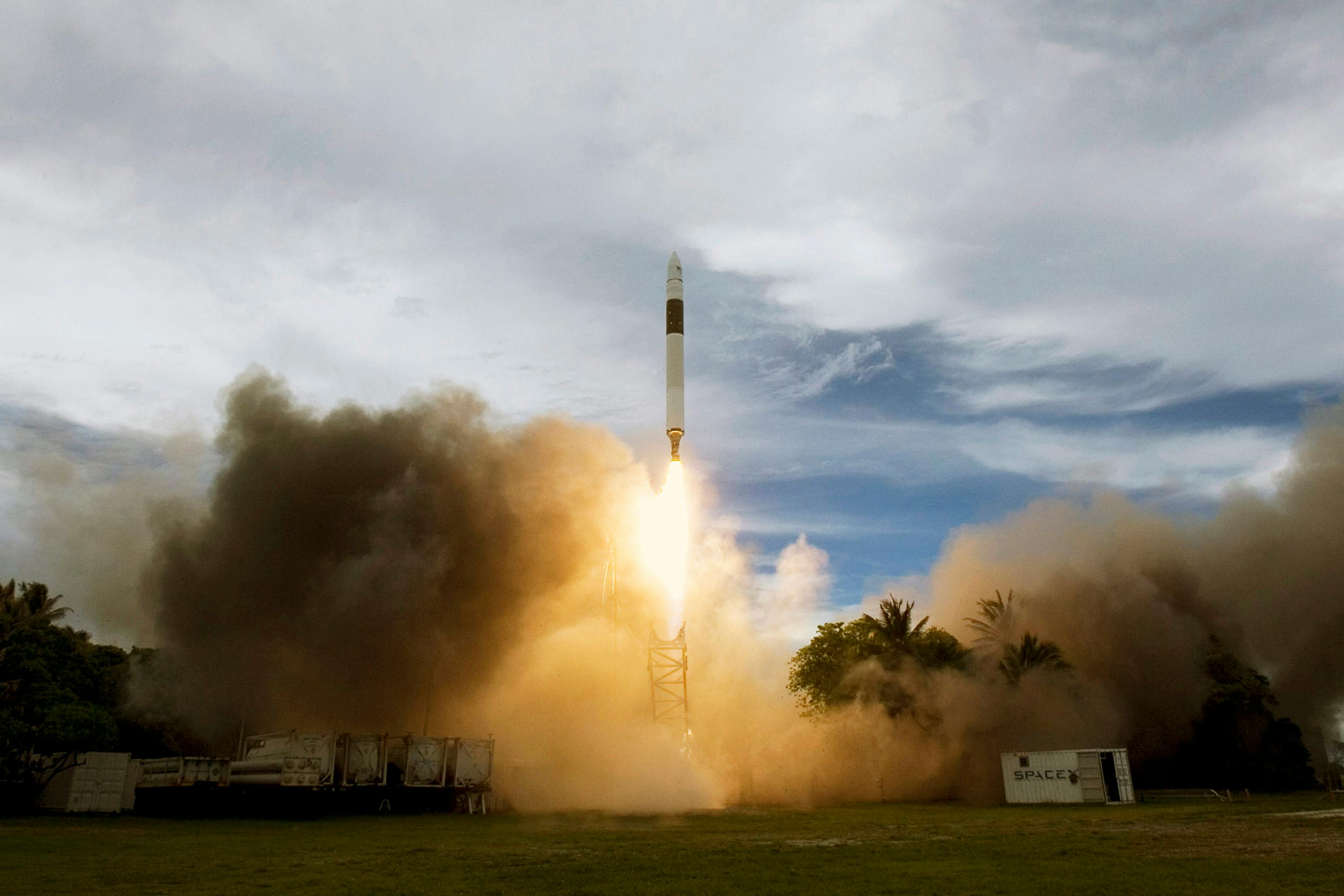
AST SpaceMobile tested the approach before committing to production with a single demonstrator: BlueWalker 3, launched on a SpaceX Falcon 9 on September 10, 2022. BlueWalker 3 had a 64-square-meter antenna, a bus designed to hold that aperture rigid in space, and the first complete instrumentation of a cellular-frequency spaceborne array.
BlueWalker 3 launch
First-generation cellular-band satellite antenna deployed on SpaceX Falcon 9. Pre-deployment volume was 2.6 m³; deployed area was 64 m².
First full deployment
BlueWalker 3's 64 m² phased array fully unfurled in orbit. Initial deployment had a brief snag that required a controlled re-engagement.
First voice call via BlueWalker 3
AT&T and Samsung Galaxy phone in Midland, Texas connects to BlueWalker 3 via direct-to-cell link. Call quality described as 'LTE-grade.'
First 4G data demonstration
AT&T phone achieves 10 Mbps downlink over BlueWalker 3 during controlled test, proving direct-to-device broadband feasibility.
First five BlueBird satellites launched
SpaceX Falcon 9 delivers initial production BlueBirds. Each uses improved 64 m² array with commercial hardware.
Full direct-to-cell commercial service trial
AT&T begins limited commercial service to subscribers in Texas and New Mexico using BlueBird constellation.
Seventeenth BlueBird in orbit
Constellation reaches threshold for continental U.S. coverage during peak demand windows.
The BlueWalker 3 test program delivered the crucial data: a standard 5G-capable smartphone, with no modification, could establish a voice call and LTE data session with a satellite in low Earth orbit. The quality was not perfect. Speeds were inconsistent, handoffs between satellites had to be engineered carefully, and the orbit-design effort required to keep satellites overhead was non-trivial. But the signal flowed.
BlueWalker 3 also demonstrated one of the most controversial aspects of the program. The 64-square-meter flat surface, when oriented to reflect sunlight toward Earth, made BlueWalker 3 one of the brightest artificial objects in the sky - briefly outshining stars and rivaling the International Space Station in brightness. Astronomers raised serious concerns. AST SpaceMobile engaged with the astronomy community and implemented orientation strategies to minimize reflection, but the fundamental issue - a large flat antenna is always going to be a bright object under the right geometry - has not been solved.
BlueBird Production Hardware
Each production BlueBird satellite carries a refined version of BlueWalker 3’s architecture. The basic parameters of the spacecraft are:
The first-generation BlueBird is a deployable antenna array mounted on a bus derived from the NanoAvionics M12P platform, with AST-developed phased-array electronics. Production has been distributed across the U.S. (Midland, Texas), the Middle East (Saudi Arabia, partnered with Taqnia Space), and Europe (United Kingdom, partnered with Bittium). The company has publicly stated that its goal is to produce a BlueBird every month by the end of 2026 and two per month by 2028.
The Block 2 generation, first launched in late 2026, will increase the antenna area to 220 square meters and add proprietary AST silicon designed for cellular-band phased-array control. Block 2 will reportedly enable 5G-grade data rates (hundreds of megabits per second) rather than 4G-grade, and will require launches on Falcon 9 Heavy or a similar super-heavy vehicle.
The Competitive Landscape
AST SpaceMobile is not the only company chasing direct-to-phone satellite service. The market has three main players, each with a different architecture.
Direct-to-device satellite architectures
| AST SpaceMobile BlueBird | SpaceX Starlink D2C | Iridium + Lynk Global | |
|---|---|---|---|
| Architecture | Giant LEO antenna | Smaller LEO antennas, lots of satellites | Smaller LEO (Lynk) plus Iridium backbone |
| Aperture | 64 m² Gen 1, 220 m² Gen 2 | Unpublished (smaller than BlueBird) | Classical satellite antennas |
| Bands | 700-2700 MHz (terrestrial cellular) | T-Mobile cellular (1900 MHz) | Licensed cellular + Iridium L-band |
| Service type | 4G voice/data, 5G roadmap | Text messaging initially, voice planned | Texting, limited voice |
| Constellation size | 95 initial + 168 Gen 2 | 500+ D2C-equipped Starlinks | 70 Lynk satellites |
| Partner model | Existing mobile network operators | T-Mobile partnership (US) | Major operator partnerships |
- Architecture
- Giant LEO antenna
- Aperture
- 64 m² Gen 1, 220 m² Gen 2
- Bands
- 700-2700 MHz (terrestrial cellular)
- Service type
- 4G voice/data, 5G roadmap
- Constellation size
- 95 initial + 168 Gen 2
- Partner model
- Existing mobile network operators
- Architecture
- Smaller LEO antennas, lots of satellites
- Aperture
- Unpublished (smaller than BlueBird)
- Bands
- T-Mobile cellular (1900 MHz)
- Service type
- Text messaging initially, voice planned
- Constellation size
- 500+ D2C-equipped Starlinks
- Partner model
- T-Mobile partnership (US)
- Architecture
- Smaller LEO (Lynk) plus Iridium backbone
- Aperture
- Classical satellite antennas
- Bands
- Licensed cellular + Iridium L-band
- Service type
- Texting, limited voice
- Constellation size
- 70 Lynk satellites
- Partner model
- Major operator partnerships
The core disagreement between AST and its competitors is whether the aperture size matters more than the satellite count. SpaceX has chosen to deploy more satellites with smaller antennas, arguing that the revisit rate advantage of the Starlink constellation (thousands of satellites) offsets the smaller per-satellite link budget. AST has chosen fewer satellites with enormous antennas, arguing that the per-bird link capacity is what matters most for connecting a standard smartphone.
The test will play out in the commercial market over 2026-2028. Starlink Direct to Cell began commercial text messaging in early 2024 and added voice capability in mid-2025. AST BlueBird began commercial trials in mid-2025. Lynk Global has been operating with limited commercial service since 2024. Each architecture has demonstrated it can work. Whether any of them can scale to a business that supports a meaningful consumer service at affordable pricing is not yet clear.
The Astronomy Problem
The most serious non-commercial issue facing the BlueBird program is brightness. When BlueBird satellites pass overhead under sun-illuminated conditions, they can reach visual magnitudes of approximately 0 to -2, roughly as bright as the planet Jupiter at its brightest. In the early evening or morning twilight hours - the same windows when astronomers do most optical observing - BlueBirds form streaks across long-exposure images that permanently destroy the data in affected pixels.
The International Astronomical Union, working with Vera C. Rubin Observatory and other major ground-based astronomy programs, has published formal analysis papers documenting the BlueWalker 3 and BlueBird brightness problem. The consensus position is that the BlueBird constellation, at its planned full size of 263 satellites, would measurably degrade ground-based astronomy through the 2030s and 2040s.
AST has committed to orientation strategies that reduce brightness during observable hours (keeping the large face of the antenna pointed away from the Sun), installation of optical dampening coatings on external surfaces, and coordination with observatories about orbital parameters. These mitigations have reduced the worst-case brightness by roughly 1-2 magnitudes, but the fundamental geometry of a 64-square-meter flat panel in low Earth orbit remains a structural problem.
The Regulatory Piece
AST SpaceMobile’s business depends on regulatory permission from the FCC (for U.S. operations), Ofcom (UK), and the telecommunications regulators of every other country where it wants to provide service. The key regulatory argument is whether a direct-to-phone satellite service should be treated as a terrestrial mobile service (using terrestrial cellular spectrum allocations) or as a satellite service (with its own, separate allocations).
AT&T and Verizon have argued to the FCC that direct-to-phone services should be permitted to reuse their existing terrestrial cellular spectrum with minimal coordination, effectively treating the satellite as a very tall cell tower. Other operators - particularly those who lease satellite spectrum directly, like Ligado and Inmarsat - have argued that this is a giveaway of public spectrum to large terrestrial carriers, and that direct-to-phone services should use separately allocated satellite spectrum.
The FCC issued preliminary rulings in 2024 that favored AST’s architecture, allowing co-channel use of terrestrial cellular spectrum for direct-to-phone services under specific technical conditions. This ruling was critical to the constellation’s commercial case. A reversal by a future administration would significantly complicate the business.
What Success Looks Like
If the BlueBird program succeeds, the result is a layer of satellite connectivity that overlays the existing terrestrial cellular networks in a way that is mostly invisible to consumers. When you are in a dead zone - on a remote hiking trail, in a rural farming area, on a ship, in a disaster zone - your phone automatically switches to satellite connectivity and continues to work. When you return to terrestrial coverage, it switches back. You never know which network you are on.
That business model would be worth billions of dollars per year in aggregate. It would solve the “last-mile connectivity” problem for several hundred million people worldwide who live in areas where terrestrial cellular coverage is poor. It would transform public safety, maritime communications, aviation messaging, and the economics of rural broadband.
What Failure Looks Like
If AST’s physics work but its economics don’t, the BlueBird program becomes one of the decade’s most spectacular commercial space failures. Shareholders lose billions. Mobile network operators quietly shift their direct-to-phone strategies to Starlink D2C or Lynk. The 95-satellite constellation decays slowly over the 2030s, with the last BlueBirds reentering the atmosphere around 2038-2042.
If the physics doesn’t work at scale - for example, if the link budget only closes under ideal weather and orientation conditions, and real-world service quality is too inconsistent for consumers to use - the program ends even faster. BlueBird satellites become expensive technology demonstrators of a concept that couldn’t be commercialized.
The most likely outcome, based on the data AST has publicly released and the performance of BlueWalker 3 and the first seventeen BlueBirds, is somewhere in the middle. The physics appears to work. The service can deliver useful connectivity. The question is whether the capital intensity of deploying 263 satellites with 64-220 square meter phased arrays each is competitive with SpaceX’s 500+ smaller direct-to-cell satellites that piggyback on the existing Starlink constellation.
The Answer the Industry Is Watching For
In the next eighteen months, two things will clarify the answer. First, AT&T’s commercial satellite direct-to-cell service using BlueBird needs to reach a subscriber count large enough to generate real ARPU data - not just anecdotes from test users. If ordinary AT&T customers sign up for satellite coverage at meaningful rates, the business model works. If they don’t, it doesn’t. Second, SpaceX’s Starlink D2C rollout in partnership with T-Mobile needs to demonstrate its own subscriber take rate. A head-to-head comparison of the two architectures in the U.S. market, using real commercial data rather than investor pitches, will settle the underlying technical argument.
Whichever outcome plays out, the BlueBird program has already proven something important: that you can unfold a 64-square-meter antenna in orbit, hold it stable, and use it to talk to a standard smartphone. That capability did not exist three years ago. Whether it gets monetized into a mass-market business is a question the market will answer over the next three to five years.
References(9)
- AST SpaceMobile Corporate Overview - BlueBird and BlueWalker Programs
- BlueWalker 3 Deployment Press Release - AT&T, November 2022
- First Voice Call from Smartphone to Satellite - SpaceNews, April 2023
- BlueWalker 3 Brightness Impact on Astronomy - Tregloan-Reed et al., Nature Astronomy, 2023
- FCC Ruling on Supplemental Coverage From Space - FCC 24-28, March 2024
- Starlink Direct to Cell Technical Overview - SpaceX FCC Filing, 2023
- Lynk Global Service Overview - Lynk Corporate Documentation
- AT&T-AST SpaceMobile Commercial Launch Announcement, July 2025
- AST SpaceMobile Q4 2025 Investor Presentation

Theodore Kruczek