· space brief · 7 min read
China's 75 Unusual GEO Maneuvers Flagged by CSIS | KeepTrack Space Brief
CSIS analysis identifies 75 unusual orbital maneuvers by Chinese GEO satellites over 10 years, consistent with military reconnaissance. Track GEO objects via KeepTrack.

Top Stories
CSIS Identifies 75 Unusual Maneuvers by Chinese GEO Satellites Over 10 Years
A Center for Strategic and International Studies analysis flagged 75 “unusual” orbital maneuvers by a subset of Chinese satellites in geostationary orbit over roughly a decade. The study asserts the pattern is consistent with military reconnaissance and intelligence collection missions rather than routine station-keeping.
GEO is increasingly contested. Satellites in that belt have long dwell times over fixed regions, making proximity operations there particularly sensitive. KeepTrack users can monitor GEO objects and their positional history using the satellite tracking tools — anomalous drift or co-orbital approaches show up clearly against expected station-keeping envelopes.
Read the full story: Breaking Defense
Astroscale Completes Critical Design Review for Two UK Military LEO Cubesats
Astroscale has cleared the critical design review for a pair of cubesats the British military plans to launch in 2027. The satellites will monitor space weather and track objects in low Earth orbit, providing an independent UK sensing capability in LEO.
CDR completion means the hardware design is locked and production can begin. Two dedicated LEO space-domain awareness cubesats give the UK military direct visibility into the orbital environment without relying solely on allied data feeds.
Read the full story: SpaceNews
Artemis 2 Crew Completes Lunar Flyby on April 7
NASA’s Artemis 2 crew completed a free-return trajectory around the Moon on Monday, April 7. The astronauts documented the flyby in photos released publicly, the first crewed lunar flyby since Apollo 17 in 1972.
No lunar orbit insertion was performed — the mission profile uses lunar gravity to slingshot the Orion capsule back toward Earth. The crew and capsule are currently on return trajectory.
Read the full story: Space.com
EnduroSat and Shield Space Plan Inspection Cubesat Demo Ahead of Orbital Mothership Concept
Bulgarian manufacturer EnduroSat and UK defense startup Shield Space plan to fly a maneuvering inspection cubesat in 2027. The demo is a precursor to a larger “mothership” concept that would carry and deploy dozens of inspection cubesats on demand.
Close-proximity inspection missions are operationally relevant for both debris assessment and adversary satellite monitoring. The mothership architecture, if it advances, would represent a deployable on-orbit ISR platform with significant rendezvous and proximity operations (RPO) implications.
Read the full story: SpaceNews
Hungary Contracts Northrop Grumman for First National GEO Communications Satellite
Hungary’s 4iG signed with Northrop Grumman to build the country’s first geostationary communications satellite. 4iG also announced separate deals with L3Harris for defense systems and Apex for satellite manufacturing — three major contracts announced together.
Hungary joining the list of nations operating sovereign GEO comms capacity adds another tracked object to an already crowded belt. The satellite’s orbital slot and expected launch timeline have not been disclosed.
Read the full story: SpaceNews
U.S. Defense Budget Request Hits $1.5 Trillion — Space Allocations Under Review
The FY2027 defense budget request totals $1.5 trillion, with details still being parsed by appropriators. Key lawmakers are separately scrutinizing the F-35 program’s trajectory within that topline.
For the space community, the budget’s treatment of Space Force procurement, satellite communications funding, and missile warning constellation investments will determine near-term launch and acquisition timelines. Full line-item breakdowns are expected as the request moves through the congressional markup process.
Read the full story: Breaking Defense
Satellite of the Day
EUTELSAT 2-F2
EUTELSAT 2-F2, launched on January 15, 1991, from French Guiana aboard an Ariane 44L rocket, was a workhorse communications satellite operated by Eutelsat. Built by AESPC/DASAO, this Box + 2 Panel spacecraft carried 16 Ku-band transponders (with 8 additional capacity) to deliver telecommunications services across Europe, the Middle East, Africa, and Asia. With a launch mass of 1,878 kilograms and solar arrays spanning 22.4 meters when deployed, it represented the capable mid-power satellite design of the early 1990s.
The Eutelsat II series played a crucial role in establishing Eutelsat as a major player in the commercial satellite communications market during the pre-digital television transition era. EUTELSAT 2-F2’s Ku-band payload made it ideal for point-to-point and broadcast applications, serving as a backbone for telecommunications infrastructure across three continents. Like many satellites from this generation, it has since decayed from orbit, but it remains an important reference point in the history of European space-based communications.
| Detail | Value |
|---|---|
| NORAD ID | 21056 |
| Operator | EUTEL (Eutelsat) |
| Launch Date | January 15, 1991 |
| Orbit | Geostationary (14.88° inclination) |
| Purpose | Communication |
| Status | Decayed |
Learn more about this satellite: View EUTELSAT 2-F2
Upcoming Space Launches
April 8
- China Aerospace Science and Technology Corporation Long March 6A:
- Unknown Payload from Taiyuan Satellite Launch Center Launch Complex 9A, People’s Republic of China (19:30 UTC) Details on this mission have not been disclosed. The Long March 6A is China’s first rocket to feature solid rocket boosters, augmenting its two YF-100 main engines with four strap-on solids.
April 9
-
Avio S.p.A Vega-C:
- Solar wind Magnetosphere Ionosphere Link Explorer (SMILE) from Guiana Space Centre Ariane Launch Area 1 (ELV), French Guiana (06:29 UTC) A joint European Space Agency and Chinese Academy of Sciences mission, SMILE will study how Earth’s magnetosphere responds to the solar wind using four science instruments. The spacecraft will operate in a highly elliptical Earth orbit for a planned mission life of three years, investigating solar storms, geomagnetic storms, and space weather phenomena. Watch Live
-
Isar Aerospace Spectrum:
- Onward and Upward from Andøya Spaceport Orbital Launch Pad, Norway (20:00 UTC) The second test flight of Isar Aerospace’s Spectrum small launch vehicle, carrying six payloads: CyBEEsat (TU Berlin), TriSat-S (University of Maribor), Platform 6 (EnduroSat), FramSat-1 (NTNU), SpaceTeamSat1 (TU Wien Space Team), and a “Let it Go” experiment from Dcubed. Exolaunch is managing payload integration and deployment. Delayed from January 21 due to a pressurization valve issue. Watch Live Launch Preview
April 10
-
CAS Space Kinetica 1:
- Unknown Payload from Jiuquan Satellite Launch Center Launch Area 130, People’s Republic of China (03:54 UTC) Details on this mission have not been disclosed. Kinetica 1 (also known as Lijian-1) is a four-stage solid-propellant light launch vehicle developed by CAS Space, a subsidiary of the Chinese Academy of Sciences, capable of lifting approximately 2 tonnes to low Earth orbit.
-
SpaceX Falcon 9 Block 5:
- Cygnus CRS-2 NG-24 (S.S. Steven R. Nagel) from Cape Canaveral Space Force Station Space Launch Complex 40, FL, USA (12:03 UTC) A Northrop Grumman Cygnus cargo resupply spacecraft bound for the International Space Station, flying under NASA’s Commercial Resupply Services program. The spacecraft is named the S.S. Steven R. Nagel, honoring the former NASA astronaut who flew four Space Shuttle missions and accumulated 723 hours in space. Watch Live
April 11
-
SpaceX Falcon 9 Block 5:
- Starlink Group 17-21 from Vandenberg Space Force Base Space Launch Complex 4E, CA, USA (02:39 UTC) A batch of 25 Starlink V2 Mini Optimized satellites launching to low Earth orbit. Booster B1063 will attempt a landing on the drone ship Of Course I Still Love You in the Pacific Ocean on its 32nd flight. Watch Live
-
China Rocket Co. Ltd. Smart Dragon 3:
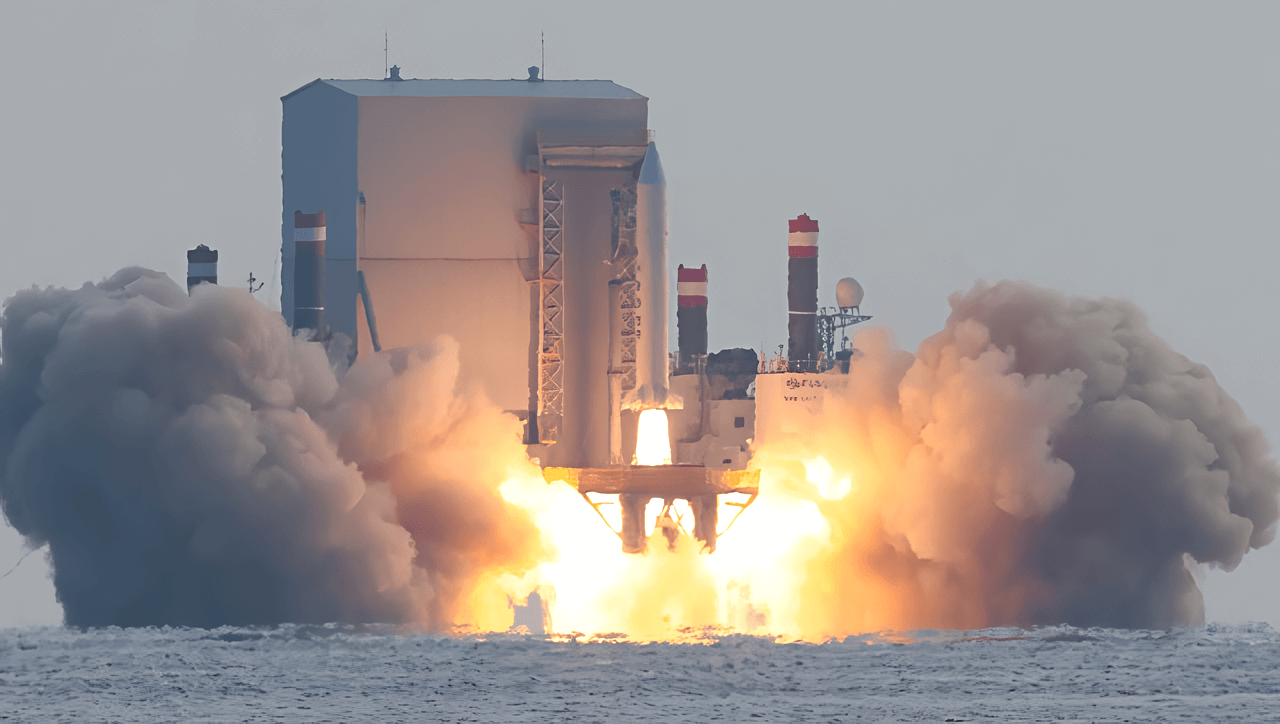
- Unknown Payload from Haiyang Oriental Spaceport, South China Sea (launch location 3) (11:22 UTC) Details on this mission have not been disclosed. Smart Dragon-3 is a solid-fueled commercial orbital rocket developed by a subsidiary of CASC.
April 14
-
SpaceX Falcon 9 Block 5:
- Starlink Group 17-27 from Vandenberg Space Force Base Space Launch Complex 4E, CA, USA (02:00 UTC) A batch of 25 Starlink V2 Mini Optimized satellites launching to low Earth orbit. Watch Live
-
SpaceX Falcon 9 Block 5:
- Starlink Group 10-24 from Cape Canaveral Space Force Station Space Launch Complex 40, FL, USA (06:13 UTC) A batch of 25 Starlink V2 Mini Optimized satellites launching to low Earth orbit. Watch Live
-
Blue Origin New Glenn:
- BlueBird Block 2 #2 from Cape Canaveral Space Force Station Launch Complex 36A, FL, USA (10:45 UTC) The second satellite in AST SpaceMobile’s next-generation BlueBird constellation, designed to provide space-based cellular broadband for commercial and government customers. This will be the third flight of the New Glenn rocket overall. Booster recovery intentions have not been confirmed by Blue Origin.
Schedule Changes
- New Addition: Kinetica 1 | Unknown Payload has been added to the manifest, scheduled for April 10 at 03:54 UTC from Jiuquan Satellite Launch Center.
- Completed Launches: Long March 8 | SpaceSail Polar Group 07 and Minotaur IV | STP-S29A have been removed from the upcoming calendar following successful launches.
- Status Update: Smart Dragon 3 | Unknown Payload has been upgraded from To Be Confirmed to Go for Launch, targeting April 11 at 11:22 UTC.
- Status Update: Isar Aerospace Spectrum | Onward and Upward has been upgraded from To Be Confirmed to Go for Launch, targeting April 9 at 20:00 UTC.
Note: Launch dates and times are subject to change due to technical or weather considerations.

Maurice Stellarski