· space brief · 9 min read
Blue Origin's New Glenn Destroyed in Hotfire Anomaly | KeepTrack Space Brief
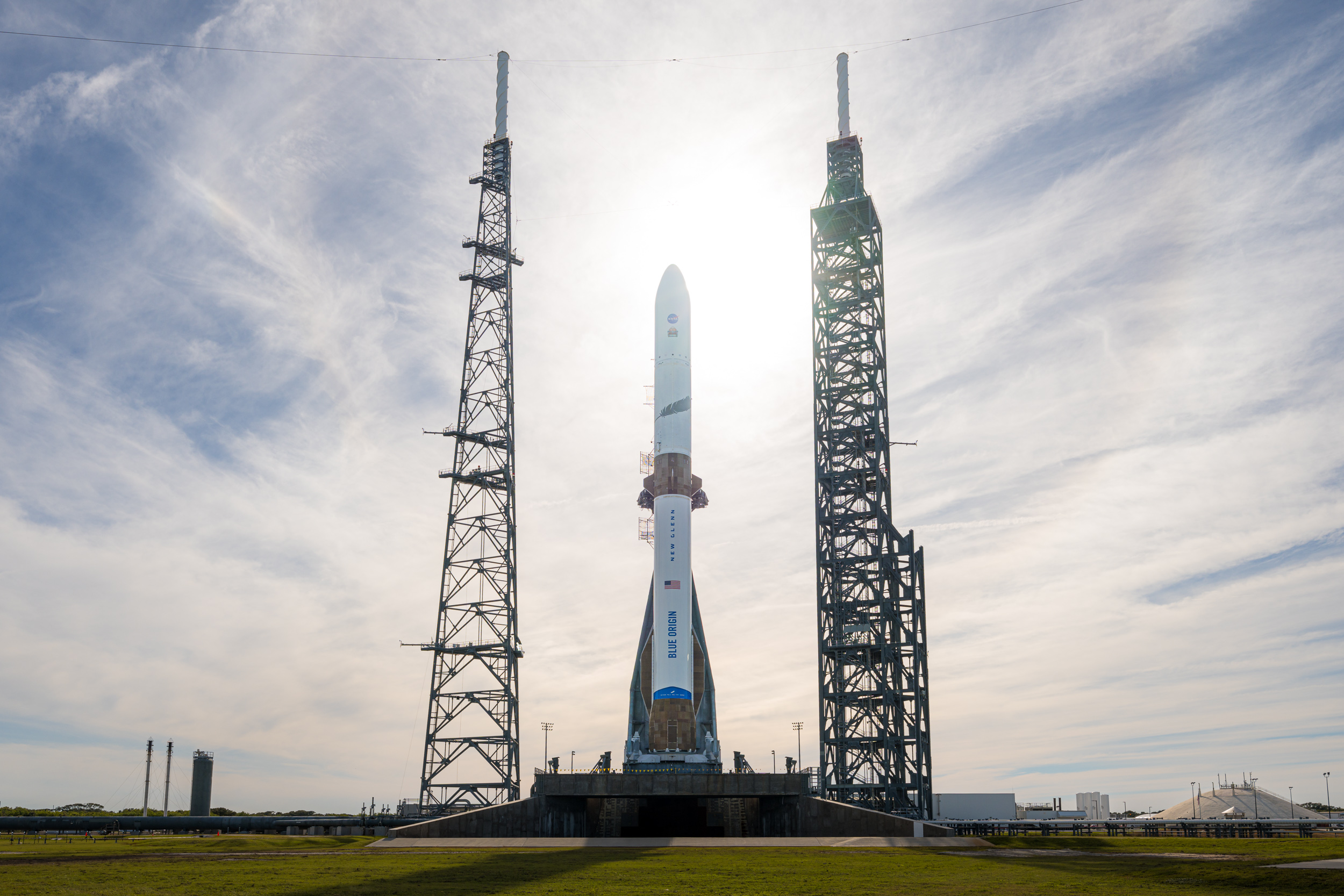
Blue Origin lost New Glenn during static fire testing at Launch Complex 36. Vehicle sustained serious damage in anomaly. NASA Artemis timeline impacts possible.

Top Stories
New Glenn Destroyed in Hotfire Anomaly at Launch Complex 36
Blue Origin lost New Glenn during static fire testing at Launch Complex 36. The vehicle sustained serious damage — this is not a pad abort or minor anomaly. It’s a vehicle loss.
Blue Origin says it’s keeping focus on Blue Moon lunar lander development and its Mars mission program. Whether that’s operationally realistic depends on how much of the New Glenn program shares infrastructure, personnel, or supply chain with those efforts. Watch for any NASA Artemis schedule impacts tied to the Blue Moon Human Landing System contract.
Read the full story: NASASpaceFlight
HASC NDAA Markup Pushes Back on Space Force Satellite Decisions
The House Armed Services Committee is moving to preserve a missile-warning satellite program the Pentagon wants to cancel. The markup also takes aim at a recent tactical communications satellite procurement and raises GPS oversight concerns.
This is a direct challenge to Space Force acquisition priorities. If the missile-warning program survives the legislative process, it forces the Pentagon to fund a capability it has already decided to walk away from. For KeepTrack users tracking the GPS constellation and missile-warning birds, the NDAA outcome could affect what gets launched, replaced, or sustained over the next several years.
Read the full story: SpaceNews
NASA’s X-59 Hits Mach 1.1 in First Supersonic Flight
NASA’s X-59 quiet supersonic demonstrator broke the sound barrier on June 5, reaching Mach 1.1. The aircraft is designed to reduce sonic boom intensity to a level that could support revised FAA overland supersonic flight rules.
The data collected from these flights will feed directly into FAA and ICAO rulemaking. If the boom reduction holds up across a wider test range, it opens the door to commercial supersonic routes over land — a regulatory question that has blocked the market since Concorde.
Read the full story: Space.com
HASC FY27 NDAA Adds Right-to-Repair Provisions for Defense Equipment
The House Armed Services Committee adopted the FY27 National Defense Authorization Act markup, including new right-to-repair language backed by Rep. Maggie Goodlander (D-N.H.). The provisions target OEM restrictions that prevent troops from repairing equipment in the field.
For the space and satellite sector, right-to-repair pressure is relevant wherever proprietary ground systems and space hardware intersect with DoD sustainment. The language isn’t space-specific, but the precedent matters for defense contractors who lock maintenance to authorized service chains.
Read the full story: Breaking Defense
DoD Cyber Strategy to Define AI Role Across Pentagon Entities
Katie Sutton, Assistant Secretary of Defense for Cyber Policy and Principal Cyber Advisor, is developing a DoD cyber strategy that will include a defined framework for AI adoption across Pentagon organizations.
The strategy is aimed at coordinating AI use — not just permitting it — across entities that currently operate with inconsistent approaches. For space operations, where AI is increasingly used in conjunction monitoring, space situational awareness, and tasking, a unified DoD AI framework has direct implications for how commercial and government tools get integrated into classified workflows.
Read the full story: Breaking Defense
House Passes Ukraine Support Act: $8B in Military Finance Loans
The House voted 226-195 to pass the Ukraine Support Act. The bill authorizes $8 billion in military finance loans to Ukraine and extends the Ukraine Security Assistance Initiative through 2027.
The vote margin was narrow. The bill now moves to the Senate. Continued U.S. military support to Ukraine sustains demand for ISR, communications, and space-based targeting capabilities — sectors where commercial satellite operators have been directly involved since 2022.
Read the full story: Breaking Defense
Leaf Space Launches TreeNet Connectivity Service with D-Orbit and EnduroSat
Italian ground segment operator Leaf Space unveiled TreeNet on May 27, a space connectivity service designed to make inter-satellite and ground communications more seamless. D-Orbit and EnduroSat are the initial partners for on-orbit testing.
TreeNet is positioning as infrastructure-layer software for the growing smallsat market. With EnduroSat providing the bus and D-Orbit providing the orbital transfer platform, the test chain covers the full operational stack. Results from this trial will be worth watching for anyone evaluating commercial ground-to-space connectivity architectures.
Read the full story: SpaceNews
Satellite of the Day
SHIJIAN-6 04B
SHIJIAN-6 04B (SJ-6 04B), also known as Shi Jian 6/4A, is a Chinese technology and signals intelligence (SIGINT) satellite operated by the China Aerospace Science and Industry Corporation (CASC). Launched on October 6, 2010, from the Taiyuan Satellite Launch Center aboard a Chang Zheng 4B rocket, this compact spacecraft was designed and manufactured by the China Academy of Space Technology (DFHZ). At just 350 kilograms with a 1-meter body and 4-meter solar panel span, SJ-6 04B represents China’s continued investment in reconnaissance and technology demonstration capabilities.
The satellite was designed with an original mission lifetime of 2 years, making it a relatively short-duration platform compared to many intelligence-gathering missions. Its sun-synchronous orbit and SIGINT payload suggest it was tasked with monitoring electromagnetic emissions across a wide geographic area. The Shijian (meaning “Practice” or “Experiment” in Chinese) series has served as a testbed for various orbital technologies and mission concepts, and SJ-6 04B fits into this broader pattern of Chinese space program development, contributing valuable operational data for future satellite systems.
| Detail | Value |
|---|---|
| NORAD ID | 37180 |
| Operator | CASC (China) |
| Launch Date | October 6, 2010 |
| Orbit | Sun-synchronous, 97.87° inclination |
| Purpose | Technology, SIGINT |
| Status | Active |
Track this satellite in real-time: Track SHIJIAN-6 04B
Upcoming Space Launches
June 7
- SpaceX Falcon 9 Block 5:
- Starlink Group 17-43 from Vandenberg Space Force Base, Space Launch Complex 4E (02:00 UTC) A batch of 29 Starlink V2 Mini Optimized satellites launching to low Earth orbit. Watch Live
June 8
-
Agency for Defense Development South Korean ADD Solid-Fuel SLV:
- Demo Flight from Sea Launch, ADD Offshore Launch Platform (05:00 UTC) Test flight of South Korea’s solid-fuel sea-launched vehicle demonstrating small satellite launch capability to low Earth orbit. Launch Preview
-
SpaceX Falcon 9 Block 5:
- Starlink Group 10-35 from Cape Canaveral Space Force Station, Space Launch Complex 40 (10:07 UTC) A batch of 29 Starlink V2 Mini Optimized satellites launching to low Earth orbit. Watch Live
June 9
- LandSpace Zhuque-2E Block 2:
- Unknown Payload from Jiuquan Satellite Launch Center, Launch Area 96A (08:11 UTC) The Zhuque-2E Block 2 is an enhanced medium-lift rocket powered by liquid oxygen and methane, capable of delivering up to 6,000 kg to low Earth orbit. The Block 2 variant features a lengthened first stage with increased propellant load and upgraded TQ-12A engines for greater performance. Payload details are not yet available.
June 10
-
Indian Space Research Organization GSLV Mk II:
- GISAT-1A (EOS-05) from Satish Dhawan Space Centre, Second Launch Pad (TBD UTC) GISAT-1A (GEO Imaging Satellite) is an Indian Earth-observing satellite that will operate from geostationary orbit, enabling continuous observation of the Indian subcontinent and rapid monitoring of natural hazards and disasters. The GSLV Mk II is India’s largest operational launch vehicle, featuring an indigenous cryogenic upper stage.
-
China Rocket Co. Ltd. Smart Dragon 3:
- Unknown Payload from Haiyang Oriental Spaceport, Haiyang Offshore Launch Location (00:30 UTC) Smart Dragon-3 is a solid-fuel commercial orbital rocket developed by a CASC subsidiary, making its launch from an offshore platform. Payload details are not yet available.
-
Mitsubishi Heavy Industries H3-30:
- H3-30 Test Flight from Tanegashima Space Center, Yoshinobu Launch Complex LP-2 (00:53 UTC) A test flight of the H3-30 variant, featuring three LE-9 engines on the first stage and no solid rocket boosters. The vehicle will carry a dummy primary payload (Vehicle Evaluation Payload 5, VEP-5) alongside several small hitchhiking satellites: PETREL, STARS-X, BRO-22, VERTECS, and HORN-L/R. The H3 is developed jointly by Mitsubishi Heavy Industries and JAXA as Japan’s next-generation expendable launch vehicle.
-
China Aerospace Science and Technology Corporation Long March 5:
- Unknown Payload from Wenchang Space Launch Site, Launch Complex 101 (07:22 UTC) China’s heavy-lift Long March 5 rocket, capable of delivering up to 25,000 kg to low Earth orbit, launches from Wenchang. The vehicle uses non-hypergolic liquid propellants and matches the capability class of American heavy-lift vehicles. Payload details have not been disclosed.
-
SpaceX Falcon 9 Block 5:
- Starlink Group 17-44 from Vandenberg Space Force Base, Space Launch Complex 4E (14:00 UTC) A batch of 29 Starlink V2 Mini Optimized satellites launching to low Earth orbit. Watch Live
June 11
- Rocket Lab HASTE:
- Curveball from Wallops Flight Facility, Rocket Lab Launch Complex 2 (Launch Area 0 C), Virginia, USA (04:00 UTC) A suborbital hypersonic test flight under Rocket Lab’s Hypersonic Accelerator Suborbital Test Electron (HASTE) program. The HASTE variant of the Electron rocket serves as a suborbital testbed for hypersonics research. This mission is classified as Government/Top Secret; further payload details are not available.
June 12
- SpaceX Falcon 9 Block 5:
- Starlink Group 10-54 from Cape Canaveral Space Force Station, Space Launch Complex 40 (12:27 UTC) A batch of 29 satellites for the Starlink mega-constellation, SpaceX’s space-based internet communication system. Watch Live
June 14
- SpaceX Falcon 9 Block 5:
- Starlink Group 17-54 from Vandenberg Space Force Base, Space Launch Complex 4E (14:00 UTC) A batch of 24 satellites for the Starlink mega-constellation, SpaceX’s space-based internet communication system. Watch Live
June 16
- China Aerospace Science and Technology Corporation Long March 3B/E:
- Unknown Payload from Xichang Satellite Launch Center, Launch Complex 2 (08:00 UTC) The Long March 3B/E is one of China’s most capable medium-range launchers and the most powerful variant of the Long March 3 series, developed primarily for delivering heavy communications satellites to geostationary transfer orbit. It features stretched boosters, an extended first stage, and a larger payload fairing. Payload details have not been disclosed.
Schedule Changes
- Falcon 9 Block 5 | Starlink Group 10-54 was newly added to the manifest, scheduled for June 12, 2026 at 12:27 UTC from Cape Canaveral Space Force Station, Space Launch Complex 40. Status: Go for Launch.
- Falcon 9 Block 5 | Starlink Group 17-54 was newly added to the manifest, scheduled for June 14, 2026 at 14:00 UTC from Vandenberg Space Force Base, Space Launch Complex 4E. Status: Go for Launch.
- Long March 3B/E | Unknown Payload was newly added to the manifest, scheduled for June 16, 2026 at 08:00 UTC from Xichang Satellite Launch Center, Launch Complex 2. Status: To Be Confirmed.
Note: Launch dates and times are subject to change due to technical or weather considerations.

Maurice Stellarski