· space terms · 7 min read
Lagrange Points
Five spots in the Earth-Sun system where the gravitational tug of two massive bodies and the pull of circular motion all cancel out, creating gravitational parking spaces where spacecraft can sit for decades with almost no fuel.
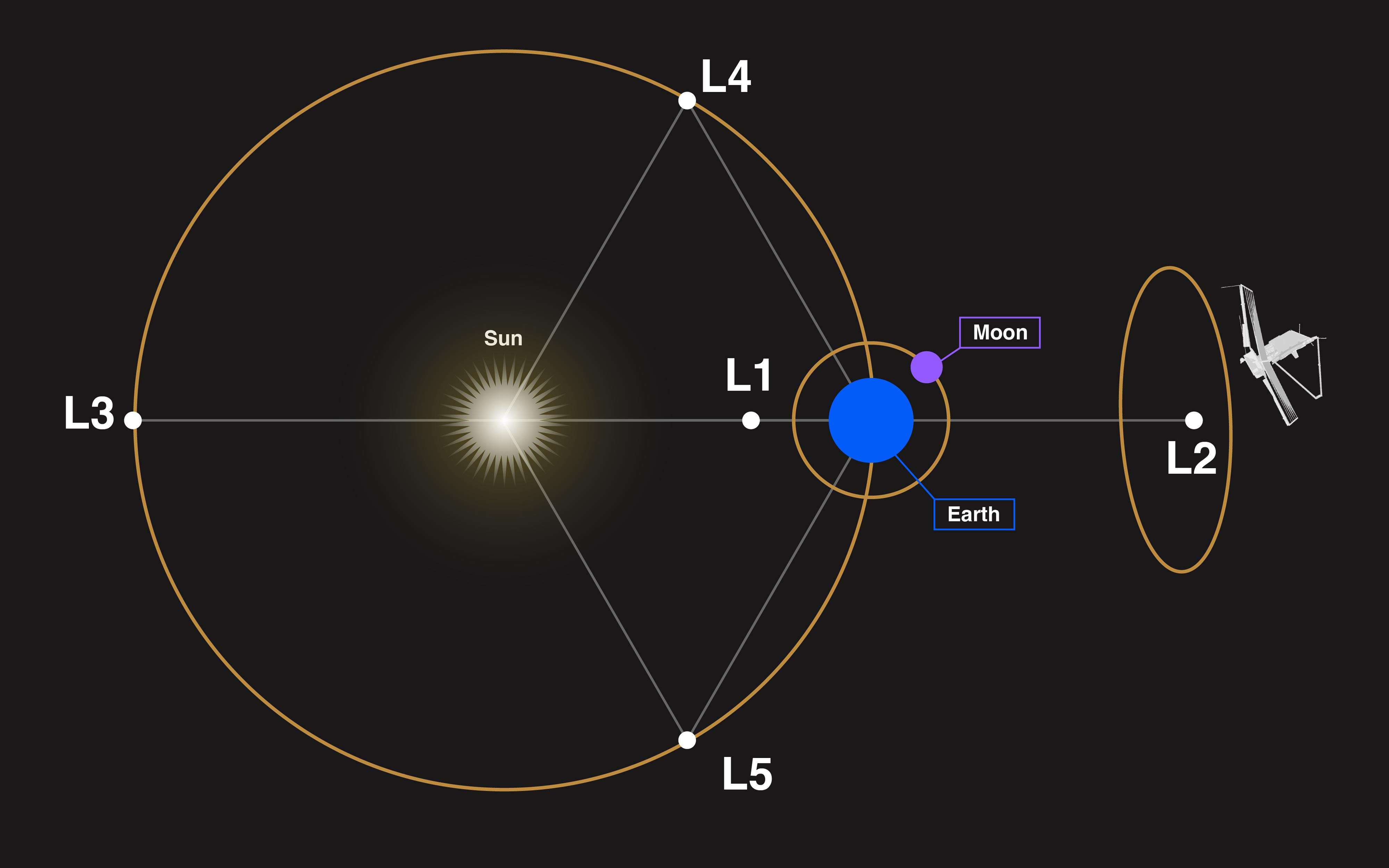
Picture a tug-of-war between two people of very different sizes. In the middle, a rope knot finds a spot where the combined pull of both participants, plus the spinning of the whole contest around the stronger person, balances out perfectly. If you placed a marble on that spot, it would just sit there. That is a Lagrange point, and there are five of them in every two-body gravitational system in the universe.
Lagrange points are the places in space where the gravitational pulls of two large bodies and the centrifugal force of a co-rotating reference frame cancel each other out. A spacecraft placed in one of these points, orbiting with the same period as the two parent bodies, can stay there with almost no propellant. In the Earth-Sun system, these five locations - called L1, L2, L3, L4, and L5 - have become some of the most valuable real estate in the solar system.
The Technical Bits
Lagrange points were discovered mathematically before anyone could use them. Joseph-Louis Lagrange published the analysis in 1772 as part of his work on the three-body problem. He proved there are exactly five equilibrium solutions in a co-rotating frame for any pair of orbiting masses, and he derived their geometry.
L1 sits between the two parent bodies on the line connecting them. In the Earth-Sun system, L1 is about 1.5 million kilometers sunward of Earth, where the Sun’s stronger gravitational pull is partly canceled by Earth’s. A spacecraft orbiting the Sun at this distance would naturally move faster than Earth, but because Earth’s gravity pulls it back, it can match Earth’s 365-day orbital period and stay on the Sun-Earth line forever.
L2 sits on the same line but on the far side of Earth, 1.5 million kilometers further out. Here the combined pull of Sun and Earth, plus the centrifugal push of the co-rotating frame, all balance. A satellite at L2 orbits the Sun with the same period as Earth even though it is outside Earth’s orbit - because Earth’s gravity adds to the Sun’s, effectively making the Sun feel stronger at that distance.
L3 is on the opposite side of the Sun from Earth, at roughly Earth’s orbital distance. It is famously useless: you cannot see it from Earth (the Sun is in the way), and small orbital perturbations from Jupiter and Venus disrupt any attempt to station-keep there.
L4 and L5 are the interesting ones. They sit 60 degrees ahead of and behind Earth in its orbit around the Sun, each forming an equilateral triangle with Earth and the Sun. Unlike L1, L2, and L3, which are dynamically unstable (a perturbation pushes the spacecraft away, like balancing a pencil on its point), L4 and L5 are stable so long as the mass ratio between the two parent bodies is large enough. A spacecraft nudged slightly off L4 will wander into a tadpole-shaped orbit around the point and stay there indefinitely.
Why It Matters
Lagrange points are gifts to science. L1 offers an uninterrupted view of the Sun, making it the best place in the solar system for solar observatories. The SOHO spacecraft has parked near the Earth-Sun L1 since 1996, watching the Sun continuously for more than two solar cycles. NOAA’s DSCOVR and NASA’s ACE also use L1, providing early warning of solar storms - because any stream of charged particles from the Sun will hit L1 roughly 15-45 minutes before it reaches Earth.
L2 is even more valuable for astronomy. With Earth on one side and the Sun on the other, a spacecraft at L2 can orient itself so that its sunshield blocks both the Sun and Earth simultaneously. That keeps the instruments in permanent darkness and at cryogenic temperatures, ideal for observing faint infrared signals from deep space.
James Webb Space Telescope rides a halo orbit around the Earth-Sun L2, using the shadow of its five-layer sunshield to hold its infrared instruments below 40 Kelvin. The Gaia star-mapper, Euclid, WMAP, Planck, Herschel, the Chinese Chang’e 2 follow-on mission, and Russia’s Spektr-RG observatory have all used L2. It has become the flagship astronomy address in the solar system.
L4 and L5 in the Sun-Jupiter system are famous for the Trojan asteroids - tens of thousands of rocks trapped in those stable points since the early solar system. Earth has just one known Trojan asteroid, 2010 TK7, discovered at L4. Nobody has ever parked a spacecraft at Earth’s L4 or L5, but the idea of using these stable points for future space stations or telescopes keeps resurfacing.
How Spacecraft Actually Live There
Almost no spacecraft literally sits at a Lagrange point. Doing so would require ideal conditions that never exist in practice - any perturbation from the Moon, from the non-spherical shape of Earth, from radiation pressure, or from the other planets would drift the spacecraft away. Instead, satellites fly “halo orbits” or “Lissajous orbits” around the Lagrange point, tracing complex looping paths that keep them in the general vicinity while avoiding direct line-of-sight with the Sun (which would saturate ground stations trying to talk to them).
JWST’s halo orbit at L2 has an amplitude of roughly 800,000 km perpendicular to the Earth-Sun line, with an orbital period of about six months. The telescope uses station-keeping burns every few weeks, consuming small amounts of propellant to maintain the orbit. NASA designed JWST with about 10 years of station-keeping fuel, but after a conservative insertion burn by Ariane 5 at launch, that budget was extended to over 20 years.
Station-keeping at L1 and L2 is manageable. Station-keeping at the unstable L3 point is effectively impossible for long missions, which is why no operational spacecraft uses it.
Fun Fact Space Nerds Might Not Know
The ICE (International Cometary Explorer) spacecraft did the first Lagrange point orbit in 1978, parking at Earth-Sun L1. When its primary mission ended, NASA used a series of clever gravity-assist maneuvers to fling the spacecraft out of L1, around the Moon several times, and eventually into interplanetary space where it became the first spacecraft to visit a comet (21P/Giacobini-Zinner in 1985). That escape trajectory, designed by Bob Farquhar, is still studied in astrodynamics courses as one of the most efficient multi-body rerouting sequences ever flown.
Looking Forward
The Lagrange point economy is growing. Multiple proposed missions target L2 for the 2030s: Roman Space Telescope, PLATO (exoplanets), LiteBIRD (cosmic microwave background), HiZ-GUNDAM, and various Chinese infrared missions. NASA’s proposed Habitable Worlds Observatory will also use L2. The space around the Earth-Sun L2 is starting to get crowded, and mission planners now have to account for other spacecraft when designing new halo orbits.
Lunar Lagrange points are becoming important too. The Earth-Moon L2, behind the Moon from Earth’s perspective, was used by the Queqiao relay satellite to support China’s Chang’e 4 landing on the far side. NASA’s planned Lunar Gateway, part of the Artemis program, will operate in a Near-Rectilinear Halo Orbit around the Earth-Moon L2, which is not quite a Lagrange point orbit in the classical sense but relies on the same three-body dynamics.
For KeepTrack users, L1 and L2 spacecraft don’t show up in the standard catalog of Earth-orbiting satellites because they are deep-space missions, tracked by NASA’s Deep Space Network rather than by the Space Surveillance Network. But they are worth knowing about, because the gravity math that keeps JWST parked in infrared darkness a million miles away is the same math Lagrange worked out two centuries before anyone could imagine a telescope there.

Theodore Kruczek