· today in space history · 8 min read
The Day When Cassini Chose the Long Way Home
Cassini's Titan T-115 encounter marked the moment the spacecraft stopped looking down and started looking sideways, trading one type of science for another as it entered the final chapter of an iconic mission.
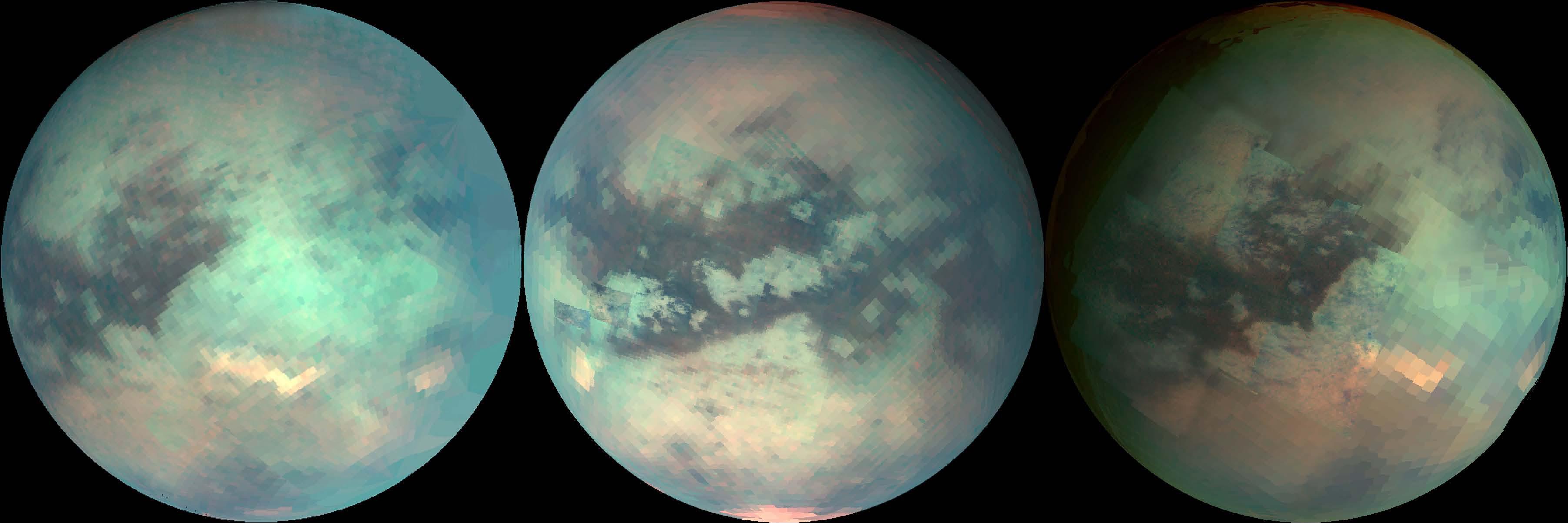
On January 16, 2016, the Cassini spacecraft was closing in on Saturn’s moon Titan for what had been designed as a turning point in one of humanity’s greatest planetary exploration missions. The spacecraft had already made 114 close flybys of this hazy, methane-shrouded world - studying its thick atmosphere, mapping its hydrocarbon lakes, and collecting data that fundamentally changed how we think about habitability beyond Earth. This 115th encounter, known simply as T-115, would be different. It wasn’t about getting the best view of Titan anymore. It was about the future - or more precisely, the end.
Cassini had been orbiting Saturn since July 2004. Nearly 12 years of continuous operations in the harsh radiation environment of the Saturnian system. The spacecraft was aging. Its fuel reserves were finite. And NASA’s leadership had made a decision: rather than risk an eventual collision with one of Saturn’s moons, Cassini would go out on its own terms. The Grand Finale - a series of orbits diving between Saturn’s rings and the planet itself - would begin the following year. But before that happened, there was unfinished science to do. And that’s where T-115 came in.
The Inclination Game
Orbital inclination is just the angle at which a spacecraft orbits relative to a planet’s equator. When Cassini first arrived in 2004, its orbit was almost flat - nearly aligned with Saturn’s equatorial plane. That made sense for the early mission. Scientists wanted to study the rings edge-on, observe the small inner moons, and get close looks at Titan’s equatorial region.
But by 2016, the science questions had shifted. Cassini’s mission planners wanted to understand Saturn’s inner radiation belts, the polar regions, and the gravitational interactions between Titan and the ring system itself. To answer those questions, the spacecraft needed to climb - to gradually tilt its orbit until it was passing nearly over Saturn’s poles.
Here’s where the Titan flybys became a tool rather than a destination. Each close pass by Titan’s gravity well could be used to nudge Cassini’s orbit into a slightly different inclination. Mission planners had mapped out exactly which flybys would deliver which orbital changes, and T-115 was one of the most important in that sequence.
The Science
T-115 carried real science objectives beyond its role in reshaping Cassini’s orbit. The Composite Infrared Spectrometer (CIRS) was scheduled to perform what’s called “limb mapping” on both the north and south limbs of Titan - studying the edge of the atmosphere at two different locations to see how it was changing with the seasons.
This is where the timing mattered. Titan experiences seasons - long, drawn-out seasons that last about 7-8 Earth years thanks to Saturn’s 29-year orbit around the Sun. When Cassini arrived in 2004, it was winter in Titan’s northern hemisphere and summer in the south. The northern pole was shrouded in darkness, topped by a visible “hood” of dense, high-altitude haze. By 2016, things had shifted dramatically. The equinox had come and gone in August 2009, and now the northern hemisphere was in late spring approaching summer while the south was sliding into winter. Scientists could use simultaneous observations of both poles to understand the circulation patterns driving these changes.
To understand how Earth’s atmosphere moves warm air from the equator toward the poles, you’d want to measure the temperature structure at different latitudes at the same time. That’s exactly what CIRS was doing on T-115 - gathering data points that would help scientists build a more complete picture of Titan’s atmospheric circulation. NASA considered this one of the two most scientifically important Titan flybys in the entire Solstice mission for CIRS.
Racing Against Time
January 2016 was when Cassini really shifted into end-game mode. The spacecraft wasn’t going to run forever. Each flyby burned a tiny amount of attitude control fuel. Each instrument observation used power from the aging radioisotope thermoelectric generator. NASA had calculated that Cassini had roughly 20 months of productive operations left. The Grand Finale was scheduled for September 2017 - a dramatic ending in Saturn’s atmosphere, planned to ensure the spacecraft couldn’t accidentally contaminate potentially habitable moons with Earth microbes.
So the flybys in early 2016 weren’t casual. They were part of a carefully constructed sequence. After T-115 came T-116 and T-117 in February, and then a series of increasingly aggressive orbits that would eventually take the spacecraft right through Saturn’s ring system. Each encounter was a choice: do we maximize the scientific return from this Titan pass, or do we use it to adjust the orbit for something we’ll do later? Cassini’s planning team had to balance dozens of competing priorities.
T-115 happened to hit both priorities. The inclination increase was essential for the later ring-diving orbits. The limb mapping science was valuable in its own right. It was one of those sweet spots where orbital mechanics and science objectives aligned.
T-115: The Inflection Point
Cassini's 115th Titan encounter marks the beginning of the final phase - orbiters start increasing inclination toward 63.7 degrees for ring operations and the Grand Finale.
T-116: Inclination Jump
The 116th encounter delivers the most dramatic orbital change - increasing inclination by over 13 degrees in a single pass.
F-Ring Orbits Begin
A Titan flyby takes Cassini to the gateway of F-ring orbits, marking the start of the Grand Finale phase with unprecedented views of Saturn's rings.
The Grand Finale
Cassini completes its final orbit and intentionally plunges into Saturn's atmosphere, ending 13 years of science at Saturn.
What Made T-115 Different
To understand why T-115 mattered, you need to know what made Cassini’s entire Saturn mission possible in the first place - gravity assist. When Cassini was launched in 1997, engineers couldn’t send it directly to Saturn. The rocket wasn’t powerful enough. So they sent it on a long, looping path - Venus, Venus again, Earth, Jupiter. At each planet, gravity grabbed the spacecraft, bent its trajectory, and slung it toward the next target. By the time Cassini reached Saturn, it had borrowed gravitational energy from multiple worlds.
The Titan flybys worked on a similar principle, but in reverse. Instead of using other planets to build up speed, Cassini used Titan to sculpt its orbit. The spacecraft would pass close to Titan’s gravitational well, and engineers on Earth could time the approach perfectly so that the interaction nudged Cassini’s orbit in exactly the way they needed.
What made the 2016 flybys especially important was that they were happening on a tight schedule. Mission planners had determined that they needed Cassini’s orbit to be at a specific inclination by a specific date to maximize the science return from the ring orbits. T-115, T-116, and a sequence of other encounters were timed to hit those targets, with a decade of planning coming together in a series of precise flybys separated by weeks.
The End of an Era
Cassini wouldn’t last much longer after T-115. By the time September 2017 rolled around, the spacecraft would be out of usable fuel. But those final 20 months - from T-115 through the final orbit around Saturn - would produce some of the most dramatic imagery and most significant data of the entire mission.
The Titan flybys, including T-115, had enabled something almost no one expected when Cassini launched: a detailed understanding of a moon that rivals Earth in complexity. Scientists had mapped Titan’s methane lakes, studied its dune fields, gathered evidence for a subsurface water ocean, and documented its dynamic atmosphere across two full seasons. And they’d done it all because mission planners figured out how to use Titan’s gravity not just to reach a destination but to reshape the entire mission.
On January 16, 2016, as Cassini passed 3,817 kilometers above Titan’s hazy surface, the spacecraft wasn’t saying goodbye to Saturn’s largest moon. It was shifting its focus. The rings, the radiation belts, the polar regions - those were where the final chapter would be written. Titan had served its purpose as both destination and instrument, and now Cassini was ready for the end.

Theodore Kruczek