· today in space history · 6 min read
The Day a Giant Space Balloon United the Cold War
When a 135-foot inflatable mirror bounced a radio signal from England to Russia, it became the first joint US-Soviet space venture - and changed how we think about satellite communication.
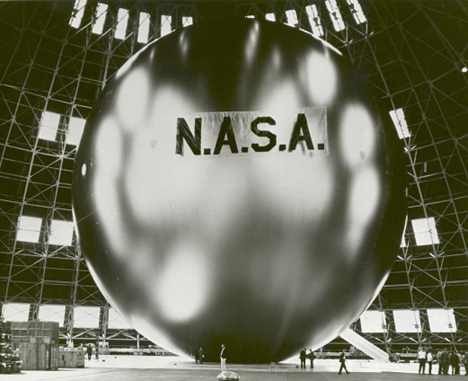
You’d be surprised by how much satellites really do for us. Over 10,000 metallic powerhouses circle the Earth day and night, allowing people to navigate roads, connect to loved ones, and keep our nation safe. But before we could get instantaneous Wi-Fi and widespread television, we had Project Echo. It was the first passive communication satellite experiment, launched by NASA in 1960. On January 25, 1964 - exactly 61 years ago today - Echo II went up into orbit and made satellite communication history.
Lighter than Air
The idea behind this satellite was first dreamt up by NASA engineer William J. O’Sullivan Jr. in 1956 at the Langley Aeronautical Laboratory. John R. Pierce of Bell Telephone Laboratories had a similar idea about using a reflective object to relay information back to Earth. An affectionately nicknamed “satelloon” was proposed to launch during the International Geophysical Year. This would be the first ever relay communication satellite to rebound sound back to Earth. Thus, Project Echo was born.
To begin, what is an Echo satellite? Essentially, it’s a giant ball-shaped mirror in space that reflects radio waves back from low Earth orbit that scientists send from Earth. Echo satellites were passive, as they did not amplify this signal and transmit it back (a satellite with that function would be called active).
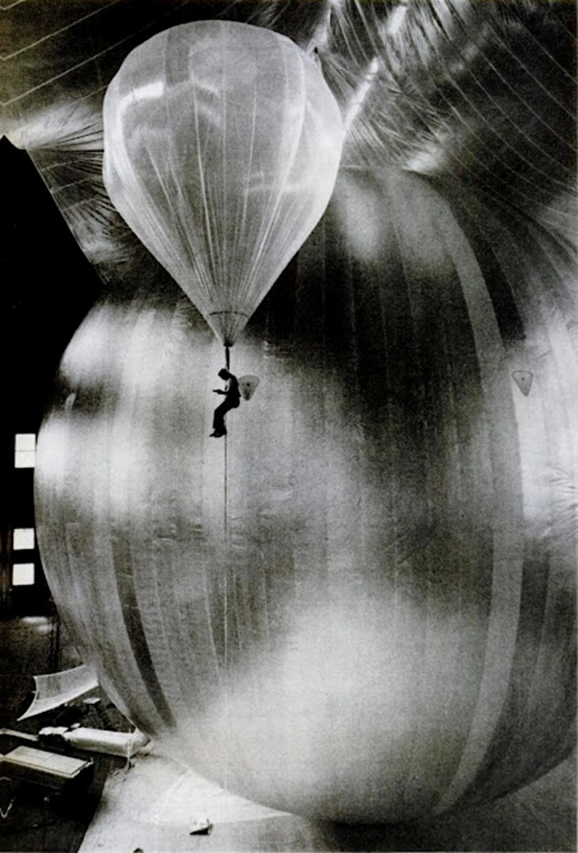
It was nothing incredibly complicated, being a giant Mylar balloon coated in metal. For context, Mylar is a plastic which has the thickness of 1/10th of a human hair. Giant might be an understatement - Echo I was about 100 feet in diameter, while Echo II would grow to an even more impressive 135 feet. Because of this size, both balloons were visible to the naked eye from Earth.
What made designing this difficult was the fact that it was sent up to space flat and had to be inflated by expanding air within the balloon. On Earth, 18 tons of air were needed to maintain its spherical shape, but in space, only a few kilograms were sufficient due to the lack of atmosphere.
This is President Eisenhower Speaking…
The existence of an Echo II implies an Echo I, which had a bumpy ride to success. The first attempt to launch Echo I on May 13, 1960 ended in failure when the rocket’s second stage malfunctioned. As a test balloon expanded in an earlier suborbital flight, the residual air left inside proved far too much for it to handle - the sphere ruptured into a rain of Mylar and metal glimmering in the sunset (not to worry, it all burned up in the atmosphere).
The still-young NASA redeemed itself on August 12, 1960, when from the warm shore of Cape Canaveral, Echo 1A (commonly called Echo 1) was successfully sent to space with the help of the Thor Delta launch vehicle. That same day, it reflected the first radio message from Earth, sent by President Eisenhower.
This is one more significant step in the United States’ program of space research and exploration being carried forward for peaceful purposes. The satellite balloon, which has reflected these words, may be used freely by any nation for similar experiments in its own interest.
It communicated with the ground through a 50-foot-long horn-shaped antenna at Bell Labs in Holmdel, New Jersey - which would later be used to detect evidence of the Big Bang. In 1964, while calibrating this same antenna, Drs. Arno Penzias and Robert Wilson detected cosmic microwave background radiation, earning them the Nobel Prize in Physics.
This peaceful-purposes pledge by Eisenhower laid the groundwork for what would eventually evolve into today’s global satellite communications. The balloon ended up surviving for nearly 8 years before burning up on reentry on May 24, 1968.
Echo II was going to be a new and improved version of this satellite. It was smoother and more spherical, and its rigidized skin allowed it to maintain shape under pressure and even survive strikes from micrometeoroids.
A Story of Cooperation
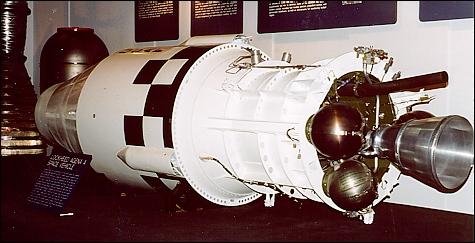
Echo II was launched on January 25, 1964, with the Thor Agena rocket from Vandenberg Air Force Base, reaching orbit about an hour after liftoff. As the balloon expanded in space, it quickly became the largest object to orbit Earth at the time, revolving around the planet once every 109 minutes.
First Shotput Test
Suborbital balloon test reaches altitude but ruptures during inflation
Echo I Launch Failure
Thor Delta second stage malfunction prevents orbital insertion
Echo 1A Success
First successful passive communications satellite reaches orbit from Cape Canaveral
Echo II Launch
Larger, improved balloon satellite launched from Vandenberg AFB
Echo 1A Reentry
After nearly 8 years, the original Echo burns up in the atmosphere
Echo II Reentry
The last Echo satellite ends its mission after 5+ years in orbit
During the launch of Echo I, the speech relayed by Eisenhower mentioned that the satellite balloon could be used freely by any nation - and it was true: The Echo Project, especially Echo II, became a beacon of international cooperation.
Shortly after launch, a radio signal sent from the Jodrell Bank Observatory in Manchester, England was reflected off Echo II and caught by the Zimenki Observatory in Russia - making it the first joint US-USSR space venture. Soviet experiments tested the satellite for its capabilities as an unmodulated carrier, and for functions of telegraphy, voice, and facsimile transmission. It was tracked by antennas matching its movement from the ground in both territories (and the UK). In the time it remained in space, Echo II shone brighter than even the North Star.
Echo II still remains as a vibrant and optimistic part of space history. From the early setbacks to its beautiful glare in the night sky, Project Echo sent a message of cooperation and scientific trailblazing that would echo through the decades of satellite communications to come. Echo II finally reentered the atmosphere on June 7, 1969, five years after launch.
If satellite communication is something that interests you, SignalRange is a free platform by Kruczek Labs that makes it easy to start and learn. Launched in 2026, it provides a video game experience to learn how to communicate with satellites and operate a commercial ground station. Check it out at https://signalrange.space!

Mariana Mokhova