· today in space history · 7 min read
The Moon Landing That Almost Didn't Happen
Six hours behind schedule, with a backup engine system shuddering in lunar orbit and mission controllers in Houston running out of options, Apollo 16 came within one meeting of being sent home without landing. The problem was a wobble in a gimbal. The solution was math done under pressure.
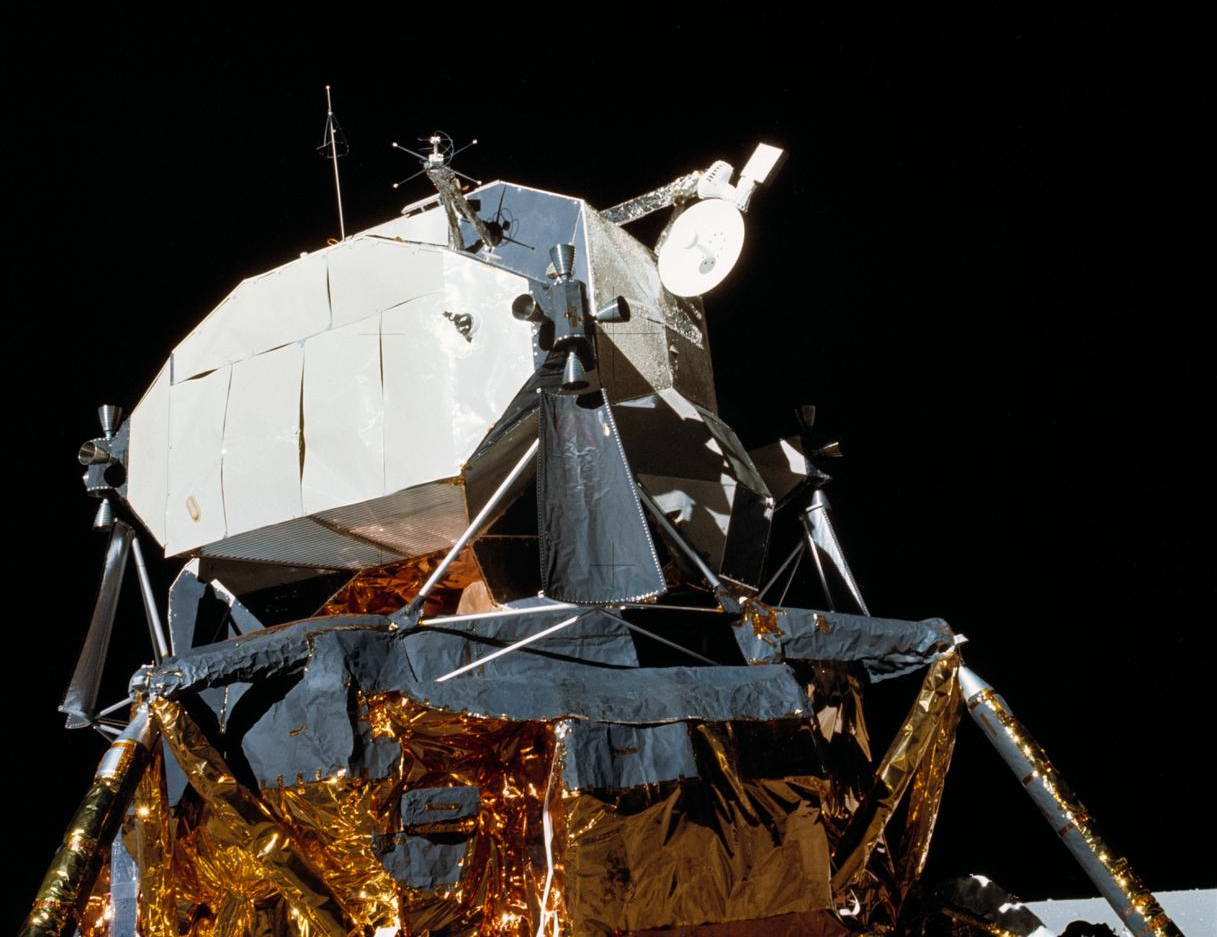
On the afternoon of April 16, 1972, a Saturn V rocket lifted off from Pad 39A at Kennedy Space Center carrying Commander John Young, Command Module Pilot Ken Mattingly, and Lunar Module Pilot Charlie Duke. The mission was Apollo 16, the fifth lunar landing attempt and the first to target the highlands rather than the flat volcanic plains where every previous crew had touched down. The destination was the Descartes region, a rugged area 2,250 meters above the elevation of the Sea of Tranquility, chosen because geologists were convinced it had been shaped by ancient lunar volcanism.
The geologists were wrong about the volcanism. But the mission nearly failed for a completely different reason, and the story of how it almost didn’t land is more interesting than what most people remember about Apollo 16.
The launch was clean. The translunar injection burn was nominal. For three days, the crew coasted toward the Moon without incident. Then, in lunar orbit, as Young and Duke prepared to separate the lunar module Orion from the command module Casper and begin their descent, Ken Mattingly reported a problem. The backup gimbal system on the Service Propulsion System engine was oscillating. The yaw actuator on the secondary thrust vector control circuit was shuddering in a way it should not have been.
Mission rules were explicit: all four thrust vector control circuits on the SPS engine, both primary and backup, had to be fully functional before a lunar landing could proceed. If Mattingly couldn’t use the SPS reliably, there would be no way to safely perform the transearth injection burn to bring the crew home. A wobbly engine in lunar orbit was not a theoretical concern. It was a potential death sentence.
Mission Control ordered Young and Duke, who had already undocked in Orion, to station-keep near Casper rather than begin powered descent. For the next six hours, engineers on the ground ran every analysis they could think of. The question was whether the primary gimbal system alone could handle the transearth injection burn if the backup had to be locked out. Simulations were run. Thermal models were checked. Stress calculations were redone.
The answer came back: yes. The primary system could handle it. If Mattingly had to use the secondary system, the engine might shudder during the burn, but it would remain controllable. The risk was acceptable. Mission Control gave the go for landing.
Powered descent began six hours late. Young and Duke touched down in the Descartes Highlands on April 20, 1972.
The Crew
Apollo 16’s crew was unusually experienced by Apollo standards. John Young was on his fourth spaceflight and his second trip to the Moon (he had orbited on Apollo 10). He would go on to command the first Space Shuttle mission, STS-1, nine years later, making him the only person to have commanded both an Apollo lunar mission and a Shuttle flight. Charlie Duke, the lunar module pilot, had served as CapCom during Apollo 11’s landing and was the voice that said “Roger, Twank… Tranquility, we copy you on the ground” when Armstrong reported touchdown.
Ken Mattingly was making his second attempt at a lunar mission. He had been bumped from Apollo 13 seventy-two hours before launch after being exposed to rubella. He never got sick. He watched from Mission Control as his replacement, Jack Swigert, stirred the oxygen tank that nearly killed three people. Apollo 16 was his chance to finally fly to the Moon.
Launch
Saturn V lifts off from Pad 39A. All stages perform nominally.
SPS Gimbal Problem
In lunar orbit, Mattingly detects oscillations in the backup thrust vector control system. Landing delayed six hours while engineers analyze the risk.
Lunar Landing
Young and Duke land Orion in the Descartes Highlands, 2,250 meters above the Sea of Tranquility's elevation.
Three EVAs
71 hours on the surface. Three moonwalks totaling 20 hours 14 minutes. 96 kg of samples collected. 27 km driven on the Lunar Roving Vehicle.
Splashdown
Command module Casper splashes down in the Pacific after 11 days, 1 hour, 51 minutes in space.
The Highlands That Weren’t Volcanic
The Descartes region had been selected because orbital photography and remote sensing data suggested it was one of the few places on the Moon where volcanic processes had shaped the terrain. The Cayley Formation and the Stone Mountain area appeared to have features consistent with volcanic flows and deposits. If confirmed, this would have meant the Moon’s interior had been geologically active far more recently than the mare basalts suggested.
Young and Duke spent 71 hours on the surface, conducted three EVAs totaling over 20 hours, drove 27 kilometers in the Lunar Roving Vehicle, and collected 96 kilograms of rock and soil samples. They deployed an Apollo Lunar Surface Experiments Package that would transmit data back to Earth for years. Duke set a record as the youngest person to walk on the Moon at 36 years and 201 days (a record that still stands as of 2026, since no one has walked on the Moon since 1972).
The samples they brought back overturned the volcanic hypothesis entirely. Nearly everything in the Descartes Highlands turned out to be impact breccia: rock that had been shattered, melted, and re-fused by asteroid and comet impacts over billions of years. There was no volcanic material. The geological models that had driven the site selection were wrong.
We were told we’d find volcanic rocks up there. We found impact breccias. The whole premise for going to Descartes was wrong. But that’s science. You go, you look, and sometimes the answer is different from what you expected.
This was not a failure. Disproving a hypothesis is as scientifically valuable as confirming one, and the discovery that the lunar highlands were dominated by impact processes rather than volcanism fundamentally changed how scientists understood the Moon’s geological history. It established that the highlands are essentially a record of the Late Heavy Bombardment, the period roughly 4 billion years ago when the inner solar system was pummeled by a massive flux of impactors.
What Mattingly Did Alone
While Young and Duke worked on the surface, Ken Mattingly conducted one of the most productive solo orbital science programs of the Apollo era. The command module Casper carried a Scientific Instrument Module bay loaded with instruments: a panoramic camera, a mapping camera, a laser altimeter, a gamma-ray spectrometer, an X-ray fluorescence spectrometer, and an alpha-particle spectrometer.
Mattingly operated these instruments through 64 lunar orbits, mapping the chemical composition and topography of a significant swath of the Moon’s surface. The gamma-ray and X-ray data he collected contributed to the first compositional maps of the lunar surface, identifying variations in aluminum, magnesium, and thorium concentrations that later informed our understanding of how the lunar crust differentiated from the mantle.
On the return trip to Earth, Mattingly performed a deep-space EVA to retrieve film canisters from the SIM bay, floating outside the command module 290,000 kilometers from Earth. It was one of only three deep-space EVAs ever conducted (the others were on Apollo 15 and Apollo 17).
The Last Before the Last
Apollo 16 was the penultimate Moon landing. Only Apollo 17, in December 1972, would follow. The program was already being wound down. Apollo 18, 19, and 20 had been cancelled in 1970 due to budget cuts and declining public interest. Young, Mattingly, and Duke flew knowing they were among the last humans who would walk on the Moon for a very long time.
Young, characteristically, did not dwell on this. He went on to serve as Chief of the Astronaut Office, commanded STS-1 in 1981, commanded STS-9 in 1983, and remained an active astronaut until 2004, a career spanning 42 years from his selection in 1962 to his retirement. He died in 2018 at 87. Duke became the tenth person to walk on the Moon and, as of 2026, is one of only four surviving Moon walkers. Mattingly flew two more missions on the Space Shuttle before retiring from NASA.
Fifty-four years after Apollo 16, the Descartes Highlands remain one of the most scientifically important lunar sites ever visited, precisely because the science didn’t go as planned. The mission proved that orbital science and surface exploration could work in tandem, that wrong hypotheses tested against real data produce real knowledge, and that a shuddering gimbal in lunar orbit doesn’t have to end a mission if the people on the ground are willing to do the math.
References(8)
- Apollo 16 Mission Overview - NASA
- Apollo 16 - The Planetary Society
- Into the Lunar Mountains: Remembering Apollo 16, 50 Years On - AmericaSpace
- Remembering Apollo 16's Almost-Not Moon Landing - AmericaSpace
- Apollo 16 - National Air and Space Museum
- Apollo 16 Lunar Surface Journal - NASA
- Roving the Lunar Highlands: The 50th Anniversary of Apollo 16 - Coca-Cola Space Science Center
- Apollo 16 Mission Report - NASA Technical Reports Server

Theodore Kruczek