· today in space history · 6 min read
A Tribute to Albert Einstein
Ask anyone on the street who the smartest person ever was, and most will say Albert Einstein. Exactly 71 years ago today, this genius departed from the world. Today, we examine Einstein's innumerable contributions to astronomy and how he shaped space history for years to come.
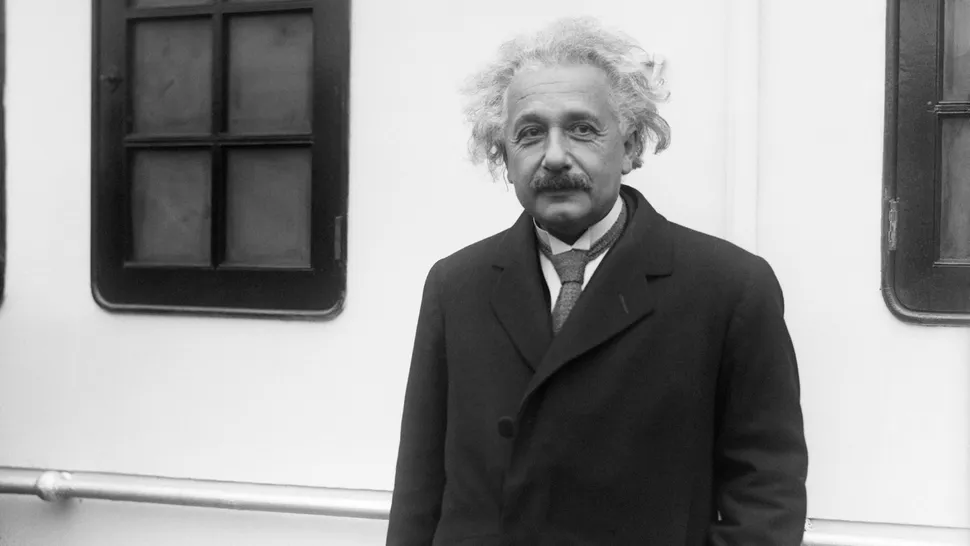
Ask anyone on the street who the smartest person ever was, and most will say Albert Einstein. The architect of general relativity, Nobel Prize winner, and visionary of matter’s mysteries — he was truly one of a kind.
And exactly 71 years ago today, this genius departed from the world. While any scientist can recognize his immense contributions, understanding his transformative impact requires a closer look. Today, we will examine Einstein’s innumerable contributions to astronomy and how he shaped space history for years to come.
”The Soup Is Too Hot!”
Amidst the towering cathedrals and rolling hills of the now German city of Ulm, Albert Einstein was born in 1879. He grew up quiet, the first words slipping from his lips at age 4, when he profoundly proclaimed that the soup was too hot.
Science made its way into Einstein’s life soon after, when he was presented with a compass at age 5. His curiosity about the inner workings of electromagnetism was awakened. He took up mathematics and taught himself algebra and calculus at age 12. As he developed his proficiency in philosophy and physics, Einstein made a name for himself as a prodigy in scientific circles.
Completing his education at the Swiss Federal Polytechnic School in 1900, Einstein proceeded to take his talents to a patent office in Bern. In 1905, his miracle year, he published several groundbreaking papers that shook the world of physics: Brownian motion, the photoelectric effect, and the special theory of relativity were all ideas tackled by the genius mind in a shocking timeframe.
Born in Ulm
Albert Einstein is born amidst the towering cathedrals and rolling hills of the German city of Ulm.
Swiss Federal Polytechnic
Completes his education and proceeds to take a position at a patent office in Bern.
Miracle Year
Publishes groundbreaking papers on Brownian motion, the photoelectric effect, and the special theory of relativity.
Nobel Prize
Awarded the Nobel Prize in Physics for his work on the photoelectric effect.
Letter to Roosevelt
Signs a letter to President Roosevelt recommending the creation of an atomic bomb to combat Nazi Germany. Does not work on the Manhattan Project.
Death in Princeton
Passes away quietly in Princeton, New Jersey, after years at the Institute for Advanced Study.
He went on to earn the Nobel Prize for his work on the photoelectric effect in 1921 and contributed to other scientific projects. Despite being adamantly anti-war, Einstein’s signature marked the letter sent to President Roosevelt, recommending the creation of an atomic bomb to combat Nazi Germany (the Nazis labeled his work as “Jewish Physics”). It is important to note that he did not work on the Manhattan Project. The rest of his years were spent working in the Institute for Advanced Study before he passed away quietly in Princeton, New Jersey.
Now that we have familiarized ourselves with his life, let us examine his contributions to humanity’s study of the stars.
The Backbone of Modern Cosmology
No discussion about Einstein’s work can take place without touching on the theory of general relativity. This was his most important contribution to physics and went on to shape scientific research for years to come.
While doing patent work in 1905, Einstein destroyed the idea of absolute time. Earlier works of Henri Poincaré and Hendrick Lorentz provided cloudy fragments of the truth he unveiled: they reasoned that physical laws are the same for stationary and uniformly moving observers, asserting that no experiment can detect uniform absolute motion. Einstein made the connection that time could vary depending on motion and that space and time were linked. He proved that massive objects (like planets and stars) could bend spacetime, with this being the principle behind gravity.
This discovery was controversial, as it completely debased Newtonian physics. But much like how Copernicus defied the ancient authority of Aristotle, Einstein was able to do the same with his research. By the 1920s, the theory was widely accepted, marking the moment where classical physics began to collapse.
General relativity was huge for space, as it changed the way that we understand the positioning and movement of celestial objects. Take the black hole, for example. Using general relativity, scientists were able to understand their true nature — a warping of space so severe that not even light can escape it. Einstein’s discovery was central to understanding such ripples in space-time and the warping of light.
Eclipses Through Enlightened Eyes
Speaking of warping light — this was another major discovery shaping our understanding of celestial events. Einstein discovered that gravity can affect light. This was a big deal because the previous understanding of gravity was that it could only affect mass, and light just happens to have none. However, using the framework of gravity being a curvature of spacetime rather than a force, he reasoned that light always follows the straightest possible path, with this path potentially curving with the spacetime should it also be warped.
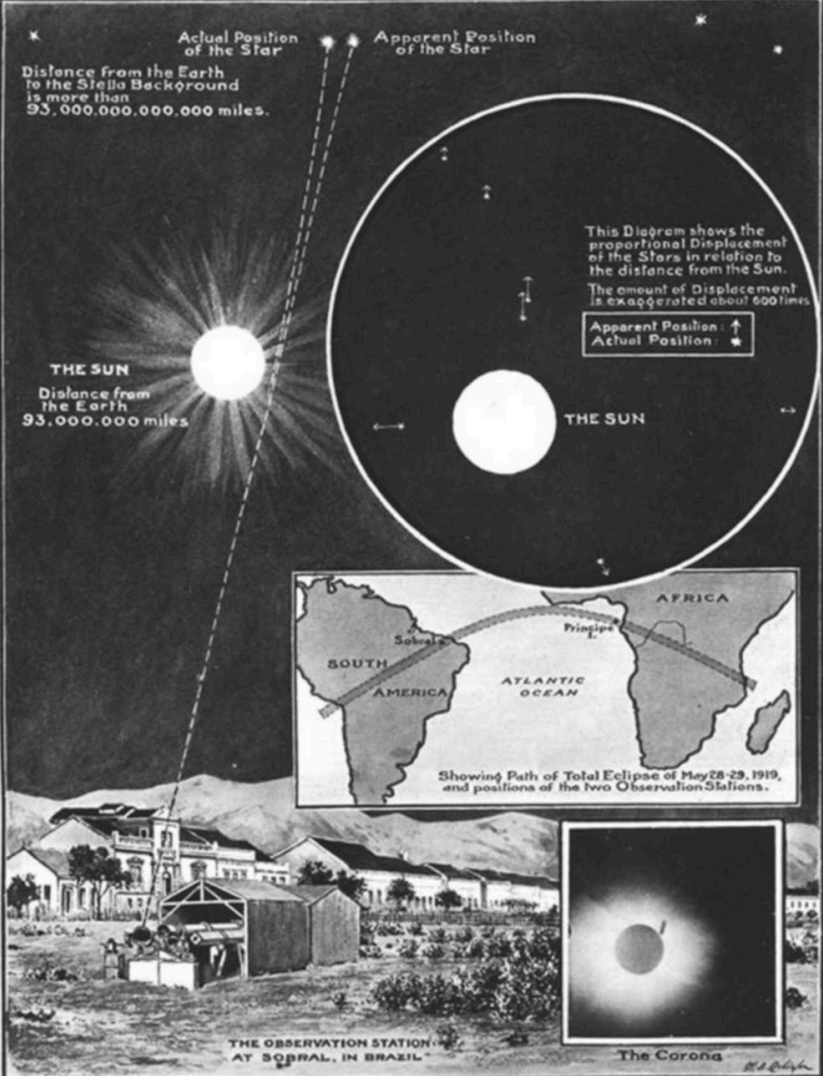
Confirmation from the scientific community came soon after. Arthur Eddington, an English astronomer who is known for formalizing stellar equilibrium, led expeditions to observe a solar eclipse in 1919. Travelling all the way to West Africa and Brazil, he led several teams in measuring the gravitational deflection of starlight passing near the sun. The data confirmed that the starlight passing near the sun was slightly shifted, exactly as Einstein predicted.
The problem conceived by my brain was solved by the bright Brazilian sky.
A small curiosity quickly spiraled into a foundational part of astronomy as telescope technology allowed us to observe massive objects like galaxies, and bend light to act like lenses. Building on this knowledge, astronomers began to map the universe and explore the concept of dark matter.
The Cosmological Constant
The theory of general relativity was a headache to put together for Einstein. As he expanded upon the idea of the curvature of spacetime, he found that in all his solutions, the universe was not still. His equations implied that it was either expanding or contracting.
The idea was preposterous, and Einstein settled on defining this oddity as the cosmological constant, a variable that acted as the repulsive element in his equation to balance gravity and keep the universe static.
But the world quickly learned that Einstein didn’t make mistakes — in 1929, Edwin Hubble observed a redshift in the light of distant galaxies. This recession of galaxies was pressing, as those that were further away were moving away faster. All of a sudden, the cosmological constant was no longer necessary: Einstein didn’t make a mistake at all! He didn’t need this balancing force in his equation, as the galaxies really were expanding.
The Legacy of a Genius
“I Have No Special Talent. I Am Only Passionately Curious.”
Albert Einstein defied all norms to uncover truths that forever changed physics, spaceflight, and everything in between. He predicted phenomena before we had the tools to detect them. He revealed the dynamic interconnectedness of space.
Nowadays, GPS satellites rely on relativity corrections, and we get to see images of black holes that wouldn’t be possible without his equations. His impact remains undeniable, and his wit incomprehensible.

Einstein’s desk at the time of his death.

Mariana Mokhova