· today in space history · 15 min read
STS-51B | Three-Tenths of a Second from Disaster
Forty years ago today, Challenger lifted off LC-39A on a science mission that nobody outside Morton-Thiokol would call dangerous. Years later, after the orbiter and seven other astronauts were gone, investigators looked at the recovered boosters from STS-51B and realized the crew had come within a fraction of a second of dying first. This is the story of the launch that should have been a warning.
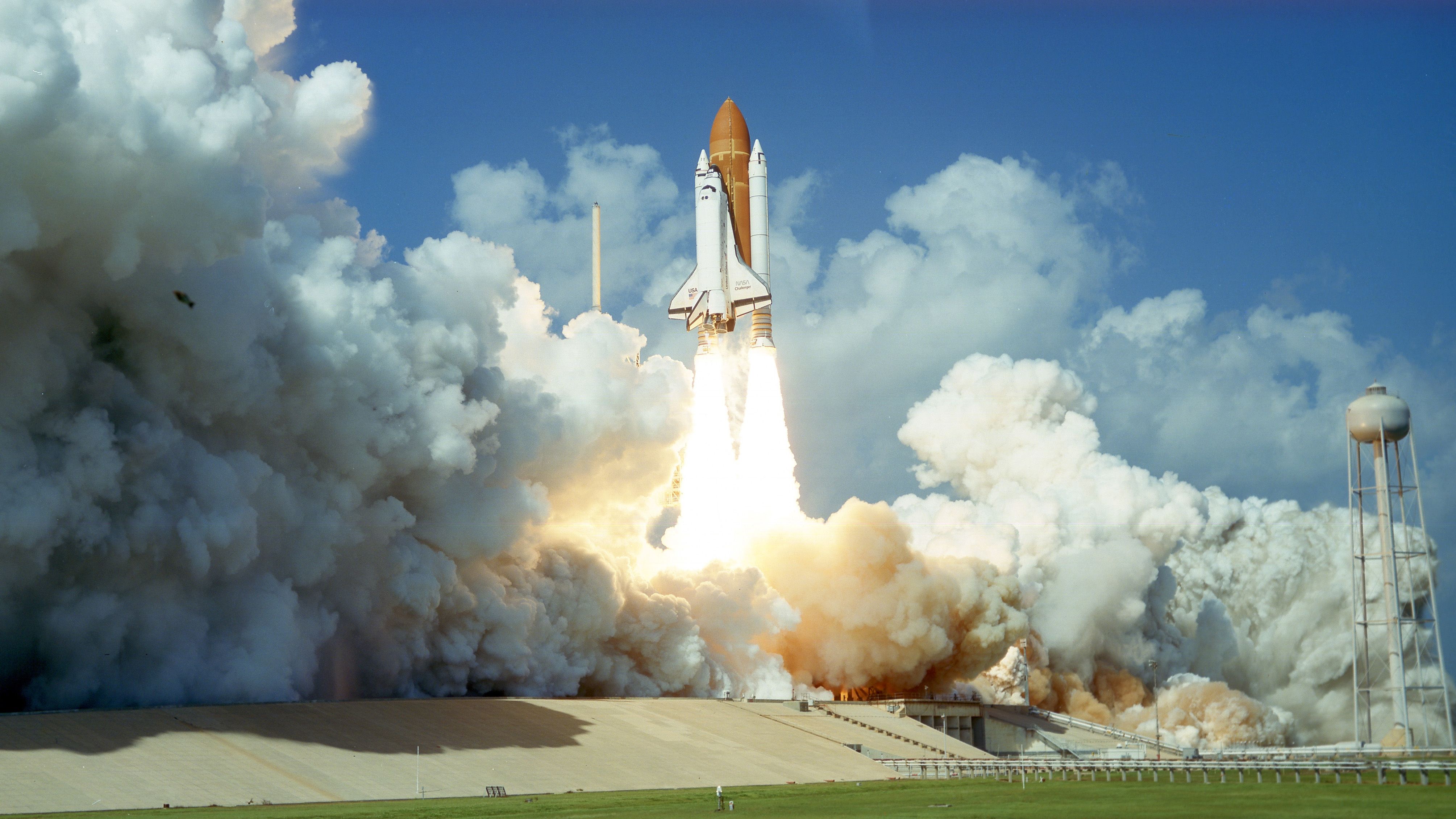
At 12:02:18 PM Eastern on April 29, 1985, Space Shuttle Challenger lifted off Launch Complex 39A carrying seven men, two squirrel monkeys, twenty-four rats, and the first operational flight of an orbital laboratory built in Europe. The countdown had been clean. The weather was good. The mission, designated STS-51B, was a science flight, the kind of methodical microgravity work that the shuttle program had been promising for a decade and was finally beginning to deliver. Nothing about the launch looked unusual.
It would be nine more months before the shuttle program tore itself open in front of a generation of schoolchildren. By then, two of STS-51B’s solid rocket boosters were sitting in storage at Kennedy Space Center, having been recovered from the Atlantic and disassembled and inspected like every other set of boosters in the program’s history. Their inspection reports were in the file. The reports would not be read with any urgency until February 1986, when investigators looking for precedent began pulling every piece of paperwork in the system that mentioned the words “O-ring” and “erosion.”
What they found in the STS-51B file is the reason this anniversary is worth remembering. The mission’s commander, a Marine colonel named Robert Overmyer, was assigned to the Challenger accident investigation almost immediately. As he worked through the booster history, he came across the inspection notes for his own flight. The primary O-ring on one of the joints in the right-hand booster had been completely burned through. The secondary O-ring, the only thing standing between his crew and the failure mode that would later destroy STS-51L, had eroded by about a third of its diameter and was charred along its length. Hot combustion gas had been chewing at it during ascent. It had held.
Don Lind, the mission specialist who reached orbit on his first and only spaceflight after a nineteen-year wait, was told some years afterward by a Morton-Thiokol engineer named Brian Russell that the secondary seal on STS-51B had come within roughly three-tenths of a second of failing entirely. That is the figure that has haunted the public memory of this mission ever since. It is also the figure that, in a different timeline, is the difference between a routine science flight and an inflight breakup over the Atlantic with seven dead aboard.
The Mission That Almost Wasn’t This Mission
STS-51B did not begin life as STS-51B. The flight that carried Spacelab-3 into orbit had originally been manifested as STS-51E, with a different payload, a different launch date, and substantially the same crew. STS-51E was meant to deploy the second Tracking and Data Relay Satellite, TDRS-B, on a flight in March 1985. When timing problems with the TDRS-B payload made that schedule impossible, NASA rolled the orbiter back to the Vehicle Assembly Building, swapped the cargo, and re-designated the flight. The Spacelab-3 mission, which had been waiting in the queue, moved up.
The crew that walked out to the pad on April 29 was unusual by any measure. The commander, Overmyer, was on his second flight. The pilot, Frederick “Fred” Gregory, was an Air Force colonel making his first trip to orbit and the first African-American shuttle pilot. Three mission specialists rode in the middeck: Don Lind, who had been selected as a scientist-astronaut in 1967 and had watched eighteen years of crew rotations come and go without ever being assigned a seat; Norman Thagard, a physician who had flown once before; and William Thornton, also a physician, on his second flight at age 56. The two payload specialists were a Dutch-born materials scientist named Lodewijk van den Berg and a Chinese-American fluid dynamicist named Taylor Wang.
The average age of the crew was 48.6 years. At the time, that made STS-51B the oldest American crew ever flown, a record set partly because so many of the science specialists had spent the better part of their careers waiting for the shuttle to do what it had been promised to do. Lind in particular was sometimes described in press coverage as the patient man of the astronaut corps, a designation he wore with good humor but which represented, by April 1985, nineteen years of geological-scale waiting.
A Laboratory in Free Fall
The Spacelab-3 manifest was written for principal investigators rather than for headline writers. Fifteen experiments were assigned to the laboratory, distributed across materials science, fluid mechanics, atmospheric physics, life sciences, and astronomy. The crew worked in two twelve-hour shifts, red and blue, so the lab was running continuously for the entire mission. Wang and van den Berg, the two payload specialists, were the principal investigators on two of the materials experiments and floated through the tunnel into the lab almost as soon as the orbiter reached attitude.
The most dramatic experimental moment of the flight, in the unsentimental sense that means something went wrong on a live downlink, belonged to Taylor Wang. His Drop Dynamics Module, an apparatus that used acoustic levitation to study the behavior of free-floating liquid drops in microgravity, failed within hours of activation. Wang, who had spent the previous decade designing and arguing for the experiment, requested permission to attempt repairs. After some negotiation between the orbiter and Marshall Space Flight Center, the ground gave him a window. He worked through it, opened a panel that had not been designed to be opened in flight, and brought the apparatus back to operational status. The DDM produced data for the rest of the mission.
The biological experiments were less obliging. The Research Animal Holding Facility, RAHF, carried two squirrel monkeys and twenty-four rats in what NASA had described in pre-flight documentation as a self-contained, low-maintenance enclosure. In flight it became something else. Food crumbs and waste escaped containment through gaps in the cage seals and drifted into the laboratory atmosphere as a fine, organic-smelling cloud. The crew dealt with it the way crews always deal with things, which is to say by inventing procedures on the fly and venting their irritation to the ground in dryly worded crew notes. Thornton, the older of the two physicians on board, became the de facto vivarium technician for the rest of the flight. The episode would be discussed at length in post-flight debriefs, and the cage design was substantially revised before any animals flew on the shuttle again.
We had a few problems with the animals. They were a lot more lively than the design assumed.
The atmospheric and astronomical experiments, by contrast, performed close to nominally. An infrared telescope mounted on a Spacelab pallet observed galactic and zodiacal sources during night passes. An auroral imaging instrument captured high-latitude airglow. The materials experiments produced crystals of mercuric iodide, triglycine sulfate, and a handful of other compounds that the principal investigators wanted to compare against ground-grown counterparts. None of it was made-for-television science. All of it was the kind of careful, comparative work that the shuttle had always been pitched as ideally suited for.
The Crosswind Landing
Mission elapsed time crossed seven days on the morning of May 6. The deorbit burn was nominal. Challenger came down through the atmosphere on its standard reentry profile, traversing the Pacific, crossing the California coast as a streak of heat in the upper air, and lining up on Runway 17 at Edwards Air Force Base.
The wind at Edwards on that morning was not aligned with the runway. NASA had been studying shuttle crosswind capabilities for years, with no operational flight having previously committed to landing in significant crosswinds. STS-51B’s flight rules permitted Overmyer to land in the conditions present that morning, and he did. The orbiter touched down at 9:11 AM Pacific time on May 6, 1985, in what the post-flight reports describe as the program’s first crosswind landing. The mission lasted seven days, eight minutes, and forty-six seconds.
The crew climbed out healthy. The orbiter was inspected, scrubbed, and prepared for its next flight. The boosters, fished out of the Atlantic by their parachute systems and the recovery vessels Liberty Star and Freedom Star, were towed back to Kennedy and disassembled.
This is where the story would have ended, except that someone wrote down what they saw inside the boosters.
The Inspection Nobody Read
Solid Rocket Booster joints on the shuttle were sealed by two O-rings, a primary and a secondary, sitting in machined grooves and pressed outward against the steel of the booster casing by a layer of zinc chromate putty. The design was inherited, with modifications, from earlier solid rocket programs and had been considered conservative enough that the secondary O-ring was originally classified as redundant. By 1985, that classification was being quietly questioned inside Morton-Thiokol, the contractor responsible for the boosters. Inspections of recovered hardware from earlier flights had shown signs of erosion on primary seals, and on at least one previous mission, STS-41B in 1984, soot had been found behind a primary O-ring, indicating that hot gas had reached it during ignition.
STS-51B’s right-hand SRB nozzle joint went further than that. The primary O-ring on the joint was destroyed. The secondary O-ring, which the design did not officially require but which the program now relied on as the actual seal of last resort, had been eroded along approximately a third of its cross-section. The damage was not a hairline scuff. It was the kind of damage that, in a longer burn or under slightly different geometry, would have continued through the seal and vented combustion gas into the external tank stack.
On STS-51B, the redundancy in the SRB joint design did not exist in the way the program had assumed. The primary seal failed. The secondary seal almost failed. There was no third seal.
The inspection report was filed. It went into the program’s Critical Items List and was reviewed in standard pre-flight readiness reviews thereafter. Morton-Thiokol engineers, including Roger Boisjoly and Brian Russell, began arguing internally and in formal memoranda that joint behavior at low temperatures was poorly characterized and potentially dangerous. The arguments did not stop the flight schedule. STS-51L was launched on January 28, 1986, in temperatures well below those at which any prior shuttle had flown, with O-ring resilience that the engineers had spent the previous nine months warning was inadequate. The joint that failed was not the same joint that had nearly failed on STS-51B, but the failure mode was a direct extrapolation of what the STS-51B inspection had documented.
SRB joint design certified
Morton-Thiokol's tang-and-clevis field joint with primary and secondary O-rings is qualified for flight, with the secondary classified as redundant.
STS-1 flies
First shuttle flight. Booster recovery and inspection becomes routine.
STS-41B erosion noted
Soot found behind a primary O-ring after recovery. First clear evidence of joint blowby.
STS-51B launches
Spacelab-3 mission. Post-flight inspection reveals the worst joint damage yet seen in the program.
Boisjoly memo
Roger Boisjoly writes the now-famous internal memo at Morton-Thiokol warning that joint failure could be 'a catastrophe of the highest order.'
STS-51L is lost
Challenger breaks up 73 seconds after launch. The cause is a joint failure of the same type STS-51B had nearly suffered.
Overmyer reads the file
Assigned to the accident investigation, Overmyer pulls the STS-51B inspection report and recognizes how close his crew had come.
What Overmyer Found
Robert Overmyer was a quiet, methodical man, a test pilot’s test pilot, and after the Challenger accident he was assigned to the investigation board’s data review team. The work involved going through every recovered booster inspection in the shuttle program’s history and looking for patterns that should have been read as warnings. The STS-51B file was one of the first he opened, because it was his.
What he saw is described in his contemporary statements with a particular kind of restraint. He had flown the orbiter through ascent. He had felt the boosters separate cleanly at two minutes and seven seconds. He had brought the crew home alive seven days later. The inspection report told him that during the first sixty seconds of his own ascent, hot combustion gas had been working through one of the booster joints, that the primary seal had given up entirely, and that the only thing left between his crew and a Challenger-style breakup was a piece of rubber that itself had been partially consumed by the time the boosters reached burnout. He never flew in space again. He had already been planning to retire from the astronaut corps, but those who knew him have said the report contributed to his decision.
Don Lind learned about the near-miss later, and from a different direction. After the Rogers Commission released its report in June 1986, Lind sought out the engineering side of the story. In the years that followed, Brian Russell of Morton-Thiokol, one of the engineers who had argued against the STS-51L launch in the night-of teleconference, told Lind directly what the post-flight numbers had implied. By Russell’s accounting, the secondary O-ring on the STS-51B nozzle joint had been eroding at a rate that, extrapolated forward, would have produced a complete burn-through within roughly three-tenths of a second of the booster’s actual end of burn.
You came within three-tenths of one second of dying.
That sentence, paraphrased and re-quoted across three decades of shuttle history writing, is the line that has fixed STS-51B in public memory. It is a number that does not need to be exact to be devastating. The flight that brought Don Lind into space, after nineteen years of waiting, was very nearly the flight that killed him. The crew who came home for a barbecue at Edwards on May 6 came home because the burn ended before the seal did, and not because the system had been designed to keep them alive.
The Warning That Wasn’t Heard
The lesson of STS-51B, in the institutional sense, is the lesson that Diane Vaughan would later describe in The Challenger Launch Decision as the normalization of deviance. Each successive instance of O-ring damage, beginning with STS-2 in 1981 and continuing through STS-41B and STS-51B and onward, was treated as a flight anomaly that the system had survived rather than as a failure mode that the system had narrowly escaped. Each survival was logged as evidence that the joints worked. The threshold for what counted as acceptable damage drifted upward over time, because the data kept arriving with the orbiters that came home.
STS-51B was the loudest of those warnings, and the one that most directly prefigured what happened on STS-51L. There were others, before and after, but the right-hand booster recovered from Challenger’s April 1985 flight contained, in physical form, a near-complete description of the failure mode that would destroy the same orbiter in January 1986. The hardware was inspected. The damage was documented. The implications were argued internally at Morton-Thiokol. None of that prevented the loss of seven crew members nine months later, including a teacher whose name became, for a generation of Americans, the name they associated with the shuttle program.
When Overmyer pulled his own flight’s file in the summer of 1986, he was not discovering anything new. He was reading what the program had already known and had already declined to act on. That is the part of the STS-51B story that does not soften with retelling. The data was there. The engineers who understood it were saying so, in writing, in advance. The system continued to fly because the system was not organized to hear them.
After the Flight
Overmyer retired from the astronaut corps in 1986 and from the Marine Corps in 1986 as well. He died in 1996, when the Cirrus VK-30 prototype he was test-flying crashed in Wisconsin. Frederick Gregory went on to fly two more shuttle missions, command STS-44, and serve as NASA’s Deputy Administrator. Norman Thagard flew four more times, including the long-duration Mir mission in 1995 that made him the first American to fly on a Russian spacecraft. William Thornton retired from spaceflight after STS-51B but continued his work in space medicine. Lodewijk van den Berg returned to industrial research at EG&G. Taylor Wang continued his fluid dynamics work at JPL and later at Vanderbilt.
Don Lind retired from NASA in 1986 and joined the faculty at Utah State University, where he taught physics until 2002. He died in 2022, having spent the latter half of his life talking with characteristic openness about the mission and what he had been told about it. He did not present himself as a survivor in any dramatic way. He presented himself as someone who had waited a long time to fly, had finally flown, had loved the experience, and had only later understood that the experience had been a great deal closer to a different kind of ending than the program had told him at the time.
That, in the end, is what STS-51B is for. It is a record of how lucky a competent crew can be, and of how unevenly that luck is distributed across a program that depends on it. The mission flew on April 29, 1985. The boosters were recovered. The reports were written. The reports were filed. The reports were read, finally and seriously, only after seven other people had died. Forty years on, the date still belongs to the seven who came home, and to the engineer who eventually told one of them the truth.
References(8)
- NASA Mission Archive — STS-51B Mission Summary
- Evans, B. — STS-51B and the O-Ring That Almost Killed Challenger's Crew, AmericaSpace, 2015
- Vaughan, D. — The Challenger Launch Decision: Risky Technology, Culture, and Deviance at NASA, University of Chicago Press, 1996
- Report of the Presidential Commission on the Space Shuttle Challenger Accident (Rogers Commission), Volumes I-V, June 1986
- NASA — Spacelab: An International Success Story, NASA SP-487
- Don Lind oral history interview, NASA Johnson Space Center Oral History Project, May 2005
- Robert F. Overmyer biographical data, NASA Astronaut Office
- Boisjoly, R. — Ethical Decisions: Morton Thiokol and the Space Shuttle Challenger Disaster, Online Ethics Center, 1995

Theodore Kruczek