


· space brief · 5 min read
Space Force Opens Secret Tracking Data to Commercial Firms | KeepTrack Space Brief
Space Force shares classified tracking data with commercial firms. Falcon 9 reentry linked to upper-atmosphere lithium plume. SpaceX launches 54 Starlink sats in one day.
📰Top Stories
Space Force Opens Secretive Space Tracking Data to Commercial Firms
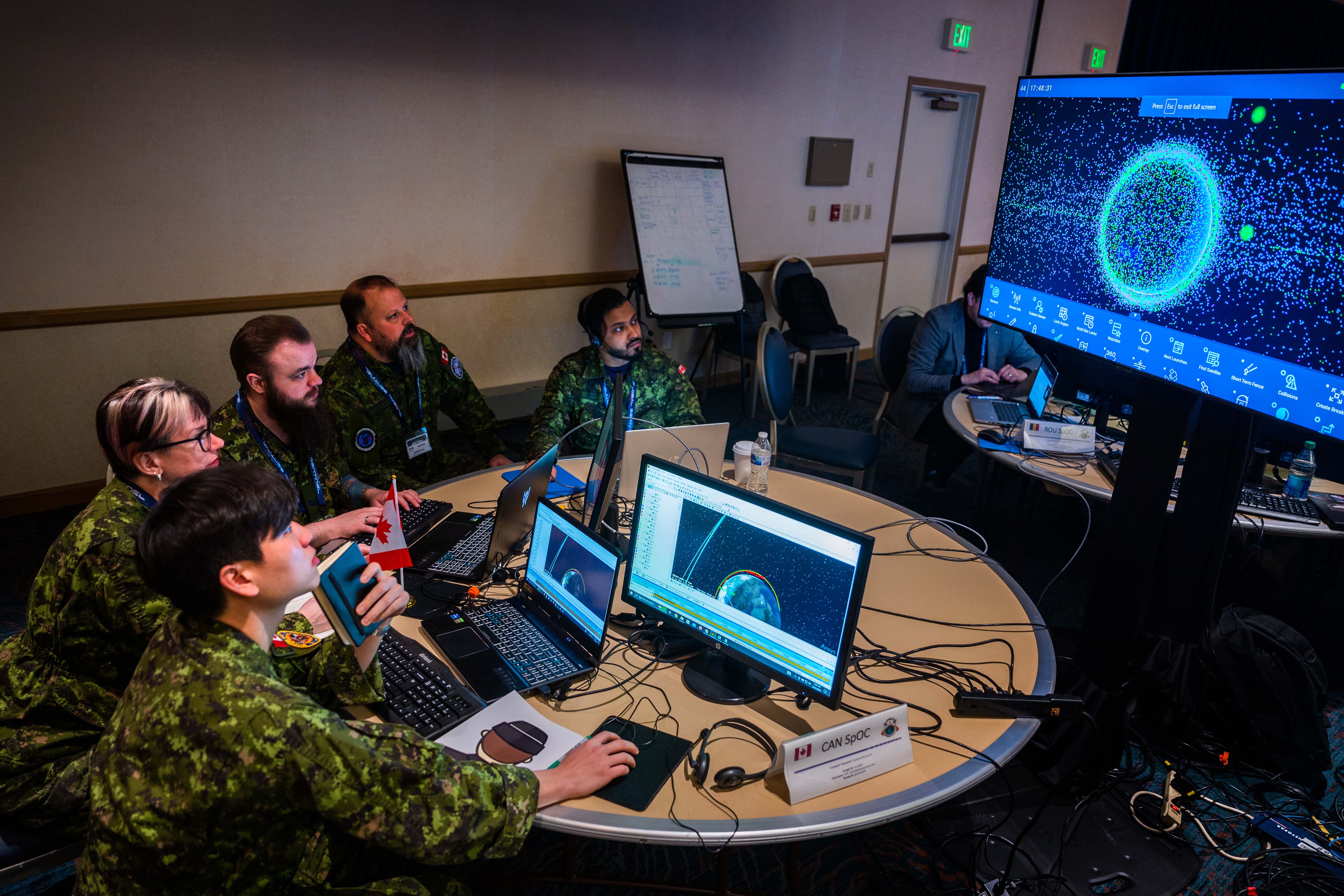
In a significant policy shift, the U.S. Space Force has begun sharing previously classified space domain awareness data with commercial companies, aiming to sharpen space threat detection capabilities. Officials say that integrating commercial sensor data and software with government tracking systems will help fill observational gaps and improve the overall quality of the space object catalog. The move signals growing recognition that no single government network can monitor the increasingly congested orbital environment alone, and that partnerships with commercial space situational awareness providers are now a strategic necessity rather than an afterthought.
Read the full story: SpaceNews
Falcon 9 Reentry Blamed for First-Ever Measured Upper-Atmosphere Lithium Plume
Scientists have traced a lithium pollution plume detected in the upper atmosphere in February 2025 directly to the uncontrolled reentry of a Falcon 9 rocket stage, marking the first direct measurement of upper-atmospheric contamination from disintegrating space hardware. As defunct satellites and spent rocket stages burn up during reentry, they release metals and chemicals at altitudes where normal atmospheric chemistry may be disrupted — an effect researchers are only beginning to quantify. The findings are likely to intensify scrutiny of the cumulative environmental impact of the rapidly growing number of rocket reentries, particularly as megaconstellation operators like SpaceX continue scaling up their fleets. You can monitor reentry predictions for tracked objects using KeepTrack’s reentry tools.
Read the full story: SpaceDaily
SpaceX Launches 54 Starlink Satellites in a Single Day from Both Coasts
SpaceX executed two Starlink launches on March 1, deploying a combined 54 satellites across opposite sides of the country. The Starlink 10-41 mission lifted off from Cape Canaveral Space Force Station at 9:56 p.m. EST, carrying 29 satellites on a north-easterly trajectory. Hours earlier, the Starlink 17-23 mission launched from Vandenberg Space Force Base at 2:10 a.m. PST, placing 25 Starlink V2 Mini satellites into orbit on a southerly trajectory. The back-to-back launches continue SpaceX’s relentless cadence of Starlink constellation expansion. All newly cataloged objects from these missions will be trackable in KeepTrack shortly after TLE data is published.
Read the full story (East Coast): Spaceflight Now
Read the full story (West Coast): Spaceflight Now
🛰️Satellite Spotlight
- Satellite Name: INTELSAT 511
- NORAD ID: 15873
- Launch Date: June 30, 1985
- Mission: Commercial communications satellite providing C-band and Ku-band telecommunications services, carrying 26 C-band and 6 Ku-band transponders to support voice, data, and broadcast transmission across global coverage zones.
- Orbit: GEO (Geostationary-like, highly inclined at ~13.3° — indicating it is no longer station-kept and has drifted into a graveyard orbit)
- Operator: Intelsat (International Telecommunications Satellite Organization)
- Fun Fact: INTELSAT 511 launched aboard an Atlas G Centaur rocket from Cape Canaveral’s LC-36B — a vehicle that flew only a handful of missions. With a design lifetime of just 9 years, this veteran bird has now been drifting silently in inclined geosynchronous orbit for over 40 years, long outlasting its operational mission as a ghost of the early commercial satellite era.
Track this satellite in real-time on our web app: Track INTELSAT 511
🚀Upcoming Space Launches
March 1
- SpaceX Falcon 9:
- Starlink Group 17-23 from Vandenberg SFB, CA, USA (08:00 UTC) A batch of 25 satellites for the Starlink mega-constellation - SpaceX’s project for space-based Internet communication system.
March 2
- SpaceX Falcon 9:
- Starlink Group 10-41 from Cape Canaveral SFS, FL, USA (00:07 UTC) A batch of 29 satellites for the Starlink mega-constellation - SpaceX’s project for space-based Internet communication system.
- Firefly Alpha:
- Stairway to Seven from Vandenberg SFB, CA, USA (00:50 UTC) Firefly Alpha’s Flight 7 will be a test flight and return-To-Flight for the launch vehicle after its April 2025 launch failure. It will test and validate key systems ahead of Firefly’s Block II configuration upgrade.
March 4
- Space One KAIROS:
- Flight 3 from Spaceport Kii, Japan (02:00 UTC) Third flight of the KAIROS launch vehicle with 5 satellites on board: TATARA-1R, SC-Sat1a, HErO, AETS-1, Nutsat-3 (TASA/Taiwan).
- SpaceX Falcon 9:
- Starlink Group 10-40 from Cape Canaveral SFS, FL, USA (06:58 UTC) A batch of 29 satellites for the Starlink mega-constellation - SpaceX’s project for space-based Internet communication system.
- SpaceX Falcon 9:
- Starlink Group 17-18 from Vandenberg SFB, CA, USA (21:00 UTC) A batch of 25 satellites for the Starlink mega-constellation - SpaceX’s project for space-based Internet communication system.
March 8
- SpaceX Falcon 9:
- Starlink Group 17-31 from Vandenberg SFB, CA, USA (10:58 UTC) A batch of 25 satellites for the Starlink mega-constellation - SpaceX’s project for space-based Internet communication system.
March 10
- SpaceX Falcon 9:
- EchoStar 25 from Cape Canaveral SFS, FL, USA (03:14 UTC) EchoStar 25 is a direct broadcast satellite, delivering content across North America with a high-power, multi-spot beam payload.
March 12
- SpaceX Falcon 9:
- Starlink Group 17-24 from Vandenberg SFB, CA, USA (02:37 UTC) A batch of 25 satellites for the Starlink mega-constellation - SpaceX’s project for space-based Internet communication system.
- SpaceX Falcon 9:
- Starlink Group 10-48 from Cape Canaveral SFS, FL, USA (12:17 UTC) A batch of 29 satellites for the Starlink mega-constellation - SpaceX’s project for space-based Internet communication system.
Note: Launch dates and times are subject to change due to technical or weather considerations.

Maurice Stellarski


